Archive d’étiquettes pour : MCD#76 v eng

The end of the Taboo on Money

Jaromil’s lengthy thesis on bitcoin is a technoetic inquiry that “takes into consideration the biopolitical dynamics that govern the bitcoin community as well specific characteristics of the technical realization, aiming to provide insights on the future of this technology as well a post-humanist interpretation of its emergence.” With author’s permission, we are publishing an excerpt from the original article (1).
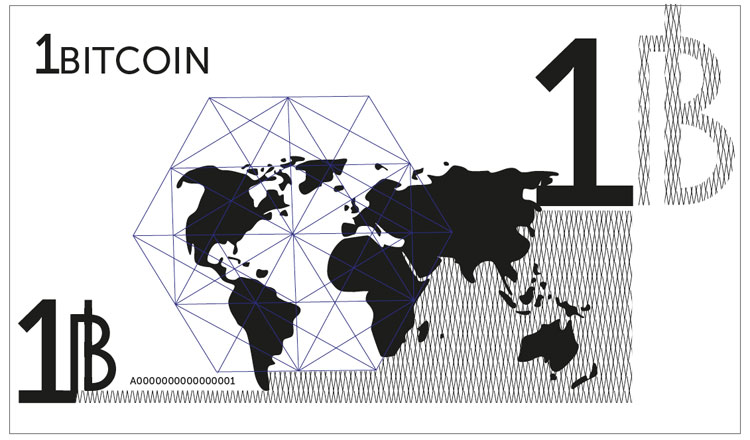
Photo: D.R.

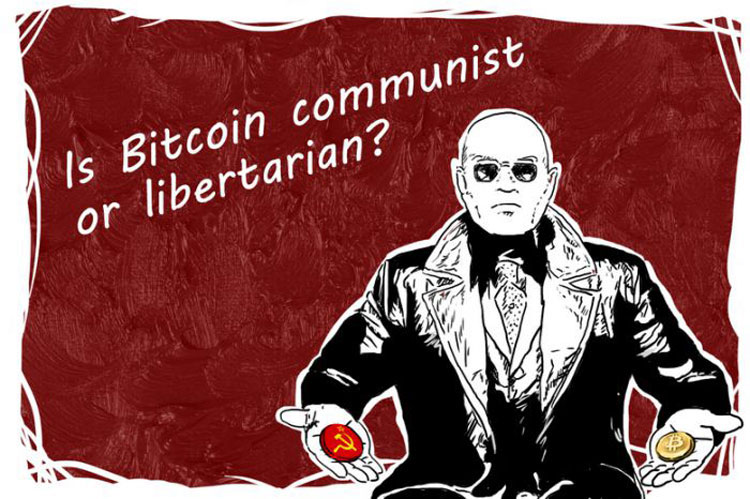
When talking about bitcoin, of its inherent qualities of networked creation of value, we can’t ignore the fact that this technology relies on community dynamics to the point one could state that bitcoin makes it possible for money to become a common and no longer a top-down convention imposed by a sovereign and its liturgy of power.

But then we are faced by a crucial question about bitcoin: what for? who benefits from it? Or, in other words, if the community aspect of Bitcoin is crucial (as in: distributing the computation needed for its authentication, sharing a common currency, a common history of transactions, a common way to quantify wealth) what do the communities use bitcoin for?

The earliest communities that adopted bitcoin, aside from the hacker community that never really used it much as a currency to exchange goods, are perfect scapegoats for those who want to turn bitcoin down. In fact, anyone willing to take a moralistic approach and prohibit the innovation that we are talking about doesn’t even need to approach itching concepts such as state sovereignty. It is very easy for witch-hunters to emphasize the fact that drugs were bought and sold with bitcoins, that gamblers love bitcoins and that some website claims to accept bitcoin payments for assassination missions. […]

Bitcoin has a role in history

Being involved in the community that has grown around bitcoin I can see that the community is comprised primarily of young idealists rebelling against the status-quo, especially when it consists of a centralized administration prone to corruption. It is clear to many how unjust monopolies are often dominating various contexts, curbing the possibilities of innovation that are in the hands of younger generations. The liberation of the medium of value exchange is an act we refer to as “breaking the Taboo on Money”. Bitcoin has a role in history: its epos coalesces in communities, new ethical reflections, new tales of passion, the glory in all the mystery around its origins. The will for liberation, decentralization and disintermediation is central to bitcoin–it is ethical and should not be seen as more conflictual than the concrete need to disintermediate many of the systemic functions that are governing modern society. Mind your own long-tailed problems, modern finance! […]

Every form of currency, since the very beginning of its earliest forms, has dealt with the grammar of power. It is the establishment of a sovereign and its glory that justifies the shared trust into a symbolic form of value circulation. The investment of power into currency, especially when its not backed by mineral values, is codified in mystery and glory.

Bitcoin is not exempted from such dynamics: it innovates the way the digital becomes tangible, a role with highly disruptive potential. Hence, even when choosing the iconography for its own currency, the bitcoin community shows a political rupture.

The intriguing mystery of the identity of its disappearing author Satoshi Nakamoto might seem a detail, but not for our analysis: it is of central importance to the bitcoin myth and that of future crypto-currencies. Bitcoin has no single monetary authority, but a shared pact and the underlying rationality of a mathematical algorithm–the intangible dream of neutrality. Being deflationary, Bitcoins exist within a finite range of possibilities, a quantity of value that is increasingly difficult to mine. No one can create more bitcoins than those established to be created in the first place, to the great horror of modern economists that regard fiat currency as a necessary tool to move within the troubled waters of contemporaneity, with good reason indeed. But there is no hierarchy in bitcoin: meaning literally that there is no sacred origin, no written fate, no single ruler, no second thought on its essence.
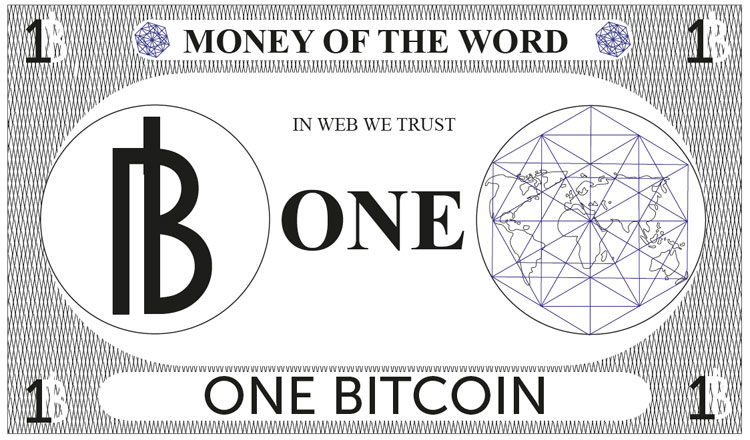
Photo: D.R.

Bitcoin promises to be the neutral medium for an economy based on participation, not the edict of a king, a central bank, or their authorized intermediaries–nevertheless, it must be said, bitcoin did create new riches, those who believed earlier than others in the promise of this algorithm. The rupture offered by this new perspective on money is not dealing with equality or welfare, it might not benefit society or help us get out of the crisis: it is a protest for network neutrality. […]

By now it should be clear that such a process of subjectivation as the one we are describing is not the simple emergence of a new innovative technology, it is not just , it goes well beyond. The enormous popularization of bitcoin is proof that the dimensions of this process of subjectivation are multiple and cannot be comprehended by adopting a single narrative, and even less so by using the categories of economic analysis.

The popularity of bitcoin as of today is enormous and still growing: this is a result of the biopolitical progression and its inscription inside a particular context, it is not a quality of bitcoin alone. Bitcoin is rooted in the protest movements that accompained the financial crisis through 2009 until now, namely the Occupy movement. While there can be reason to conceal this fact for those who hail the unconditioned and instrumental success of bitcoin, it is important to account this historically in order to understand what might happen in the future. […]

The branching of bitcoin

Being popular also means to be branched, forked, replicated, cloned, recombined and ultimately appropriated by the people: a popular icon will feed the mind of popular culture without consuming itself, but confusing its authenticity in the existence of new popular instances. This is already happening to bitcoin with very interesting consequences. Considering that its popularity is mostly among the hacker (or, should we say, young cyborgs?) community, the branching of bitcoin is giving birth to many valid technical implementations, that are both capable of functioning on large scale, and explore novel approaches to currency and networking. […]

With my own pet project in the bitcoin galaxy, called Freecoin15, I’ve started documenting the phenomenon of forking bitcoin since its early days and advocated within the community for the “configurability of the genesis code” and in general to leverage the possibilities of customisation for the technology underlying bitcoin. It is my belief that, while bitcoin represents a unique political rupture with the old establishment governing money, it is not the ultimate solution to it.

The need for digital currencies based on triple-signed receipts cannot be simply satisfied by bitcoin. Nevertheless, strengthened by the popularity and all consequences we have explored here, bitcoin might stand on the longer term as a fixed reference for future implementations: it is realistic to predict that its value will only grow in future. […]

Now that money seems to be either dead or dying, it is the time to dare this dissection. It might be the case that, by trespassing this taboo, we will find out ways to change things on a larger scale, especially considering the long due line of innovation in the field of accountancy that has still to be applied.

Ultimately, there are proofs to the rupture I’m pointing out here, in the wake of many new currencies born after bitcoin: with all irony and irreverence intended. The gates were left open by the mystery man: Satoshi the fool, Satoshi the saint, trespassed the line in front of everyone. There is no longer a taboo on money. Bitcoin is not really about the loss of power of a few governments, but about the possibility for many more people to experiment with the building of new constituencies.

Denis Roio aka Jaromil
published in MCD #76, “Changer l’argent”, déc. 2014 / févr. 2015

Jaromil is an activist, hacker and artist. Since the year 2000 he dedicates his efforts to build Dyne.org, a non-profit software house and digital community of critical makers and nomadic developers.
https://jaromil.dyne.org

(1) The whole article can be downloaded in PDF format at https://files.dyne.org/readers/Bitcoin_end_of_taboo_on_money.pdf

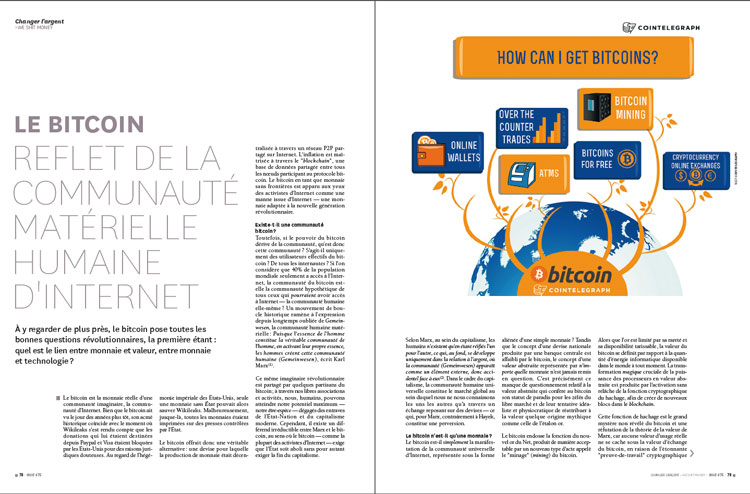
The Reflection of the Material Human Community of the Internet

Upon closer inspection, bitcoin reveals itself to be asking all the right revolutionary questions. The first one being: what is the relationship of currency to value, and currency to technology?

Bitcoins. Photo: D.R.

Bitcoin is the real currency of an imaginary community: the community of the Internet. Although bitcoin itself came into existence years earlier, the moment where bitcoin was propelled onto the historical stage was when Wikileaks found that its donations from Paypal and Visa were being blockaded on dubious legal grounds by the United States. Given the imperial hegemony of the United States, only a money without a state could save Wikileaks. Yet hitherto all currencies were printed using a state-controlled presses. This is precisely what bitcoin offered: a currency where the production of currency was decentralized in a peer-to-peer network shared via the Internet. Inflation is kept under control by a single decentralized ledge of all transactions, the blockchain. As a currency without borders, bitcoin appeared to Internet activists as manna from the Internet–a currency fit for the new revolutionary generation.

Is there a bitcoin community?

Yet if the power of bitcoin derives from the community, who is this community? Only actually existing bitcoin users? All Internet users? Since only 40% of the world even has Internet access, perhaps the community of bitcoin is the hypothetical community of all those who could have Internet access–the community of humanity itself? This brings us back in a full historical circle to a long-forgotten term, Gemeinwesen, the material humanity community: “Since the essence of man is the true community of man, men, by activating their own essence create this human community (Gemeinwesen),” writes Karl Marx (1).

This selfsame revolutionary imagination is shared by some bitcoin advocates; in their free association and activity, humans can reach our full potential–our species-being–unfettered by the chains of the modern nation-state and capitalism. However, there is a irreducible conflict between Marx and bitcoin, as bitcoin–and most Internet activists–demand for the state to be abolished without demanding the end of capitalism. For Marx, under capitalism humans “exist solely as reified for one another, something which is finally developed solely in the money relation, where their community (Gemeinwesen) appears as an external and therefore accidental thing opposite them” (2). The universal human community under capitalism is the global market where we only know each other through currency-based exchange–which for Marx, unlike Hayek, a perversion.

Photo: (CC) CoinTelegraph

Is bitcoin a mere currency?

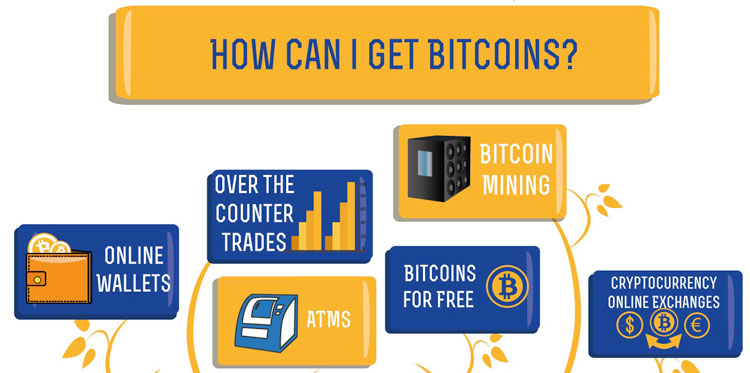
Is bitcoin merely the idea of the universal community of the Internet, presented back in an estranged form as a mere currency? While the concept of a national currency produced by a central bank is undermined by bitcoin, the concept of abstract value which is represented by any currency is never questioned. It is precisely this lack of questioning of abstract value that leads bitcoin to be a haven of free-market zealots with their quixotic Physciocratic attempt to return value to some mythical origin like the gold standard. Bitcoin serves as the new gold of the Net, suitably produced by a new kind of act called in Bitcoin “mining.”

While gold is limited by its rarity and finite supply, the value of bitcoin is set in terms of the amount of computing power available in the world at any given time. The crucial magical transformation of computational processing power into abstract value is given by the running of crytographic hash function over and over again to create new blocks in the blockchain.

This hash function is the great unrevealed mystery of bitcoin, and a refutation of Marx’s theory of value, for there is no real use-value lying hidden beneath the exchange value of bitcoin due to the senseless cryptographic proof-of-work that defines the blockchain. The fetishistic nature of bitcoin reveals itself in all the arbitrary numbers embedded in its design, such as the arcane formula used to calculate transaction fees–not to mention the fact that the total amount of bitcoin is limited to 21 millions, as well as the curious language that has developed around its users: ATH (All-time-high), To the Moon! The only difference between medieval theology and bitcoinis that today a mystified algorithm reigns in place of God.

Although bitcoin’s ability to be used as a currency to exchange commodities is merely a side effect of its production of cryptographically-verifiable currency–global capitalism is already busy recuperating bitcoin; the primary use of bitcoin is not to purchase illegal items via sites such as Silk Road, but is to avoid currency controls as well as a speculative market for hedge funds. Given that bitcoin is literally unhinged from any material world except the size of its user community and processing power, bitcoin is the ideal commodity for speculative capitalism since its value can not readily be predicted, detached as it is from any “use value.”

This is also the saving grace of bitcoin, for bitcoin is also an engineering project and may be forked into a million digital currencies for a million communities: from the serious (failed) attempt to replace domain names (such as « http://www.example.org/ ») with NameCoin to the absurd dogecoin for the community of Shiba-meme enthusiasts. Upon closer inspection, bitcoin reveals itself to be asking all the right revolutionary questions. The first question is what is the relationship of currency to value, and currency to technology? Due to the ontological transformations engendered by the rise of the Internet, the ontological categories posed–and worse, naturalized–by economics must be pulled through the lens of the Internet and thought anew.

Photo: (CC) CoinTelegraph

How can decentralization work?

Bitcoin also answers a question that is of use to potential revolutionaries from Tahrir to #Occupy. How can decentralization work in a community where there is the possibility people try to cheat? The ingenious engineering solution of bitcoin to prevent people from simply “inventing bitcoin” could be applied to many more sensible problems than that of pure fiscal speculation. In detail, bitcoin features a distributed ledger (the blockchain), where each bitcoin user becomes the bank, just as Indymedia asked people a generation to be the media at the turn of the millennium.

The blockchain is decentralized since each bitcoin user has a copy of the entire ledger. Without relying on a central authority like a bank, a community-wide voting algorithm then determines by majority consensus of who is assigned what particular bitcoins, and this continual voting prevents its members from lying about who has transferred which bitcoin to who–as well as the owners of new bitcoins produced by mining! The “proof-of-work” of cryptographic hashing could be replaced by almost anything, by any measure of things that has to be verified in a decentralized manner.

There is much that can be said for the utility of some form of decentralized accounting that does not rely on a central authority. It is precisely this kind of practical engineering that needs to return to the all-too-useless posturing that disguises itself as revolutionary thought today, lest future revolutions end in failure.

In one of his last works, Amadeo Bordiga forcefully reminds us that goal of the revolutionary party has never been the expansion of a centralized state such as the Soviet Union into all aspects of life as done by Stalin, who Bordiga was the last to spit upon and survive (3). The historical task of the party is to transmit the invariant idea that communism is the realization of material human community: “The revolutionary militant is… one who sees and mingles himself in the whole of the millenary space that binds the ancestral, tribal man, fighter against wild beasts, with the member of the future community, fraternal in the joyous social harmony.” (Bordiga, 1965)

Can the Internet be a material human community?

Today we find that the vision of a world free of domination and exploitation still speaks to today’s young revolutionaries, even though communism as an idea is wholly discredited. The vision of a world in which each can realize their own full potential through decentralized networks of association no longer speaks through the voice of the party, but through the myriad youth who are meeting each other over the Internet. Inheritors of a broken capitalism, they find themselves speaking the same strange language: Of dignity, of revolution, but also of lulzcats and Bitcoin. Can the Internet be a material human community? Any programmer would know the right answer. The material human community does not exist. It must be built.

Harry Halpin
published in MCD #76, “Changer l’argent”, déc. 2014 / févr. 2015

Harry Halpin is a research scientist at MIT and visiting researcher at IRI/Centre Pompidou. He was convinced by Ben Laurie that bitcoins were a scam but now understands greed overpowers reason.

(1) Marx, Karl (1992). Early Writings. New York: Penguin. pp. 265-6.
(2) Marx, Karl (1980). Ökonomische Manuskripte und Schriften, 1858–1861. Vol. 2 of Gesam-tausgabe 2. Berlin: Akademie Verlag, p. 53.
(3) Bordiga, Amadeo (1965). Considerations on the party’s organic activity when the general situation is historically unfavourable:
https://www.marxists.org/archive/bordiga/works/1965/consider.htm


we grow money / we eat money / we shit money

Editorial >

The Counterfeiters

Our relationship with money is complex, to say the least… On this side of the Atlantic, we preserve an almost aristocratic modesty when it comes to talking about our income, whether we are employee or heir.

On the other hand, obeying the laws of attraction / repulsion, money is a powerful source of motivation and inspiration. Like sex (just as an example), there is no taboo regarding its artistic representation and interpretation. And the crisis—assuming that it is indeed a crisis and not a structural element of our economic model—seems to spark artists’ imagination.

As we can see from the panorama of initiatives collected by Shu Lea Cheang (guest editor for this issue), along with consulting from Annick Rivoire (poptronics.fr), money is no exception to the “great transformation” brought on by digital technology—dematerialization, networking, transparency, openness, etc.—the exact opposite of the verticality and opacity of financial structures that continue to collapse before our delighted eyes…

In the age of electronic transactions, accelerated cash flow and ubiquitous banking platforms, humans seem to be out of the loop of this infernal machine generating 2.0 crashes. In parallel, we are witnessing the emergence of the first virtual currencies. Not to say that this announces a new financial counter-utopia on a human scale.

As some of the contributors point out, we find, on the contrary, greed, speculation, exploitation… along with symbols that send us back to the stone age—the analogy between the goldmines and the “mining” of bitcoins is arresting. No doubt, these so-called virtual currencies will not give us the chance to renew with our nostalgic origins of trade and donation, the absolute antithesis of money.

And it is rather troubling to see how the esthetics of both the coins and “fake-bills” distributed by the artistic and political collectives resemble state currencies, recalling the great battle between libertarians and liberals… It is reassuring to know that both coastal brothers and night workers regularly tend to their encrypted piggy banks…

Nonetheless, the monetary alternatives suggested by artists and activists express dreams of economic emancipation, indicate other possible yet uncertain paths, symbolize the potential of new media technologies, and still force us to rethink current distribution networks. In this time of penury, both material and intellectual, it’s already a lot.

Laurent Diouf
editor in chief
published in MCD #76, « Changer l’argent », déc. 2014 / févr. 2015

MCD gives special thanks to Shu Lea Cheang, Annick Rivoire and all the writers and translators who contributed to this issue.