Archive d’étiquettes pour : MCD#76 v eng

Thomas Paine’s adoptive town

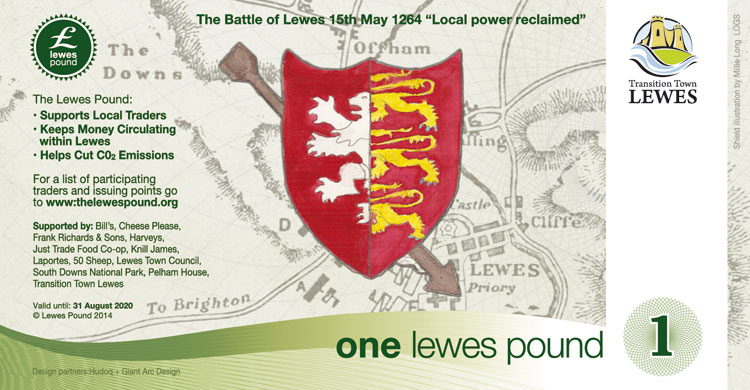
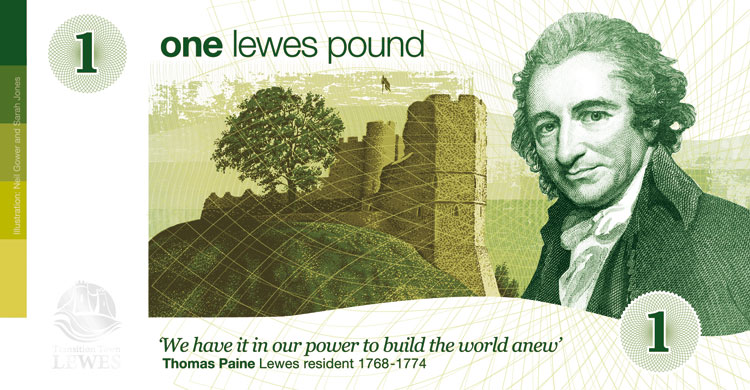
Thomas Paine, who is credited with helping to spark the French and American revolutions, is burning a hole in my pocket. Instead of the Queen’s face on British banknotes, I have Thomas Paine on my Lewes Pounds. His face is all over Lewes–this is where he was living at the start of his radical political career in the eighteenth century.

Livre lewes (recto). Conception graphique : Hudoq Digital Media, en partenariat avec Giant Arc Design. © Lewes Pound

Lewes has always been a revolutionary place. The first limits were put on the powers of an English king after the Battle of Lewes in 1264, when the barons forced Henry III to accept a parliament of nobles. When Bloody Queen Mary martyred 17 Protestants here in 1557 they became a potent anti-establishment symbol that still resonates today. Every year, on the 5th of November, Lewes’ Bonfire Boys and Girls commemorate the 1557 martyrs (and celebrate the foiling of a 1605 Catholic plot to blow up the English Parliament) by burning effigies of the Pope and the government of the day. Lewes’ Bonfire celebrations are so fiery that they can be seen from NASA’s satellites!

Thomas Paine wrote his first political work in Lewes – a treatise about the condition of his co-workers in the excise service–and went on to write Common Sense, the pamphlet which fanned the flames of revolution in America, and Rights of Man, which, in 1792, earned him a seat in the French revolutionary Parliament.

There was a Lewes Pound in Paine’s time. In fact our town had had its own currency between 1789 and 1895 as it pushed back against the outside world. The current Lewes Pound is part of a modern-day revolution, trying to relocalise economics and take back control of our lives from global capitalism.

Local currency for local businesses

I use the Lewes Pound for most of my day to day purchases – at the two food markets, in the three alternative food shops, in the cheese shop and the two bakeries, in about half the cafes and pubs, at my hair dresser and the pet food shop, in the hotel my parents stay in, at two shops where I buy clothes, at the CD shop, in my favourite restaurant. You can’t buy a daily newspaper with it for some reason but, if you’re motivated, you can do pretty much everything else.

I pay for my Lewes Pounds in sterling by direct debit from my bank account and then pick up them up once a month at a food shop near my home. If I need more Lewes Pounds, there about five shops in Lewes that dispense them, the equivalent of “cash machines”.

Livre lewes (verso). Conception graphique : Hudoq Digital Media, en partenariat avec Giant Arc Design. © Lewes Pound

The aim of a local currency is twofold: to celebrate the local community and to enhance local economies. Supermarkets, who provide fewer and worse paid jobs than local shops, extract 95% of the money spent in them. It goes into their tills and straight out of our town. The Lewes Pound can’t be spent anywhere else so it has to circulate locally, thereby facilitating and enhancing exchange between local businesses.

Part of the folklore

The Lewes pound has become part of the folklore of Lewes–like Thomas Paine and the annual Bonfire celebrations. In my opinion this focus on the folkloric has obscured the economic arguments, that local currencies can create extra local economic activity. The businesses who refuse to accept Lewes Pounds, and there are still quite a few of them, either do not understand the economic arguments or say they cannot buy anything with them in Lewes. This is a problem–most shops are not supplied by local businesses in our globalised economic system.

I also have to be clear that I am one of a very small group of people who religiously use the Lewes Pound–most people are happy to see it exists but prefer to stick with their pounds sterling, which work in London and Brighton. In some shops I am the only customer who uses Lewes Pounds! But these are experimental days. The main thing is to show how a local currency can work. If, or maybe when, the financial system collapses under the weight of its own contradictions, Lewes will be ready. As I said before, we are a revolutionary lot in Lewes!

Alexis Rowell
published in MCD #76, “Changer l’argent”, déc. 2014 / févr. 2015

Alexis Rowell is a Transitioner and eco activist. He is currently a member of Transition Town Lewes in East Sussex and act as managing Editor of Transition Free Press.
http://thelewespound.org/


The value of virtual transactions rose from $819 billion in 2001 to a quadrillion dollars today. This exponential growth can be compared to the success of bitcoin. A good example of the potential of social cooperation which generates money from the Commons and integrate the power of finance in its ability to mobilize, distribute and multiply wealth to upgrade the quality of life and the power of social intelligence.

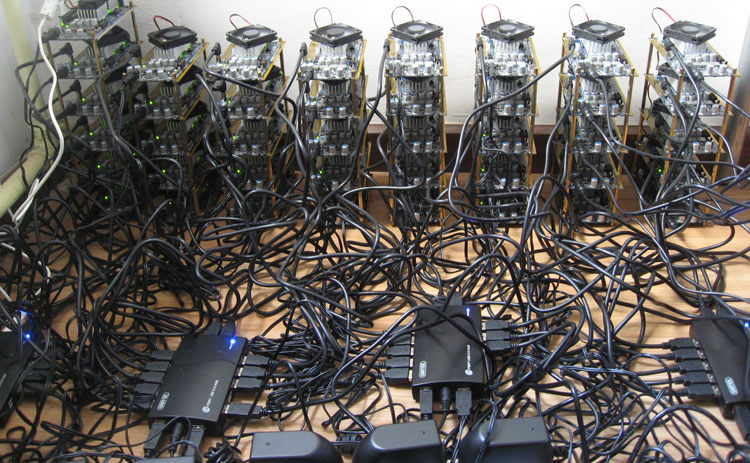
Icarus, une mine de bitcoin.

Icarus, une mine de bitcoin. www.openmobilefree.net. Photo: © Xiangfu Liu

Since money lost its referent in gold, the store of value, and found its new moorings in silicon, the second most common element on earth, it has multiplied exponentially. This shift from gold to silicon, of course, does not involve two equivalent substances. Gold used to be stored in fortressed vaults to guarantee the value of currency. Silicon is worked to make the substrate which enables the construction of increasingly faster, ubiquitous and connected logical machines. While gold strove to make the value of money stable (with disastrous consequences when it became too much and hence less valuable), silicon allows for its indefinite multiplication.

The exponential growth of monetisation

In her overview of the operation of contemporary finance delivered at the Money Lab Conference in Amsterdam in 2014, Saskia Sassen described finance as a ‘capability‘ and the ‘steam engine of our epoch, its power’. As she recounted, the value of silicon-based, virtual transactions between 2001 and 2014 has gone from 819 billions in 2001 to 62.2 trillion in 2008 and now to a quadrillion dollars. An accelerated and multidirectional transactivity enabled by digital technologies thus accounts for the exponential growth of monetisation.

A material asset like a ‘little house’ is turned into an asset-backed security and incorporated into financial instruments whose complexities can only be managed through the math of physicists. As a capability, finance creates a virtual mode of money, that does not simply reflect the value of the underlining asset, but the calculations, opinions and judgments of institutions and networks of humans and machines. As in the sovereign debt crises, the risks of these operations fall back on the owners of the material asset (homeowners, ordinary citizens), as the number of foreclosures and expulsions, but also cuts and privatisation of public and social services have also steeply risen.

The accumulation of value and power that finance has generated is thus at the moment a power waged against society–like an army which uses debt as a bridge to conquer a territory. The short brutal history of the exponential rise of silicon-based money in the first decades of the 21st century, she concluded, sees the predatory powers of finance employed in a new bout of very material land grabbing (both urban and rural, both the city centres of the global cities and land in Africa) which is going to change the DNA of society as such.

Bare activity

For post-workerist Marxists and other contemporary critics of the economy, the emergence of finance also indicates capitalism’s answer to the entrance of a new heterogeneous composition of living labor into production. Capitalism does not accumulate surplus value simply by underpaying labor, but it draws value from the whole of society–from ordinary social activities such as talking, commenting, liking, listening, reading, expressing an opinion, cooking, making music or art, wearing fashion, taking photos, recording videos, walking, partying etc.

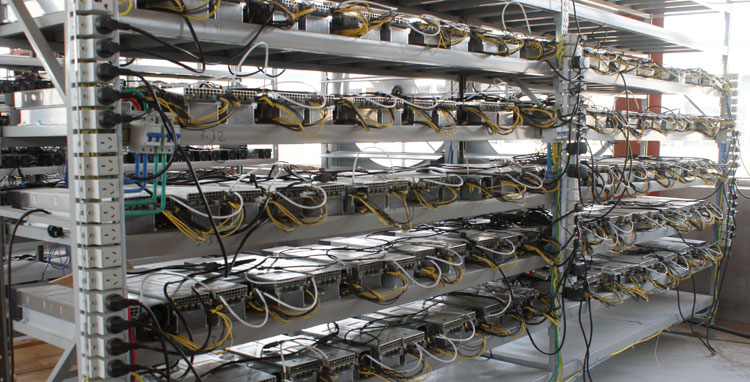
Avalon, une ferme ASIC pour extraire des bitcoins.

Avalon, une ferme ASIC pour extraire des bitcoins. www.canaan-creative.com Photo: © Xiexuan

Rather than reducing virtual money to a simulation which refers only to the imitative processes of the stock market, post-workerist authors believe that it expresses the mode of capture of a new quality of something that we might not even define as work any more, but as a kind of bare activity: whether it is described as the communicative and linguistic powers of labor (Paolo Virno, Antonio Negri, Christian Marazzi) or the pre-cognitive and pre-linguistic powers of the virtual subjective force of memory (Maurizio Lazzarato, Brian Massumi), this is a power that does not exhaust itself in its material products, but which first of all produces new modes of existence and figures of the self.

The value of the little house transformed into an asset-backed security is thus to be indexed not primarily to the material substance of the house, but to the emotional, intellectual and affective labor that architects, builders and owners put into it; to the beauty of its surrounding urban architecture including its parks, hospitals, museums, schools and university; to the density and liveliness of its social life, its cafès, restaurants and markets; and to the aesthetic qualities of its cultural forms, that is its music, its food, its art, its fashion. The activity which created the value of the little house works with the ecological limits of the finite or scarce nature of material resources, but it is powered by the expansive drive of the desire for social life. It meets the scarcity and limits of nature with new ways of doing things, new ways of enjoying and caring for the world and for others, and new ways of voluntarily acting in common.

As Maurizio Lazzarato put it, social cooperation is not about the distribution of scarce resources but about the continuous re-invention and re-enchantment of the world. It does not proceed through the harmonization of an invisible hand, but through the interplay of sympathies and antipathies, likes and dislikes, mutual or asymmetrical captures modulating the incessant circulation of the pre-individual currents of affects, beliefs and desires that underlie social life.

The fall of the marginal cost of everything

Unlike what Jeremy Rifkin thinks, capital, on the other hand, is not a complex system bound to rationally accept its own demise by virtue of the fall of the marginal cost of everything. As a social relation based in domination, its answer to the falling rate of profit is to reinject scarcity and control there where there is potential abundance and freedom. It destroys by means of war, bubbles and cuts to essential services, the wealth that it has generated so that it can start again its cycle of accumulation somewhere else. Most of us must work and accept the price that the market thinks our capacities, our skills and our competences (our human capital) are individually worth: as communicative, social and cooperative capacities are as common as silicon, then they are considered to be worth very little overall.

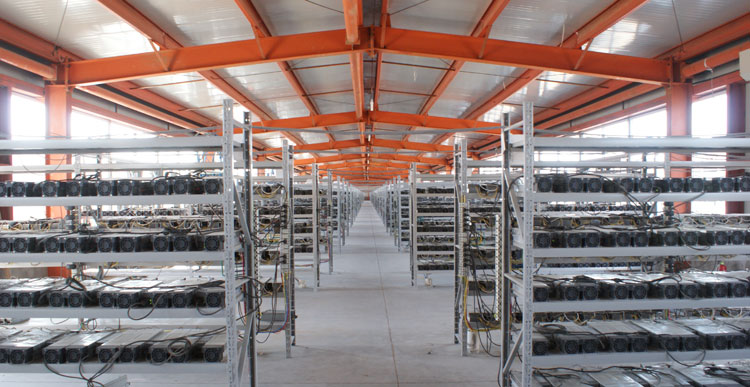
Avalon, une ferme ASIC pour extraire des bitcoins.

Avalon, une ferme ASIC pour extraire des bitcoins. www.canaan-creative.com Photo: © Xiexuan

The little money that is commonly used to pay work with is money already captured in advance, it is already allocated: it goes to pay rent, mortgage, bills, food, credit cards, loans, taxes, interests, insurances and whatever the global market thinks you should be able to consume. Wage money is the measure of your powerlessness to connect to the ‘engine of power’ that is to shape the future of society as such–to change its DNA as Sassen put it.

Hegemony of silicon money

The virtual currency movement has had the merit to show that in current conditions of the hegemony of silicon money, money is something that can be designed. The design of a currency which does not behave like an invading army in relation to social life probably passes through currencies such as bitcoin, but it cannot stop there. There are valuable components of the bitcoin protocol that a money of the commons (Andrea Fumagalli) could usefully adopt (such as the blockchain ledger), but the mechanisms of money creation enacted by the bitcoin protocols seem inadequate to the task.

The invention and success of bitcoins are examples of the powers of social cooperation, but its design does not promote it. A bitcoin is still generated through work, that is the work of mining bitcoins, even as this work is mostly performed by the computational power of logic and silicon-based machines. A bitcoin’s value is still determined by utility, that is its capacity to be spent in order to purchase something and hence satisfy an individual need. The two mechanisms of money-creation produce an eminently hoardable and unstable currency as the work of mining bitcoins gets harder (thus producing scarcity) while at the same time its utility-value is dependent on market pricing and the utility it finds in bitcoin as a store of value or medium of exchange.

A money of the commons should be directly generated by social cooperation, partaking of the powers of finance as a capability to mobilize, distribute and multiply wealth in order to nurture the social common–that is the quality of social life and the powers of social intelligence. It would have its own logic of financing and investment mobilized this time to create new institutions of commonfare (Carlo Vercellone)networks of institutions composing new democratic, participatory welfare systems concerned with education, research, health, housing and the provision of a basic income. A money of the common should thus be both a goal and a presupposition for an economy where something as common and ordinary as social existence is the source of everything that makes life worth living.

Tiziana Terranova
published in MCD #76, « Changer l’argent », déc. 2014 / févr. 2015

Tiziana Terranova teaches and researches digital and network cultures in Naples, Italy. She’s the author of Network Culture (Pluto Press, 2004) and a member of the free university network Euronomade.

Money distorts our perception of the world

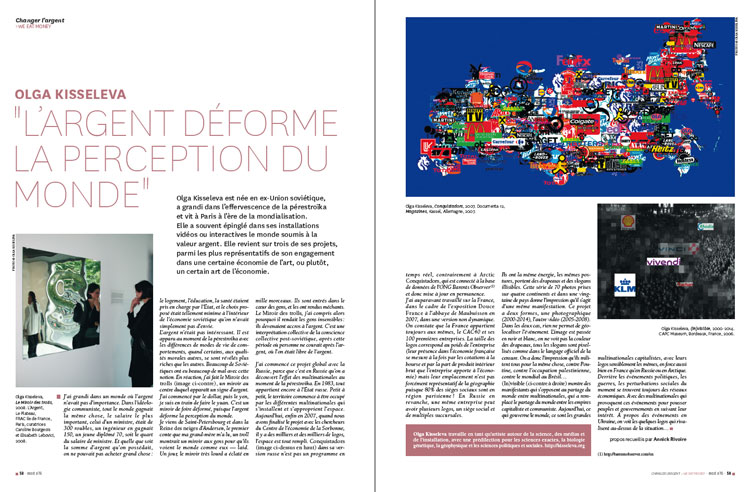
Olga Kisseleva was born in the ex-Soviet Union, grew up during the effervescence of the perestroika and lives in Paris in the age of globalization. In her video and interactive installations, she often portrays the world subjugated to the value of money. She comments on three of her projects, among the most representative of her commitment to a certain economy of art, or rather, a certain art of economy.

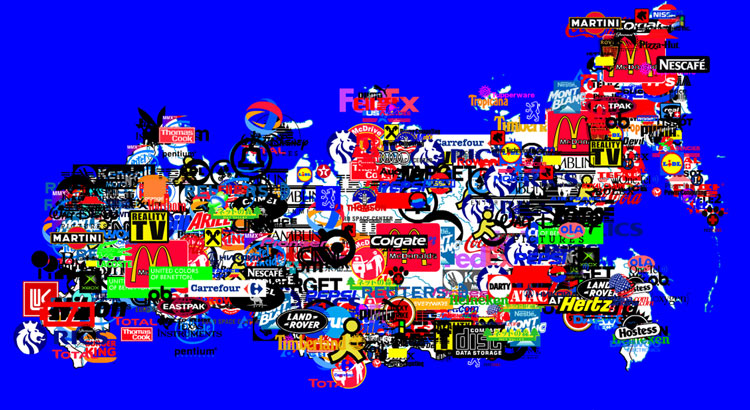
Olga Kisseleva, Conquistadors, 2007. Documenta 12, Magazines, Kassel, Allemagne, 2007. Photo: © Olga Kisseleva

I grew up in a world where money had no importance. In the communist ideology, everybody earned the same amount. The highest salary, that of a minister, was 300 rubles, an engineer earned 150, a fresh graduate 70—a quarter of the minister’s wages. And however much money you had, there wasn’t much you could buy—housing, education, health coverage were all taken care of by the government, and the choices offered by the Soviet economy were so minimal that you just didn’t care.

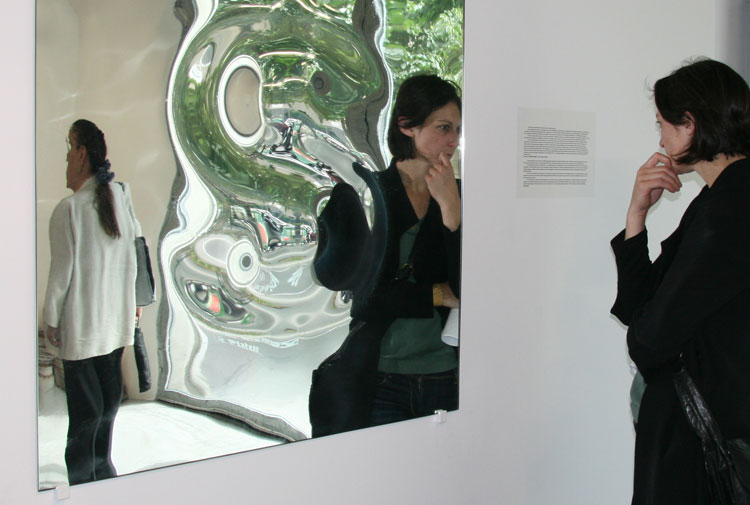
Money was not interesting. It came about during the Perestroika, along with differences in lifestyles and behaviors, when some with alternative moral qualities turned out to be richer than others. Many Soviets have a problem with this notion. In response, I made Troll Mirror, a mirror with a money symbol in the center. I started with the dollar, then the yen, currently I’m doing the yuan. It’s a distorting funfair mirror, as money distorts our perception of the world.

I come from Saint Petersburg, and in Andersen’s tale Queen of Snow, the first story that my grandmother read to me, a troll showed the mirror to people so that they would see the world as the trolls did—ugly. One day, the heavy mirror shattered into a thousand pieces. The shards entered people’s hearts and made them mean. Then I understood why it made people insensible—they became addicted to money. Troll Mirror is an interpretation of the post-Soviet collective conscience, after this period when nobody was chasing money, when we were free from money.

Olga Kisseleva, Le Miroir des trolls, 2008. L’Argent, Le Plateau, FRAC Ile de France, Paris, curatrices Caroline Bourgeois et Elisabeth Lebovici, 2008. Photo: © Olga Kisseleva

I started this global project with Russia, because it was in Russia that the effects of multinationals were discovered during the perestroika. In 1983, everything still belonged to the Russian government. Little by little, the territory began to be occupied by various multinationals, which settled in and appropriated the space. Today, or at least in 2007, when we finished the project with the researchers at the Sorbonne’s Economics Center, thousands of logos filled the entire space. The Russian version of Conquistadors is not a real-time program, unlike Arctic Conquistadors, which is linked to the ONG Barents Observer database, and so constantly updated.

I had also worked on France, for the Douce France exhibition at the Maubuisson Abbey in 2007, in a non-dynamic version. We can see that France always belongs to the same CAC40 and its 100 top companies. The size of the logos corresponds to the weight of the company (its presence in the French economy is measured by both its listing on the stock market and the gross domestic product that the company brings to the economy), but their position is not geographically accurate, as 80% of headquarters are located in the Paris region! In Russia, on the other hand, the same company can have several logos, a headquarters and multiple subsidiaries.

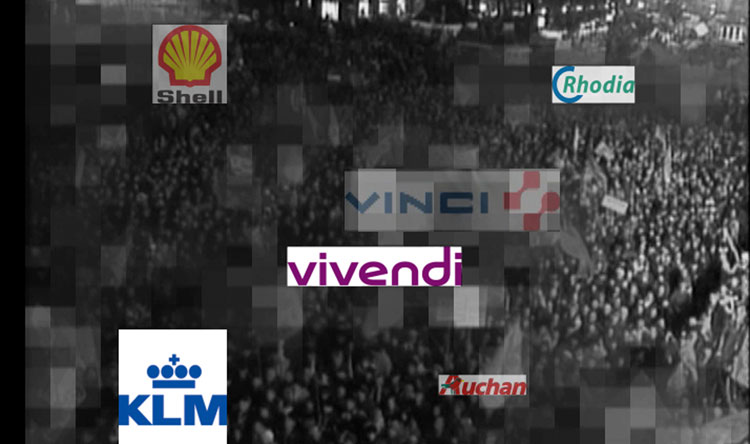
Olga Kisseleva, (In)visible, 2000-2014. CAPC Museum, Bordeaux, France, 2006. Photo: © Olga Kisseleva

They have the same energy, the same postures, carrying unreadable flags and slogans. This series of 70 photos taken on four continents in about 20 countries gives the impression that they are from the same demonstration. There are two versions of this project: one photographic (2000-2014) and the other video (2005-2008). In both cases, nothing indicates the event’s geolocation. The image becomes black and white, so we don’t see the colors of the flags, all the slogans are pixelized like in the official language of censorship. So we get the impression that they are all protesting the same thing— Putin, occupation of Palestine, World Cup in Brazil…

(In)visible shows protestors who oppose the new “sharing” of the world, operated by multinationals, which have replaced the sharing of the world between capitalist and communist empires. Today, capitalist multinationals rule the world, with basically the same logos, just as powerful in France as in Russia or in the Arctic. Behind the political events, wars, social unrests of the moment are always the economic networks, with multinationals that provoke these events in order to push people and governments to follow their own interest. Regarding events in Ukraine, we see the few rivaling logos that are above the situation…

Interview by Annick Rivoire
published in MCD #76, « Changer l’argent », déc. 2014 / févr. 2015

Olga Kisseleva works mainly in installation, science and media art, focusing on exact sciences, genetic biology, geophysics, and political and social sciences.

> http://kisseleva.org

Much soul, very emotion

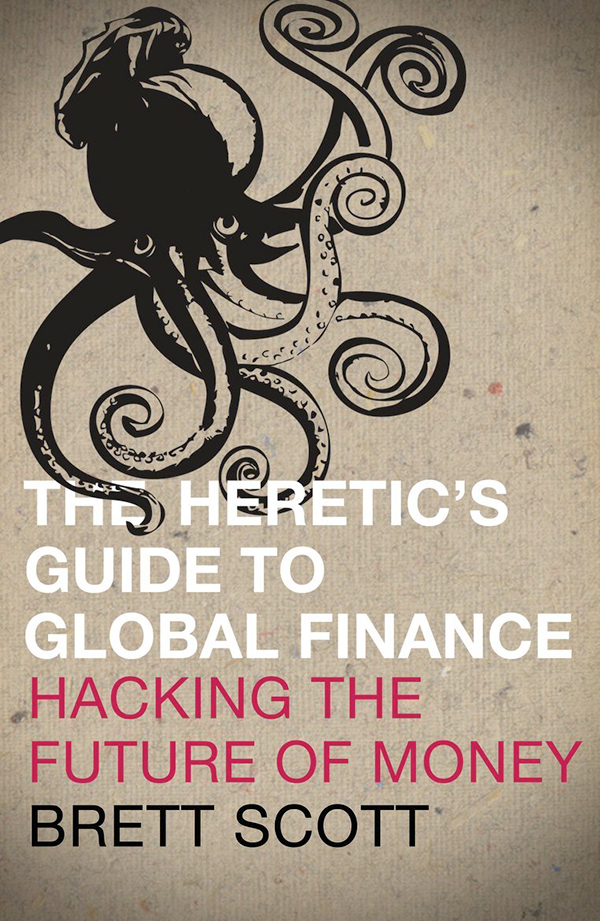
Brett Scott, the author of The Heretic’s Guide to Global Finance: Hacking the Future of Money, explains why he uses Dogecoin, despite some people in the crypto-currency community have written it is a joke, or even a scam. The former broker insists: Dogecoin is the best of all the so-called ‘alt-coins’.

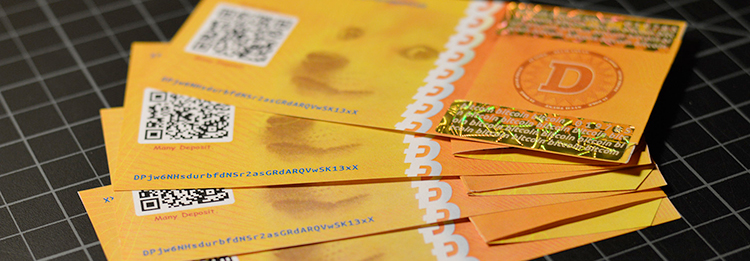
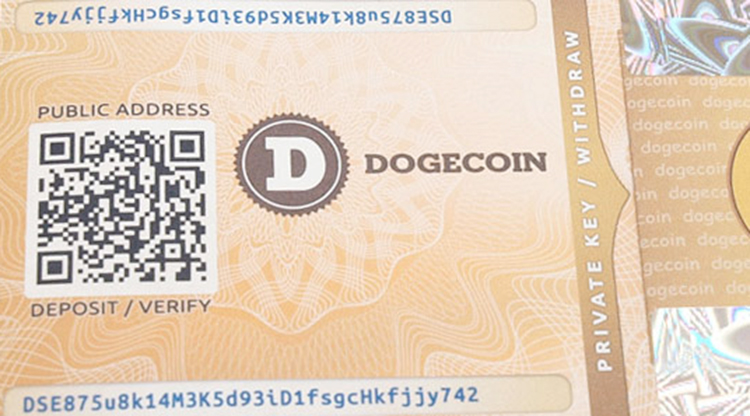
I use Dogecoin because I’m emotionally drawn to the dog. Unlike the distant, fossil-like Queen on the pound banknote, the Shibu Inu is at once transcendent and approachable, self-contained but cuddly, looking into my eyes with a sideways glance, as if it just noticed me and is wondering whether I want to play or be left alone. It’s not an aggressive dog, or for that matter, a bouncy dog trying to lick me. It has self-directed, quirky soul, and it’s almost impossible to imagine this dog being an asshole.

Some people in the crypto-currency community have written Dogecoin off as a joke, or even a scam. Maybe it’s both, but does this matter? All currency in the final analysis is really a scam, and the real question is which of those scams we want to agree to. I for one would rather pledge allegiance to a mystical pooch than to worship the image of a redundant monarch.

Indeed, Dogecoin, to me, is the best of all of the so-called ‘alt-coins’, the alternative crypto-currencies that have emerged as offshoots from the original Bitcoin source-code. Here is why.

Money isn’t ‘rational’

Run this question through your brain: Why did people invent pottery? The response from many people is because it must have been useful to store food and water, an answer which chimes well with our prevailing rationalistic world view. The assumption that pottery was explicitly ‘invented’ is problematic though, and furthermore, evidence suggests that pottery was originally used to create abstract religious figurines.

There is a similar problem among many economists who attempt to peddle ahistorical narratives about ‘why people invented money’. Their story normally involves people ‘rationally’ designing money as an alternative to ‘barter’. There is very little immediately rational about exchanging real goods for pieces of paper or shiny bits of metal though. Sure, once the social convention of monetary exchange is set up, it’s useful, but the imagined process in which bakers and butchers ‘invent’ money to deal with the awkwardness of exchanging meat for sourdough loaves is an attempt to reverse-engineer history from the perspective of present dogma.

Money is not an object that can be invented. It is a social convention that has to be culturally constructed. The use of monetary tokens only appears rational once we’re party to a collective agreement (or delusion) to imbue those tokens with value, and that collective agreement needs to be constantly maintained.

State power, local trust, meta-national mysticism and labour

In the case of our normal fiat currency, the collective agreement is given strength by the psychological (and real) force of official authorities. Most of our fiat currency is created by commercial banks, but derives much of its ‘reality’ from state endorsement of its legal status.

In the absence of a state championing a currency, you need other factors to induce collective acceptance. For example, a very small community might be able to create and maintain a local currency backed by nothing but the preexisting communal trust network, woven together from mutual friendships, ties of honour and anxiety at facing exclusion from the social group.

To create belief in a non-national currency that is not located in a small community though, is especially hard. Bitcoin provides a fascinating case study of the process. When it first started, bitcoin commanded almost no value. It had one crucial feature though. At its heart was a mysterious, almost immaterial figure called Satoshi Nakomoto, a focal point for a community to rally around.

The mystique of Satoshi was vital, imbuing what was otherwise a clever but cold piece of cryptography with a soul that people could believe in. Satoshi was the holy ghost in the machine, and the act of mining resembled a ritualistic quest to build on the blockchain started by the ghost. It’s through this process that the imagined value of bitcoin came to life, and started taking on a reality.

By contrast, imagine if a well-known person, like Stephen Hawking, invented bitcoin. It would be devoid of all mystery, resembling a science project or a corporate product, rather than an underground movement. The specifics of Stephen’s personality would replace the cryptic symbol that the Satoshi figure once stood for, and what would you have left? A clever piece of cryptography, and a somewhat banal act of using up energy in running computers.

That said, there is something about the pointless nature of randomly churning algorithms through a computer that is psychologically powerful. If you want to imagine that something essentially ephemeral is a useful commodity, it helps if you expend labour in creating it, because labour implies scarcity (you only need to work for things that are scarce), and scarcity implies a potential for an exchange value (if something is abundant there is no need to exchange anything for it).

The computing power (‘labour’) put into the bitcoin network does not create value in itself, but is a further psychological backer to bitcoin tokens’ imagined value. If they weren’t valuable we wouldn’t exert all this labour would we, and because we exert this labour they must be valuable, right?

The emergent myth of bitcoin’s rationality

Interestingly, as the ritualistic process of mining has become increasingly competitive, and the commercialisation of bitcoin has steamed ahead, new narratives have formed to explain why bitcoin tokens ‘rationally’ have value.

Chief among these is the idea, touted by the bitcoin foundation itself, that bitcoins have value ‘because they are useful’. It is part of a broader trend among the bitcoin elite to rewrite history and claim, in hindsight, that the value of bitcoin was always self-apparent, and that early adopters were just getting involved due to rational future expectations of increasing societal recognition of bitcoin’s use value as a secure means of exchange.

In this formulation, bitcoin tokens derive their value by being part of a potentially useful system, the value of each bitcoin reflecting the aggregate market assessment of how useful it is to have a secure means of exchange. It’s kind of like arguing that containers on train carriages derive the entirety of their value from the usefulness of the rail network. The implicit narrative is this: Hey, these things are useful as transmitters of value for exchange, so let’s compete over them, and in so doing create their market value, which can now be used for exchange.

Circular no? There may be a glimmer of truth in it, but it’s mostly an attempt to describe the essentially emotional and social process of currency creation with the language of cold individual rationality.

Tin-man currencies ain’t got no heart

This thinking has subsequently influenced the way that a lot of alternative crypto-coins have attempted to market themselves. Rather than embracing their own absurdity, many alt-coins have marketed their efficiency, their security, or their application to some specialist use case, as if the usefulness and competitiveness of the design was the most important aspect of why a person accepts a currency.

The crypto-conference has thus become the realm of ‘serious people’ discussing ‘serious business’, not wishy-washing mysticism and emotion. They appeal to rational functionality, rather than inspiring people to use them. They are techno-fetishistic. A guy with a PowerPoint presentation calmly explains the business case for why his crypto-currency is valuable because it uses a state-of-the-art turbo hashing system, but for fuck’s sake, tell me why I should BELIEVE in it!

It’s true that this strategy has worked to some extent for some alt-coins like lightcoin, quarkcoin and peercoin, which have gained some popularity based on design, but think about this question: Why do you use british pounds or yen? The answer to that is never, because they’re well designed, and neither is it because I rationally see how useful it is for me to have a medium of exchange, and neither is it because I’m intimidated by the state and they force me to use it.

Our answer is mostly just because everyone else seems to use it and I was taught to use it. We are born into currencies just like we are born into languages, and we learn to use them in a social context. If you want to convince a person to accept ephemeral electronic records as a currency, you need a story for people to hold on to. You need heart.

Dogecoin  is a cult, and that’s how it should be

Which brings us to Dogecoin. I can believe in Dogecoin because it gives me something to believe in. It’s a direct appeal to irrationality, a direct appeal to transcend the banal world of individual utility calculation and submit to something hilariously absurd. It is, above all, a cult, and that is infinitely more attractive than any cold appeal to robust design.

It is the peaceful, playful gaze of the Doge itself that is the mystical foundation of the currency. It doesn’t matter who invented it, because Dogecoin  is not experienced as a narcissistic project of a particular person, and it’s the symbol itself that is the leader. The Doge is a figure without ego, with cross-cultural, cross-gender, and yes, even cross-species appeal. We can all get something from the gaze of the Shibu.

This is reflected in the resultant community that has emerged around Dogecoin, people who refer to themselves as ‘shibes’ and give each other gifts of Doge. While the bitcoin subreddit has turned into a moshpit of aggressive trolling, Dogecoin  forums feel inclusive and accepting, cohering around a surreal world of esoteric slogans and acts of goodwill.

In closing then, a word on design. If there has ever been any clever design in Dogecoin, it’s been in the way the core members have focused on creating a culture from the bottom-up, rather than fetishising currency creation as a technical solution to be marketed from above. The Dogecoin  community has grown rapidly in response to community acts that establish a reason to believe in the currency, such as the sponsorship of underdogs like the Jamaican bobsleigh team, and oddball stunts like backing a Nascar racer. These are things you can sit in a pub and laugh about, outside conference halls, and that makes all the difference.

Brett Scott
published in MCD #76, “Changer l’argent”, déc. 2014 / févr. 2015

Brett Scott is a journalist, campaigner and the author of The Heretic’s Guide to Global Finance: Hacking the Future of Money (Pluto Press, 2013).

A Personal Chronology

With resource sharing becoming a necessity, the currencies in which this is happening are now on the radar of a growing number of geeks, artists and activists. Let’s talk about the aesthetics of post-credit money, writes media theorist Geert Lovink.

“The personal is political.” This 1970s adagium of the feminist movement rarely gets applied to our financial situation. Money is a private fate. You’re doomed if you have and doomed if you haven’t. Making money (Ole Bjerg, 2014) is a capacity that only the fast boys of Wall Street possess while speculating with other people’s savings–the rest of us are busy scraping coins (1). With the recent stagnation of middle class incomes, everyday finance is becoming politicized. Debt is a public affair. After 2008 we can barely say: Wir haben es nicht gewusst. Can we finally speak of an emerging ‘virtual class’ consciousness? (2) With resource sharing becoming a necessity, the currencies in which this is happening are now on the radar of a growing number of geeks, artists and activists. How are you going to make a living? Let’s talk about the aesthetics of post-credit money. But before we do this, I want to look at how internet culture and financialization have come together over the past decades and why Silicon Valley has so far stopped us from using tools that redistribute resources.

Crisis of the 1980s

In the midst of the never-ending economic malaise of the 1980s, I went through an existential crisis of sorts. Like others of my generation, I was living off social welfare, making my home in squats, and hitchhiking between Amsterdam and West Berlin while confronted with the neo-liberal backlash of Reagan and Thatcher. Witnessing the sad decline of the autonomous movements and having said farewell to academia after grad school, there were little professional opportunities for us post-hippies pre-yuppies. I felt too much of an independent intellectual to identify with the journalist role model, and in 1987 I decided to label myself ‘media theorist’, wherever that would take me. I had recently joined the Amsterdam free radio movement and had been interested in media theory ever since I majored in ‘mass psychology’ at the University of Amsterdam. But how was a ‘media theorist’ going to make a living?

A good five years later I had still not improved my job situation but quit the dole anyway, by selling essays in the media arts context, giving lectures, doing some organizing work in the Amsterdam cultural scene (dominated by baby boomers) and working part-time at the Dutch national broadcaster VPRO, earning $700 (US) a month, barely more than a social security check. The world had tumbled into yet another recession. Regardless, ‘new media’ started to boom under speculative rubrics such as ‘multi-media’, ‘virtual reality’ and ‘cyberspace’. Soon after, in early 1993, I obtained internet access. With the help of my hacker friends I uploaded my archive of digital texts, which was already considerable since I had started using a PC in 1987. It was in this context that I had my first discussion about the absence of an ‘internet economy’. I was told that content was going to be ‘free’. Users had to pay an ISP in order to gain access and would also continue to purchase and upgrade their hardware such as PCs, screens, printers and modems. In the case of software, the situation wasn’t as clear-cut. From early on there were shareware and free software vs. corporate propriety ones; games were another grey zone.

1990’s: ‘text’ as first victim

My geek friends told me: if you’re not into old media or academia, try to find an arts grant, but do not expect the internet to provide you with an income. Find some boring day job, and express yourself the way you want to at night. Set cyberspace on fire. That’s the destiny of writing and all art forms. Become an entrepreneur and start your own business, learn some coding and become one of us. In 1993 serious money could be made with web design, but then again, that wasn’t content and looked like a hyped-up, temporary opportunity. Writing, be it journalism, fiction, poetry or criticism, would have to be financed through cultural funds or traditional publishers and become de-professionalized, or ‘democratized’, to put it in more friendly terms. The internet was going to disrupt all businesses, and ‘text’ was its first victim–a Napster moment avant la lettre.

The early nineties is a crucial period in the ‘dotcom’ saga. Its libertarian spirit was captured well by Richard Barbrook and Andy Cameron in their seminal piece The Californian Ideology from 1995 (3), but the text failed to analyse a few critical elements, such as the economy of the ‘free’ and the role of venture capital and the IPO in the business plan. Internet start-ups all follow the same scheme: above all attract a critical mass of users in a short period of time. Market share is more important than a sustainable revenue stream. In this cynical model it was accepted that most start-ups would fail, and their losses would be made up by one or two success stories that would be sold early or brought to the stock market.

It took me years to decipher Wired (sold and ‘kaltgestellt’ in 1998) and then Red Herring and Fast Company to get a deeper understanding of what the economic premises of the dotcom craze were about. There were hardly any books about it, and the critical literature was about zero—and before we knew it the market had collapsed. The multitudes at the time were active in counter globalization movements focussed on the IMF and Latin America, the worthy struggles of yesteryears. A classic study on how the internet ruined San Francisco, still worth reading, is Pauline Borsook’s Cyberselfish, which came out in 2000 (4). Then there were the hilarious daily accounts of the rise and fall of dotcoms published by the Fucked Company website. Our only academic guardian in the dark was Saskia Sassen, who linked global finance with computer networks. Her complex macro picture, together with Manuel Castells’ sociological account of the ‘network society’, gave solid overviews; however neither dealt directly with the madness of dotcom culture post Netscape’s IPO in 1995. From 1997 to 2000 billions of dollars flowed from pension funds, mutual funds, etc. into internet ventures. Only part of these investments ended up as ponzi schemes of fake e-commerce companies, such as pets.com and boo.com. A great deal of the institutional investments disappeared into fiber-optic infrastructure. None had revenue; all was based on future hyper growth schemes, fuelled by outside capital. Tens of thousands of designers, musicians, engineers and social scientists quickly retrained as HTML coders, communications and PR officers and IT consultants—only to find themselves unemployed again a few years later when the bubble burst.

One way to counterbalance the ruthless waves of privatization and the stock market craze was to point to the internet as a public infrastructure. The internet, with its military and academic background, should guarantee ‘access for all’. ‘We want bandwith’ was the slogan of our one-week long campaign at Catherine David’s Documenta X, as part of the Hybrid Workspace project. The same group, coordinated by Waag Society Amsterdam, where I used to work as a part-time fellow in that period, designed a similar Free for What? campaign out of the Kiasma museum in Helsinki, late 1999.

Delays in perception concerned me back then in the ‘roaring’ nineties, as it does now. Who benefits when we do not understand Facebook’s business model? Which factors turn us from heroic subjects into grumpy consumers who merely click? Even if we try hard, as individuals, and collectively in networks and research groups, why can we only understand the dynamics of contemporary capitalism retrospectively? Is this the real reason why we lack avant-gardes? These days we can only fight the causes of the last recession. It’s no different now as we deal years later with the fallout of the 2007-2008 crisis –as basic understanding of derivatives and high-frequency trading starts to spread (thanks to Scott Patterson, Michael Lewis a.o.), as unemployment caused by the Euro crisis remains at unimaginatively high levels, as stagnation becomes permanent and as budget cuts ravaging health care, culture and the economy as a whole remain stagnant, waiting for the next crash.

2000: Bubble burst

Ever since initiatives such as the nettime mailinglist took off (in 1995), collective efforts have been made to develop a ‘political economy of the internet’, drawing from cultural, political and economic perspectives from both inside and outside academia. In February 2000, right after the victory over the millennium bug and the announcement of AOL and Time Warner’s merger, the dotcom bubble burst. A belayed attempt to analyse the ‘New Economy’ and bring together critical voices from both sides of the Atlantic was the tulipomania.com event (Amsterdam/Frankfurt, June 2000), held right after the NASDAQ crashed (mid April 2000). The histories of the first stock market craze in the early 17th century, the South Sea bubble and the crash of 1929 are well known. And now it happened again right under our own eyes, even in our own sector, causing so much destruction.

2000-2010: This Is Not an Economy

Projects like tulipomania.com directed us to look at the larger picture of global finance: Wall Street, sovereign (hedge) funds and high speed trading. Why was it impossible to imagine sustainable sources of income for the non-technical workers who were so directly involved? Why did new media exclude artists and content producers and only reward a handful of entrepreneurs and technicians? With perhaps the exception of a few years of the boom, nothing changed much over a decade. This Is Not an Economy. In fact, soon after the explosion of the ‘dotbombs’, armies of web designers and project managers lost their jobs and returned to their hometowns and their old professions. In fact, the poverty of the ‘precariat’ was about to get worse. In the meanwhile, I had to make the move to academia after two decades of working as a free-floating theorist, getting a PhD in Melbourne based on my work on critical internet culture. What new media critics like myself experienced in 1990s soon spread to neighbouring professions such as theatre, publishing and film criticism as well as investigative journalism, photography and independent radio, all joining the impoverished ‘creative class’: cool but poor. With state subsidies withdrawing, the remaining paid jobs shifted to advertisement and PR.

After finding a research job back in Amsterdam, I was able to kick off the Institute of Network Cultures in 2004–a career move that many of my fellow critics and artists were forced to make. The first big event of my newly established research unit at the polytech Hogeschool van Amsterdam (HvA) was Decade of Webdesign (January 2005), an event that looked at the shifting economics of this young profession, followed by MyCreativity (November 2006), which discussed the misery of the ‘creative industries’ policies that had recently reached Europe from the UK and Australia. Due to the rise of blogs and ‘template culture’ in the immediate aftermath of the dotcom crash, it was no longer necessary to build a website from scratch. The prices of web design had plummeted. The geek inventors of the blog software had, once again, failed to build a monetary plan into their systems, and soon the hobbyists of ‘participatory culture’ fell prey to the same old ‘free culture’ logic, this time lead by visionaries such as Henry Jenkins, who was opposed to professionalizing internet writing and instead praised the democratic nature of ‘Web 2.0’ that became so easily exploitable by emerging intermediates such as Google, Amazon, Apple and e-Bay. A handful of bloggers were eventually able to make a living from the syndication of their content, combined with web banners and micro-revenues through click rates to Amazon and Google’s AdSense and AdWords. Eventually an even smaller number of bloggers ended up being taken over by the old media industries, with the Huffington Post remaining one of the more interesting cases: its co-bloggers went to court against its founder, who had cashed in hundreds of millions of dollars from the sales of her meta blog to AOL, refusing to share the profit with the content co-producers who had built up her reputation all along.

The following period, in which ‘Web 2.0’ consolidated into ‘social media’, has been characterized by the victory of the ‘winner takes all’ logic of venture capital-backed dotcoms. The internet economy turned out not to be a ‘free market’ but a breeding ground for monopolies, with libertarian cartels policing the Silicon Valley Consensus. The real estate and financial services driving the 2007-2008 crash did not affect the internet economy. Rapid growth continued, this time fueled by new users in Asia, Africa and the rise of smart phones and tablets. The internet economy, originally based on IT and the media industries, started feeding into other economic sectors, from retail and services to health care, logistics and agriculture. The ‘Vergesellschaftlichung’, as this process is called so neatly in German, turned the internet into a general processing machine, based on largely unknown protocols (guarded by US-dominated industrial bodies) that reproduce the ideology of the free. No single individual or profession, no matter how traditional, can escape its influence, primarily because IT is becoming so small and invisible (yet another obstacle to making the monetary aspects of data flows more visible—and disputable). In response to this ‘totalizing’ (Hegelian aka Orwellian) development, we have seen the rise of ‘internet criticism’ dominated by US authors (and fulfilling an old desire of nettime’s back in 1995), and a growing awareness of internet-related aspects in general debates (from the Decline of Attention and so-called ‘Arab Spring’ to Morozov’s techno-solutionism). This criticism encompasses the ‘parasitic’ privacy strategies of Facebook, Twitter and Google. In response, public awareness that ‘if you are not paying, you are the product’ has grown. However, this cynical knowledge, spread amongst the online masses, did not result in alternative practices. At least, not until Bitcoin and other cyber currencies came on the scene…

In the early nineties I envisioned internet-enabled readers reading online or downloading my essays for a small fee, using a built-in peer-to-peer micro-payment system, designed according to the distributed nature of the computer network. If data could flow in a decentralized matter, then why couldn’t small digital payments be attached to them? A variation on the direct payment method could be a subscription model or a card with small amounts on it. A group of hackers and crypto-experts in Amsterdam were working on this very idea. I visited a number of presentations by an American called David Chaum, the founder of Digi-Cash who was at the time based at UvA Computer Science (CWI) in the east of Amsterdam, one of the early internet nodes in Europe. In 1993 I produced a one-hour radio show with Chaum in which he explained his struggle against the US credit card companies, banks, the patents involved and the importance of anonymous, encrypted data for future online payment systems.

2013: MoneyLab and the age of monetary experimentation

It is precisely this set of ideas that started to reappear again when bitcoin hit the surface in the immediate aftermath of the global financial crisis in early 2009, though this is is not the place to discuss bitcoin. In 2013 the Institute of Network Cultures kicked off a research network initiative in this field, entitled MoneyLab (5). The idea was, as always, to create multi-disciplinary dialogues between activists, artists, researchers, geeks and designers about creating peer-to-peer internet revenue models for the arts that combat exploitation and work towards a more equalitarian (re)distribution of the wealth that is being created online. A system that allows those who do the actual work to generate a decent income and that is no longer concentrated in the hands of founders and early movers.

One thing is clear: the time of merely complaining about one’s precarity is over. This is the age of monetary experimentation. The premise of MoneyLab, this issue of MCD and many other initiatives investigate the multiplicity of complementary revenue models that do not have to function as overnight alternatives for the hegemonic payment systems. Starting off with local exchange trading systems, we can then move on to possibilities and traps of crowdfunding (before the artwork has been produced), to bitcoin and other crypto-currencies (payment systems after the artwork has been finished), to live payments in special currencies designed for online games. Please join the debates about their architectures and do not leave the geeks alone. Let’s start collectives, cooperatives and other forms of autonomous organization in order to counter the neo-liberal role model of the ‘entrepreneur’.

The rainbow of alternatives can only thrive within a larger context that fights for a global redistribution of resources. It is not enough to ‘resist the virtual life’. The aim should be to disconnect Silicon Valley from capitalist logic. A first step could be the ban of venture capital and its deadly ‘hypergrowth’ obsession. So far the Googles of this world have only made the rich richer. Next stop, after the encouraging San Francisco protests against the Google’s private commuter busses, is Occupy Mountain View. Give cyberspace back to the 99%.

Geert Lovink
published in MCD #76, « Changer l’argent », déc. 2014 / févr. 2015

Geert Lovink is a media theorist, internet critic and author of Zero Comments (2007) and Networks Without a Cause (2012). Since 2004 he is the founding director of the Institute of Network Cultures at the Amsterdam University of Applied Sciences (HvA).

> https://networkcultures.org/
(1) Making Money, The Philosophy of Crisis Capitalism, Ole Bjerg, Verso, London, 2014.
(2) See the classic text of Arthur Kroker and Michael Weinstein, Data Trash, Theory of the Virtual Class (New York, St. Martins Press, 1994) that suffered, like so many studies of its time, from a speculative overestimation of a ‘politics of the body’ related to ‘virtual reality’ and a relative neglect of the network capacities of internet and mobile phones, because the internet didn’t fit into French theory’s categories of the time.
(3) Cyberselfish: A Critical Romp through the the World of High-tech, Paulina Borsook, Little, Brown & Company, 2000.
(4) http://www.imaginaryfutures.net/2007/04/17/the-californian-ideology-2/ (5)
(5) The MoneyLab reader appears in March 2015 and can be downloaded there. http://www.networkcultures.org/moneylab
Keep it moving, there’s everything to see and nothing to sell

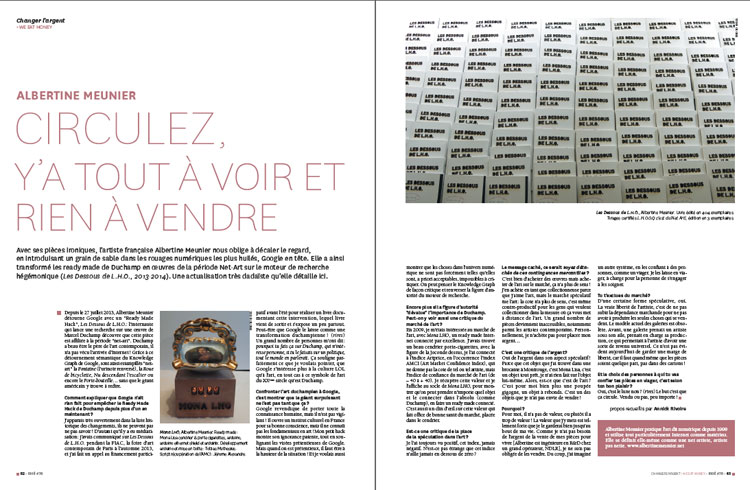
With her ironic pieces, French artist Albertine Meunier forces us to see things from a different angle, introducing a grain of sand into the well-oiled gears of our digital world, beginning with Google. Within the results of the ubiquitous search engine, she re-categorized Marcel Duchamp’s ready-mades as belonging to the Net Art period (The Innards of L.H.O., 2013-2014)—a very dadaist update, which she explains below.

Les Dessous de L.H.O., Albertine Meunier. Livre édité en 404 exemplaires.
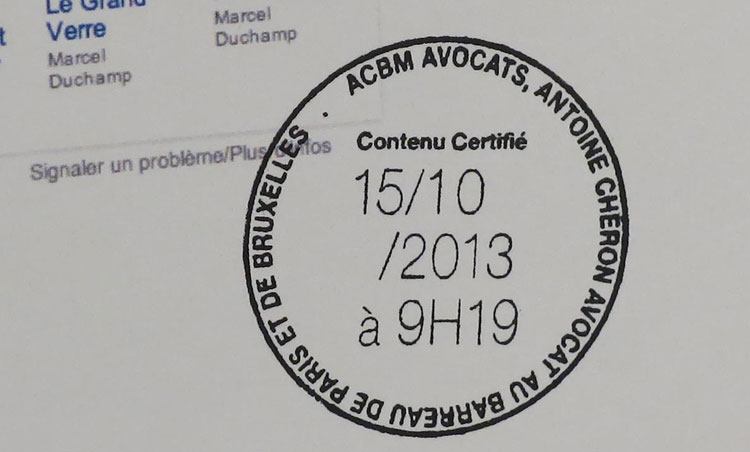
Tirages certifiés L.H.O.O.Q c’est du Net Art!, édition en 3 exemplaires. Photo: D.R.

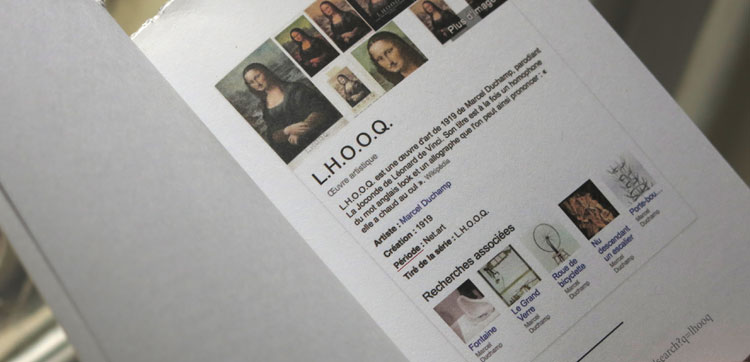
Since July 27, 2013, Albertine Meunier has been hacking Google with a “Ready Made Hack”, The Innards of L.H.O. Anyone who searches one of Marcel Duchamp’s artworks will find that it belongs to the “Net Art” period. Duchamp may be the father of contemporary art, but he never lived to see the Internet! Thanks to this semantic hack of Google’s Knowledge Graph, Duchamp’s best-known works—Fountain (the infamous urinal), Bicycle Wheel, Nude Descending a Staircase, Bottle Rack—are all time-stamped as Net Art… without a word of protest so far from the online giant.

How do you explain why Google hasn’t done anything to stop your Ready Made Hack on Duchamp for the past year now?
I appear very openly on the history list of changes, so they must know! It has also been in the media—I promoted The Innards of L.H.O. during FIAC, the contemporary art show in Paris in 2013, before summer I launched a crowdfunding campaign to publish a book documenting this performance, which has just been released and is visible all over the place. Maybe Google is leaving it as a Duchamp-style transformation? (laughs) A number of people said to me: “Why did you do it on Duchamp? Nobody’s interested in him. But if you did it on a politician, everyone would be talking about it.” That’s exactly my point, that Google is more interested in LOL culture than in art, or at least in this symbol of 20th century art that is Duchamp.

Does confronting Google with Duchamp-style art amount to demonstrating that the all-powerful giant isn’t all that?
Google claims to carry all of human knowledge, but it isn’t vigilant! It opened a cultural institute in France for its good conscience, but it doesn’t know the first thing about art! My little hack shows its patent ignorance, while highlighting its pretentious ambitions. But when you’re pretentious, you need to live up to the situation! I also wanted to show that things in the digital world are not necessarily as they seem, assumed and acceptable, impossible to criticize. You can consider the Knowledge Graph from a critical viewpoint and overthrow the search engine’s authority figure.

Especially if the authority figure “devalues” Duchamp’s importance. Is it also a criticism of the art market?
In 2009, I took an interest in the art market, with Mona LHO, an Internet-connected ready-made par excellence. I found a nice ashtray and cigarette holder with a picture of the Mona Lisa, I connected it to the AMCI (Art Market Confidence Index), which ranges from de –40 to +40. This value is displayed on the base of Mona LHO, to show that you can take any object and connect it (like Duchamp) to make a connected ready-made. It’s also a wink at this value that is supposed to indicate a healthy market, placed in the ashtray.

Is it a criticism of speculation in art?
I’ve always seen the index as a positive value, never negative. Isn’t it strange that this index never dips below zero?

Les Dessous de L.H.O., Albertine Meunier. Livre édité en 404 exemplaires.
Tirages certifiés L.H.O.O.Q c’est du Net Art!, édition en 3 exemplaires. Photo: D.R.

Is the hidden message “Don’t get attached to mercantile contingencies”?
It’s good to buy artworks, but buying on the art market is useless! I buy stuff as a collector because I like art, but market speculation kills art—the rating has no meaning, it’s even counter-productive for people who want to collect, as it distances you from the art. Many pieces become inacessible, especially among contemporary artists. Personally, I don’t buy art to invest my money…

Is it a criticism of money?
Yes, of the speculative aspect of money! Because this object that I found at a flea market in Montrouge is a ready-made Mona Lisa, I didn’t do anything to the object itself. So is it art? To me it’s much more than a Russian doll, a bouncing object. It’s one of the objects that I don’t want to sell!

Why?
To me, it has no value, or rather, it’s priceless! For me, its value is so high that I will keep it until I die. As I don’t live off the sale of my artworks [Albertine is an R&D engineer in a big company], I don’t need to sell them. So I came up with another system, confiding them to people, like my life assets. I entrust them to people who will commit to taking care of them.

So you exclude yourself from the market?
In terms of speculation, yes. An artist’s true freedom is being independent of the market, not having to produce only things that will sell. The current gallery model is obsolete. It used to be that a gallery would take an artist under its wing and take care of his or her production, and the artist would enjoy a sort of universal income. Today it’s hard to maintain a certain amount of freedom, as the artworks need to be somewhere, not in boxes!

And the people to whom you choose to confide your artistic life assets are cherry-picked by you?
Yes, isn’t it a luxury? (laughs) The point is that it circulates. No matter if it sells or not!

Interview by Annick Rivoire
published in MCD #76, « Changer l’argent », déc. 2014 / févr. 2015

Albertine Meunier has been practicing so-called digital art since 1998 and uses the Internet as raw material. She defines herself as a Net artist, which is not necessarily her artistic net worth.

> http://www.albertinemeunier.net

A currency should be affected by the environment in which it lives

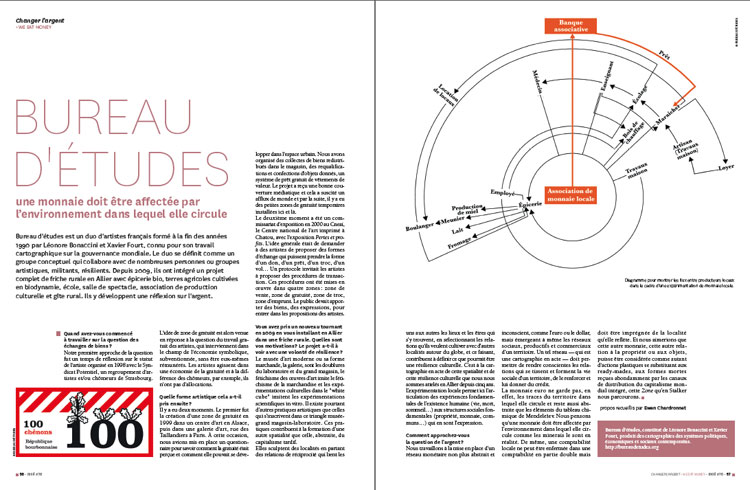
Bureau d’études is a French artist duo formed in the late 1990s by Léonore Bonaccini and Xavier Fourt best known for their creative mapping of global governance. The duo defines itself as a conceptual group, having collaborated with a number of artistic, militant and resilient individuals and collectives. Since 2009 they involved in a complete project to rehabilitate a rural wasteland in the Allier department of central France, with an organic grocery store, biodynamically cultivated farmland, a school, theater, organization for producing cultural events and a farmhouse. These days, they’re thinking about money.

© Bureau d’Études

When did you start tackling the issue of exchanging goods?

Our first approach to the issue was a discussion on the status of the artist organized in 1998 with Syndicat Potentiel, a group of artists and/or unemployed people in Strasbourg. We came up with the free zone in response to the question of artists working for free, intervening in the symbolic and subsidized economy, without being paid themselves. Artists work for free in this economy, but unlike the unemployed, for example, they don’t receive any benefits.

What artistic form did it take afterwards?

There were two big moments. The first was when we created a free zone in 1999 in an art center in Alsace, and then in an art gallery on Rue des Taillandiers in Paris. During that time we passed around an urban questionnaire to learn how free work was perceived and how it could be developed in urban space. We organized drives to collect goods that were redistributed in the store, requalifications and confections of donated objects, a free borrowing program for clothes with more value. The project received good media coverage, which attracted a lot more people, and afterward several more little temporary free zones were installed here and there. The second moment was when we curated the Losses and Profits exhibition at the French Cneai (National Center for Printed Art in Chatou) in 2000. The general idea was to ask artists to propose certain kinds of exchange, such as a donation, a loan, an exchange, a theft… A protocol invited the artists to suggest a procedure for the transaction. This procedure was applied in four zones: selling zone, free zone, exchange zone, borrowing zone. People had to bring goods, expressions, in order to enter the artists’ space for exchange.

© Bureau d’Études

These past years you also took a new direction by settling in a rural wasteland in Allier. What motivated this project? Is it inspired by a desire for resilience?

The modern art museum, or its commercial form, the art gallery, are the counterparts of the laboratory and the department store. Fetichism for artworks imitates fetichism for merchandise, and cultural experiments in the white cube imitate scientific experiments in vitro. However, there exists other artistic practices besides those represented in this museum-department store-laboratory triangle. These practices form a different space from the abstract space of late capitalism. They sculpt localities based on mutual relationships that connect the places and the people who live there, selecting the relationships that they want to cultivate around the globe, and by doing so, contribute to what could be defined as cultural resilience. For the past five years in Allier, we have devoted ourselves to mapping in action this space and this cultural resilience. This local experiment allows us to articulate fundamental experiences of human existence (life, death, sleep…) around fundamental social structures (property, currency, commons…) through which they are expressed.

How do you approach the question of money?

We are currently working on implementing a monetary network that is not abstract or unconscious, like the euro or the dollar, but rather that emerges from the social, productive and commercial networks of a territory. Such a network—which is indeed mapping in action—must make us conscious of the relationships that weave and form the social life of a territory, that reinforce it and give it credit.

The euro currency shows no trace of the territory in which it circulates and remains as abstract as the chemical elements of the periodic table. We believe that a currency should be affected by the environment in which it lives, just as minerals are in reality. Similarly, local accounting cannot be locked into a double-entry accounting system, it must be marked by the locality that it reflects. And we would like this other currency, this other relationship to property or objects, to be considered as sculptural acts that have replaced ready-mades, dead forms abundantly received by the distribution channels of integrated world capitalism, this Zone that we stalk through.

interview by Ewen Chardronnet
published in MCD #76, “Changer l’argent”, déc. 2014 / févr. 2015

Bureau d’études is Paris based Léonore Bonaccini and Xavier Fourt who have been producing cartographies of contemporary political, social and economic systems.
http://bureaudetudes.org

The artist’s currency has no use for archaic monetary systems, financial deregulation or distorted construction value. It’s a new form of political subversion, as proven by initiatives in South America that are reinventing the rules for spreading culture.

Photo: © Gustavo Romano

Instead of complaining about oppression and lack of money, activists have been creating alternative currencies and financial circuits that propose a new approach to capital. Bitcoin stands out among these alternatives as a currency that is not issued by a Central Bank and exists only on the internet, where it can be accumulated as digital files. It may seem lighthearted, like Monopoly money, but bitcoin is currently listed at over €400 at today’s official exchange rate (1). Bitcoin is not the only existing modern currency alternative, nor is this area of activity merely the domain of hackers and financial market experts.

Without worrying about encryption or investment grants, artists are creating imaginary currencies, as well as their own banks and systems that propose alternatives to macroeconomic models. Through a wide range of critical initiatives, they seek to establish new rules for the circulation of culture, using their own money to mimic value creation processes and as a device for political subversion.

Alternative currency as a collaborative methodology

One of the first collaborative currency experiments was conducted in Brazil, back in 2005. This was the now famous and controversial Cubo Card, issued by Circuito Fora do Eixo. It was a brave attempt aiming to be a parallel currency developed by cultural producers and artists to fund artistic and cultural production.

Without sufficient funds to finance the demand of music bands in Cuiabá (capital of Mato Grosso do Sul, in Brazil’s Midwest region), the cooperative enterprise Cubo decided to create its own currency–the Cubo Card–which it used to pay bands and in exchange for other services (press releases, website, rehearsal time in the studio etc). « We started distributing Cubo Cards very enthusiastically, particularly as all those who witnessed the experiment we were conducting wanted to be part of it, recognizing its value. By producing Cards, Cards and more Cards, we got to the end of the year and found that a large number of people were requesting their services at once. We had a subprime product! » says one of its creators, Pablo Capilé.

Photo: © Gustavo Romano

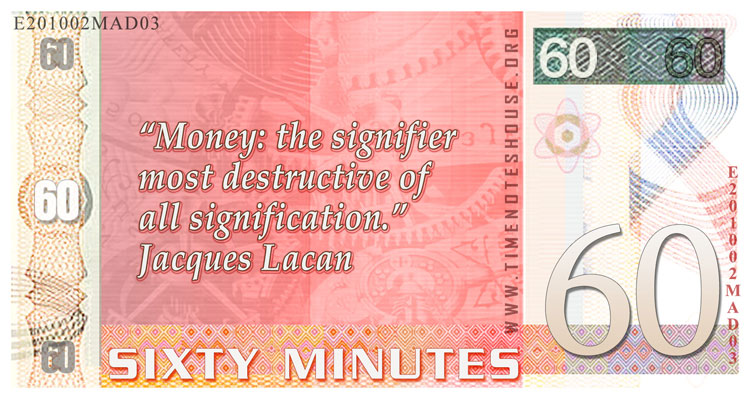
This kind of initiative, regardless of its success or failure, is especially important from a methodological point of view, shifting the debate on the cultural market towards reflection on market culture. However, the most promising attempts in this field may have been by artists who, rather than attempting to create new market formats, have been able to reinvent them, expanding the boundaries of economic thought and practice. By comparing their values and mocking symbols of efficiency, they highlight the authority of their organizational parameters, like the Argentine artist and curator Gustavo Romano in Time Notes, an ongoing project since 2010.

An imaginary currency as a critical device

It is commonly said that time is money, but in the case of Romano’s project, this saying is law. He created a database which allows you to catch up, borrow time and query the database about wasted time. In one year he set up offices for this banking network in Singapore, Berlin, Buenos Aires, São Paulo, Madrid and numerous other cities.

The project is an offshoot of a more extensive survey by the artist, the nomad global issue discussion lab known as Pshychoeconomy. Romano exhibited this work at the World Bank building in Washington, where he presented his thesis. The final report on the experience can be read in the e-book Mis 10 Días como Consultor del Banco Mundial, available for download at http://www.timenoteshouse.org/.

Romano’s subtle irony with regards to the financial market has its equivalent in the smaller world of art. After all, very few industries seem to enjoy paying to be criticized as much as art collectors. At least that’s what the work of Brazilian artist Lourival Cuquinha appears to show. He highlights the creation of monetary values in art in several of his projects and dedicates himself to what he calls financial art.

Two of his recent installations explain this relationship: an enormous asterisk consisting of rods made up of five-cent Brazilian Real coins–the lowest-denomination Brazilian coin in circulation–had to go for millions at ArtRio, the Rio de Janeiro art fair, in September 2014. This work was first shown at Cuquinha’s solo show at the Modern Art Museum of Rio de Janeiro, in June 2014.

Photo: © Lourival Cuquinha

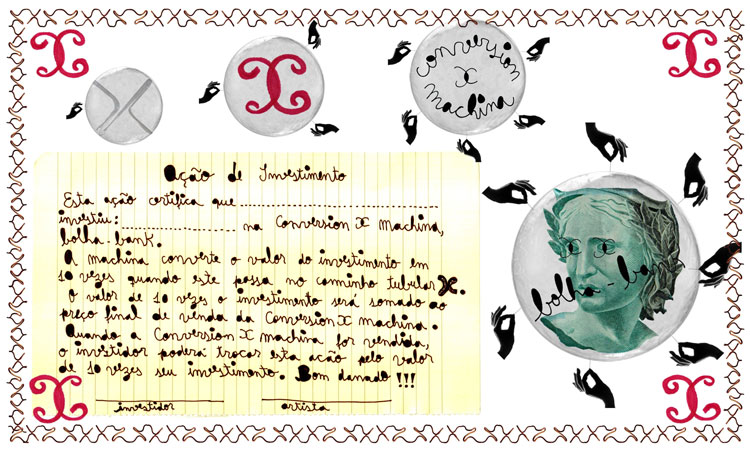
In 2013, the same art fair showed Cuquinha’s Conversion x Machina Bolha Bank (2013), a work that satirized procedures that give art pieces an investment status, placing the financial and art markets on equal footing. In order to achieve this, the artist created a machine based on a banknote vacuum, in which investments in the work were deposited. This investment entitled one to purchase shares guaranteed to multiply tenfold in value if the work was sold.

Each investor also received a wooden plaque signed by Cuquinha, which acted as a share redemption document. The more shares were sold, the more the value of the work went up. Launched in September 2013 at the ArtRio fair, the installation was initially valued at €15,000, a price calculated by multiplying the cost of producing the work (€1,500) by ten. From there, two links between the work and the show were possible. The installation could either be purchased in full for its original price, or those interested in profiting from the sale could purchase shares that were both pieces of the bubble bank and bets on its future sale.

Shares were priced between €17 and €1,000 and represented a refined metaphor for financial market bubbles. The more shares you bought, the more the price of the work went up. Each amount invested in the money vacuum was automatically multiplied by ten, thereby increasing the value of the work. By the end of the Art Fair, the work was worth €80,000.

Money circulation as a political subversion device

Not all artists who deal with money in their works do so to reflect directly on market issues. One of the most important works in the history of Brazilian art, Inserções em Circuitos Ideológicos, by Cildo Meireles, is evidence of this. Created in 1970, during the cruelest period of the Brazilian military dictatorship (1964-1985), Meireles used it to re-appropriate everyday objects, symbolically modifying them and re-launching them on the market, an example being Coca Cola bottles featuring the printed phrase Yankees go home.

Of all the Inserções, none is more relevant to our discussion than that which had the question “Quem matou Herzog?” (« Who Killed Herzog? ») stamped on Brazilian one cruzeiro notes, the lowest currency value at the time (1970’s). Meireles replicated a ritual that was common in Brazil, particularly among the low income population, which consisted of writing wishes, messages, prayers and promises on banknotes that circulated endlessly. He adopted this Brazilian ritual to question the death of an important political journalist, Vladimir Herzog, who was murdered under torture by the Military Police and whose death was attributed to suicide, showing a forged photograph.

This work recently returned with the question “Onde está o Amarildo?” (« Where is Amarildo? ») stamped on the current lowest-denomination Brazilian banknote, the two real note. A construction worker who disappeared on July 14, 2013, after being stopped by the Polícia Pacificadora (Police Pacification Unit) at the Rocinha slum in Rio de Janeiro, Amarildo’s « disappearance » reintroduces the question at the heart of the work Inserções em Circuitos Ideológicos: where is the public sphere in Brazil? Who is entitled to it? Which classes are granted the freedom to come and go in Brazil’s public space?

Giselle Beiguelman
published in MCD #76, “Changer l’argent”, déc. 2014 / févr. 2015

Giselle Beiguelman is an artist and professor at the College of Architecture and Urbanism at the University of São Paulo, where she coordinates the Design course.

http://www.desvirtual.com

This article revisits and updates the ideas presented in “A arte de fabricar dinheiro” (“The Art of Producing Money”) and “Daquilo que não se vende” (“That Which is not Sold”), published in the journal SELECT, editions 1 and 14.

(1) August 8, 2014.

Hope for Africa

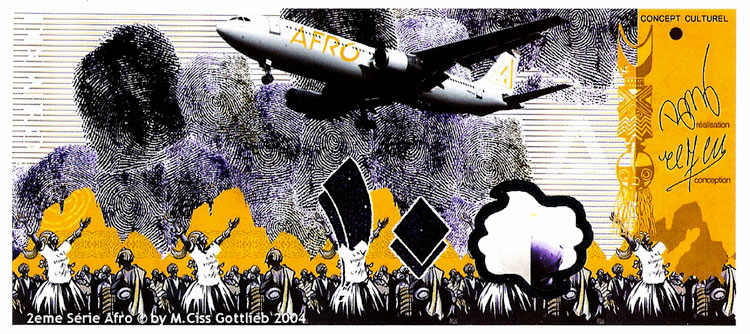
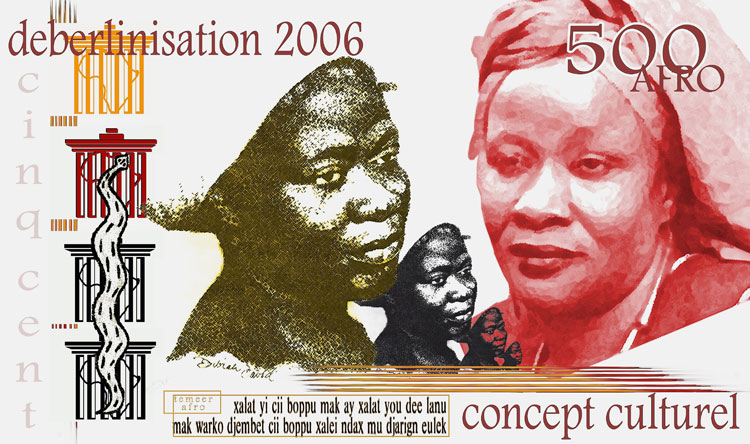
Since 2002, Mansour Ciss Kanakassy from Senegal and Baruch Gottlieb from Canada have been nurturing a concrete artistic utopia: the Afro, a unique currency for the African continent. Materialized on bills featuring Léopold Sédar Senghor and promoting an economic pan-Africanism, it shares a common goal with the Déberlinisation laboratory, which criticizes the African borders established by Berlin at the end of the 19th century. From Berlin, the two artists answered our questions (by e-mail).

Afro 2ème série (verso), 2004. Baruch Gottlieb / Mansour Ciss. Photo: D.R.

Could you explain the context in which you founded the Déberlinisation laboratory?

The mostly arbitrary borders that were established at the Berlin Conference, or Congo Conference, in 1884-1885 are more or less still in place. To this day, they prevent exchange among Africans, whether it’s on an intellectual, financial or creative level. As a laboratory, we want to troubleshoot this situation, so: “Déberlinisation”!

For Déberlinisation, you designed and developed an “imaginary” currency as a symbol of pan-Africanism called the Afro. Why imaginary?

It’s imaginary in that current conditions are not favorable for Africans to achieve economic sovereignty. African economies are always under the control of European banks, especially French banks for the former French colonies. The Afro is an impossible dream, at least for now. However, in its concrete form, it gives people an immediate and tangible feeling of another possible world. The hope that it brings persists, despite the harsh realities that Africa faces.

Was creating a common currency for all of Africa well received in Africa

In general, Africans find that the Afro would be a good idea. The majority of Africans hope to one day manage their own potentials and natural resources.

How are artists actively involved in a new form of economic development?

By inventing new territories of thought. As Achille Mbembe says: “deep down, such a thought should be a mixture of utopia and pragmatism. It should be, by necessity, a thought of what is to come, of emergence and uprising. But this uprising should go well beyond our heritage of anticolonialist and anti-imperialist battles, whose limits, in the context of globalization and in view of what has happened since our independences, are now obvious.”

Afro 2ème édition, 2006. Baruch Gottlieb / Mansour Ciss. Photo: D.R.

What are the Afro’s recent developments? I read online that an Afro distributor was installed in Berlin?

We created M-AFRO, an electronic currency that could be exchanged via cell phone, but so far we haven’t had the chance to launch it. We currently lack the financing to make ATMs to distribute bills.

Have you contacted any central African banks in order to move from utopia to the concrete project of a pan-African currency?

Central African banks are under the absolute authority of the French Treasury. This prevents us from creating a truly autonomous African economy.

In an interview on Afrik.com (1), you talked about an African village where the Afro was circulated by the “Central Bank of the United States of Africa”. Could you tell us more about this experiment?  

It was an African village conceived in 2003 in Vienna, Austria, by a Sudanese architect, along with the curator David Nejo. We experimented with an Afro payment system there.

How do you relate the Afro to the emergence of virtual online currencies such as bitcoin, which challenge the conventional role of central banks and more generally the dominance of international finance?

Without a social movement to accompany them, new instruments for exchanging value would have no beneficial effects.

Do you think that the Afro prefigures a more general form of artist emancipation (beyond Africa) from globalization, economics, finance?

The Afro represents a chimera, the chimera that appeared everywhere in Africa during the independences of the 1960s, and that represented a breath of hope for many in the northern hemisphere. It’s evident that the world will never be at peace without a peaceful Africa. To a certain extent, we can imagine that Africa’s more egalitarian participation in world affairs could help us all. The Afro, as the fantasy of a unique African currency that is implemented and wisely administrated, could simply aid the prosperity and potential of average Africans, and allow countries in the North to have more mature relationships with these communities.

Interview by Annick Rivoire
published in MCD #76, “Changer l’argent”, déc. 2014 / févr. 2015

(1) http://www.afrik.com/article7317.html

Mansour Ciss, recipient of the Léopold Sédar Senghor grant for artistic excellence, exhibits widely in Africa and in Europe. He is the founder of the Villa Gottfried / Sénégal. http://mansourciss.de

Baruch Gottlieb is a member of the Déberlinisation laboratory, the Berlin collective Telekommunisten and the Arts & Economics Group. He is a lecturer at the Institute of Time-Based Media, University of Art in Berlin. http://g4t.info

In 1993, a trendy neighborhood of newly reunited ex-East Berlin gave rise to Knochen Bank and its currency, the knochengeld (“bone money”). The highly mediatized artistic experiment lasted only seven weeks, but was one of the first to introduce an ultra-local alternative currency that challenged the role of money in society.

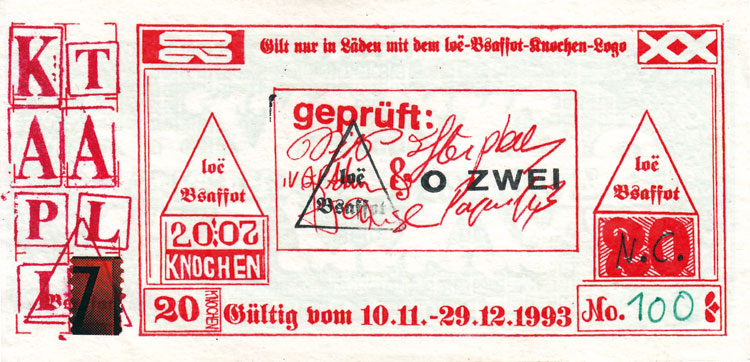
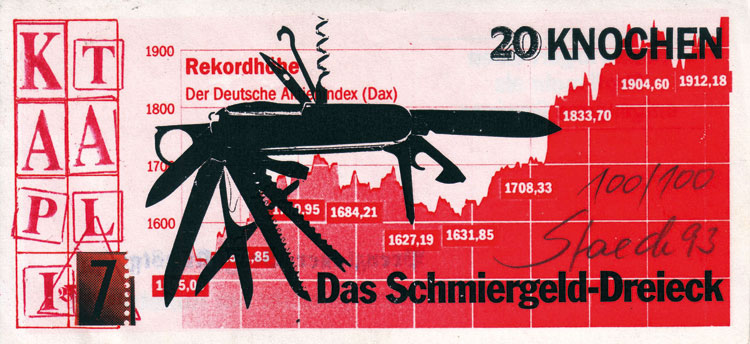
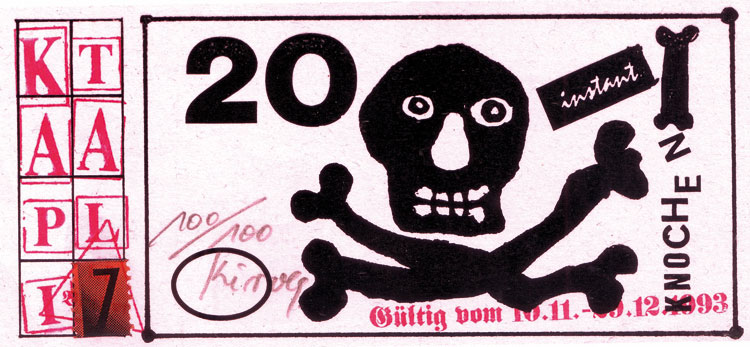
Knochen. Nils Chlupka. Photo: D.R. / Courtesy : Nils Chlupkas (collection/archive).

Nils Chlupka walks across his cobblestoned courtyard in a village situated in the far east of Brandenburg. He is surrounded by barns and an old farm, old motorcycles are parked here and there, tomato plants are growing peacefully. Chlupka’s hair is gray and short, his shirtsleeves are rolled up, he wears faded jeans, he has a heavy Berlin accent. Is this the image of a banker? Not quite. But we’re no closer when we try to imagine him in a suit and tie. And yet, this man was indeed a banker in the past, even the director of a bank. That was 21 years ago. Nils Chlupka was the head of Knochenbank (“bone bank”). It existed for exactly seven weeks.

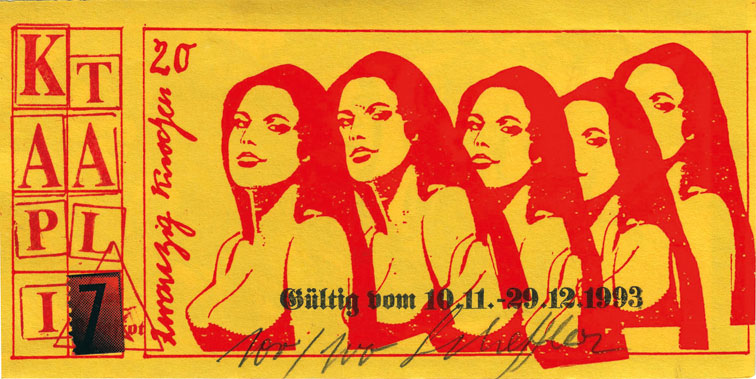
As the director of Knochenbank, from November 10 to December 29, 1993, he administered the alternative payment method “Knochengeld” (“bone money”), which circulated in the Prenzlauer Berg district of Berlin. 5,400 “Knochen” bills, designed by 54 artists, circulated among about 30 bars, galleries and shops in the neighborhood bordered by Oderberger Straße and Marienburger Straße. It was an authentic method of payment, exchangeable for Deutsche Mark (DM).

This extraordinary artistic action was extremely successful. The currency was welcomed with open arms, as people bought out the bank’s almost entire stock of the bills. All expenses related to manufacturing the bills were reimbursed, all the artists received “real” DM, it was covered by all the media, even the “real” world of finance and the museums were interested in the action, which in this form could only exist in this very special place.

Knochen. W.A. Scheffler. Photo: D.R. / Courtesy : Nils Chlupkas (collection/archive).

At the right place at the right time

Berlin-Prenzlauer Berg in the 1990s was characterized by the dilapidated charm of non-renovated apartment buildings in East Berlin, with spectacular apartments that costed almost nothing. It was the perfect breeding ground for young creatives. Some were already there, others came from all over the world. People met in illegal and legal bars, people opened bars, small shops, experimented in galleries. An atmosphere of renewal prevailed in an environment that was still marked by the failed system, which in turn inspired the cultural circles that flourished there.

Nils Chlupka was the founder and owner of «Kommandantur». It was one of the first bars that opened its doors in 1991 at the foot of the water tower located at the corner of Knaackstraße and Rykestraße. Chlupka grew up in former East Germany, and had just lived through his first currency change from the Ost-Mark to the Deutsche Mark. He was interested in the value and importance of money; he made his own bills for his own bar.

Wolfgang Krause, an artist from Dresde, founded the “o zwei” gallery on Oderberger Straße in 1991. He exhibited photos and paintings, and like almost everyone in the neighborhood, was prepared to make unconventional encounters. And so he invited Bert Papenfuß, who was interested in the value of money, to the gallery. The fourth person to join this alliance was C.H. Adam, a Swiss man “who had already used money for artistic purposes in his native country,” according to Chlupka.

What brought the four together was money, but not in the sense of vile Mammon, the biblical deity of material wealth or greed. They were interested in the role money plays in society. They gathered around the collective Ioë Bsaffot: “It’s slang for ‘fake papers’,” Chlupka explains; and they developed the concept of “Knochengeld”.

The term “Knochengeld” refers to an idea of Diogenes, who believed that money should smell bad and go bad, as that would prevent it from being stashed. The artists also referred to the financial theorist Silvio Gesell (1862-1930), inventor of “melting money”. He also wanted people to use money as a means of exchange and not be able to hoard it. He advanced that money is perishable—that its value “melts” over time. This type of liquid cash with a negative interest rate would be spent fast, which would boost the economy.

Knochen. Klaus Steak. Photo: D.R. / Courtesy : Nils Chlupkas (collection/archive).

5,400 bills numbered by hand and signed

The founders of the collective based in Prenzlauer Berg had a solid network. They were quickly able to convince 30 owners of shops and galleries to help introduce the gestating alternative currency. Within one week, they found 54 artists to design the Knochen. The Knochen were made with various materials, conveyed all sorts of messages, and the graphic design of each one was different. Their only common factor was their size and their value. Each creation was printed in 100 copies. Each one of the 5,400 bills was numbered by hand and signed. Their validity was certified by an official stamp of the Ioë Bsaffot collective.

One bill was worth 20 Knochen, which corresponded to 20 DM. As it was designed to be spent, each week it lost one Knochen of its total value, i.e. one DM. So the Knochen that had not been spent ended up being worth nothing. In the collection points of the participating bars and galleries, each bill was stamped to certify that it had been circulated. Those who had not spent their Knochen could acquire tickets that were pasted onto the bills in order to renew their value.

“We even asked the central bank of Land if what we were doing was legal,” says Chlupka. “We learned that in fact it wasn’t legal, but that we could do it anyway, given that Knochen referred back to DM.” Besides, it was an artistic action for a limited time only.

Knochen. Dietmar Kirves. Photo: D.R. / Courtesy : Nils Chlupkas (collection/archive).

A gallery transformed into a bank

The “o zwei” gallery became the bank. Bills could be withdrawn in exchange for Deustche Mark or exchanged for DM by the bar and gallery owners. From the start, the artistic action was a total success. “Art collectors and bourgeois came and almost tore the bundles out of our hands,” recalls Chlupka. Each bundle contained a sample of each 20 Knochen bill.

One bundle costed 1,050 DM. Those who could not afford it but who were “chasing” a particular Knochen spent the bills they acquired individually and bought new ones until they stumbled—or not—on the desired bill. There was no guarantee. But that didn’t matter, because “people spent their money in the neighborhood anyway, where they could pay for their beer with Knochen instead of DM, it didn’t cost anything more,” the director of the bank explains.

And so began the effective circulation of money. The alternative currency boosted and stimulated business. After seven weeks, it was over. During the auction organized for the closure, the German Museum of History and financial institutes such as the Deutsche Bank were buyers, recalls Chlupka: “Knochen became more and more expensive as art objects.”

On his farm in the countryside, he contemplates a few Knochengeld bills 21 years later. In Prenzlauer Berg, he can no longer use them to pay, as this money has no value there. Such is not the case in the art world, where their negative value has been replaced by a positive that is determined by the art market. One bundle that Chlupka followed on eBay reached the sum of 5,000 euros—and that was two years ago. Blessed is the one who has collected Knochen. For Knochengeld doesn’t smell either.

Stephanie Reisinger
published in MCD #76, “Changer l’argent”, déc. 2014 / févr. 2015

Stephanie Reisinger is a German journalist. Her themes are Scandinavia with focus on family policy and war Children and Local, she worked as a reporter in Berlin and Brandenburg.