Archive d’étiquettes pour : MCD#70 v eng

It really is a very odd business that all of us, to varying degrees, have music in our heads. When the Overlords of Arthur C. Clarke landed on our planet, they were surprised by the energy that our species applied to producing and listening to music; they would be even more surprised to learn that, even in the absence of external sources of stimulation, we hear for the most part continuous interior music. (Oliver Sacks, Musicophilia)

Whether we want to be or not, we are all science-fiction characters living in a science-fiction period. (Ray Bradbury)

Bach never modulated in the conventional sense, and leaves the extraordinary impression of an infinitely expanding Universe. (Glenn Gould)
 

Before we begin to imagine the natural and unnatural copulations between music and science-fiction, perhaps it’s best to define the latter, which is often for some what it is not for others, and not necessarily vice-versa.


In the 1950s, Jacques Sternberg titled one of his works: A Subsidiary of Fantasy called Science-Fiction. A bit simplistic, perhaps. Especially considering that fantasy is a non-rational novelistic conjecture, which squarely places it in a different conceptual niche from science-fiction, which is considered “more or less” rational. Pierre Versins, author of a now-mythical Encyclopedia published in the early 1970s, believes that science-fiction is a universe that is bigger than the known universe. A bit excessive, however. Versins must have realized as much, because he later specified: Science-fiction is not a “literary genre” but a state of mind (…) which is revealed through all genres, from poetry to film, and in all forms, from image to discourse.

This is where it gets much more interesting. Norman Spinrad, author of cult books Bug Jack Barron and The Iron Dream, hammers in the nail: We can only define science-fiction by the perception we have of it. Science-fiction is therefore what is perceived as such. So there is no doubt that Gravity’s Rainbow (Thomas Pynchon), House of Leaves (Mark Danielewski), Glamorama (Bret Easton Ellis) or Mantra (Rodrigo Fresan), while not publicized as such, can be perceived as science-fiction novels, just as Donnie Darko (Richard Kelly), Element of Crime (Lars Von Trier) or Mulholland Drive (David Lynch) can be perceived as films of the same genre.

What about music?

Since at least the 18th century, music has tapped into the world of science-fiction. One of the first musical works to be assimilated with SF is probably Joseph Haydn’s opera Il mondo della luna (1777), with a libretto by Goldoni, in which a truant tricks a gullible astronomer into believing that he lives on the moon. Later, Leos Janacek also takes an interest in our satellite with The Excursions of Mr. Broucek (1917), who first visits the moon and then time-travels to the 15th century. The science-fiction opera has tempted numerous neo-classical or post modern composers, such as Lorin Maazel (1984, based on George Orwell’s novel), Philip Glass (The Making of the Representative for Planet 8, based on a libretto by Doris Lessing) and Howard Shore (The Fly, based on George Langelaan’s short story and directed by David Cronenberg).

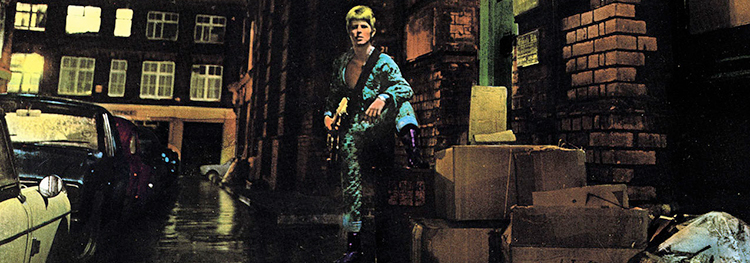
The worlds of jazz and especially rock, which are part of the same cultural, or rather counter-cultural community, as Boris Vian, Philip K. Dick, Robert Silverberg, Philip José Farmer, Michael Moorcock and J.G. Ballard, have more naturally built a number of bridges with SF. One of the most assiduous is David Bowie, with an imposing number of works, including Space Oddity (1969) inspired by 2001, a Space Odyssey by Arthur C. Clarke, or the concept album The Rise and Fall of Ziggy Stardust and the Spiders of Mars, which narrates the escapades of an extraterrestrial rock star, and Diamond Dogs, a dystopia in the spirit of 1984.

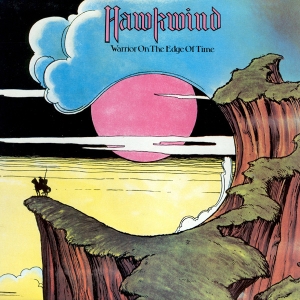
We could list dozens of groups, of course, but that deserves an article of its own (1). However, we will mention the British group Hawkwind, almost all of whose albums fall under the sign of SF, including Warrior of the Edge of Time based on the Cycle of the Eternal Hero by Michael Moorcock (who wrote the lyrics to three of the songs on the album), and the French group Magma, whose entire production revolves around the relationships/conflicts between Earthlings and the planet Kobaïa (with lyrics written in the ad hoc invented language of Kobaïan).
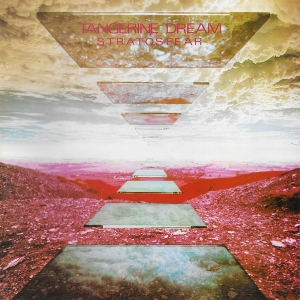
But psychedelic music is where SF has most potential in the Spinrad sense of perception. First off, there is the Pink Floyd spaceship piloted by Syd Barrett who delivers titles sparkling with stars and scented with acid and marijuana, such as Astronomy Domine, Interstellar Overdrive and Set the Control for the Heart of the Sun, as well as the whole “Krautrock” constellation (German rock of the 1960s and ’70s) with the representatives of the “cosmiche musik” trend: Tangerine Dream (Alpha Centauri, Phaedra, Rubycon, Stratosfear) or Klaus Schultze (Cyborg, Timewind, Moondawn, Dune), whose album titles evoke interstellar cargo-crossed immensities and more or less exotic planets that were already celebrated by Gustave Holst in his time. But whereas the British composer’s music only fully functioned as illustration once the theme was announced, all it took was a few notes for the cosmiche rockers to propel us into space.

How is this exploit possible without the use of words or images to funnel the listener’s imagination? With David Bowie or Hawkwind, the SF perspective is also suggested by the texts and imagery on the album covers. But without these textual or visual references, their music is incapable of assuring that the listener’s imagination is oriented toward science-fictional worlds. Hence the question:

Does science-fiction music exist?

Referring to Spinrad’s definition, I believe that we can answer in the affirmative: Phaedra, Rubycon, Moondawn, Dune, and almost all the German psychedelic albums that “sound” sci-fi, and which can therefore be considered as SF music. This leads to another question, which is much more difficult to answer:
Why—or rather how—does certain music sound sci-fi?

The archetypes of science-fiction, such as time machines, teleporting machines or space machines stuffed with electronics must have something to do with it. Indeed, sequencers, drum machines, samplers and, of course, computers decked music software are no longer instruments but also “machines” that generate sound. In the first half of the 20th century, they were only pure “anticipation”, excepting the first creation of mad engineers: the telharmonium (1900) or ætherophone (1919), better known as the Theremin, which already smelled like steampunk.

These first electronic instruments were often used before the arrival of synthesizers to add a certain “strangeness” to the soundtracks of fantasy and science-fiction films. The same can be said about Ondes Martenot (1928), the ingenious “steampunk” ancestor of the synthesizer, with its wooden keyboard and portable electronics. The German group Kraftwerk (who use the Ondéa, the modern version of Ondes Martenot) has played on these archetypes with the most clairvoyance and efficiency, especially on stage: electronic music + minimalist texts made up of keywords interwoven like strands of DNA + “hard science” stage design with robots standing in for the musicians + projection of films on key topics of science and technology… Thus, they are undeniably the precurseurs of cyberpunk (2). While their cosmiche colleagues ogled the space opera, albeit as sophisticated as Dune (inspired by Frank Herbert’s novel), Kraftwerk build a bridge between William Burroughs (Naked Lunch, Nova Express) and J.G. Ballard (Atrocity Exhibition, Crash) on one hand, and William Gibson (Johnny Mnemonic, Neuromancer) and Bruce Sterling (Mozart in Mirrorshades, Schismatrix), the popes of cyberpunk, on the other.

But synthetic sounds alone do not trigger a mental cinema in the image of space opera or even cyberpunk. The “composition”, the creative talent of the musician (fortunately) remains an essential element. As evidence, let’s go back in time for a moment (time travel is still a beautiful invention):

In his Last conversation before the stars, (1982) Philip K. Dick talks about his plans for a new novel titled The Owl in Daylight in which one of the main components is music, saying Pythagorus concluded that the foundation of the universe was the combination of mathematics and music, because they are two aspects of the same thing. Such was his teaching—hence the expression “music of spheres”. Then he said that moving bodies emit music but that we don’t hear it because we’re immersed in it since the time we were born, so we’re no longer aware of it. However, we perceive uninterrupted music.
This music that we do not perceive, but that exists somewhere in the mathematical universe of the world, do we not hear it somehow in the soundtrack of Eraserhead as “interpreted” by David Lynch and Alan Splet? It seems that this reinvented music of matter, of time and of space is, according to Spinrad’s definition, unquestionably science-fiction music, just like the images that go with it.

We can also get an idea of this explicitly SF intention through a creative shock: in the overture of Zaïs, where Jean-Philippe Rameau manages to musically translate the establishment of a progressive order of matter, in a true harmonic interpretation, two centuries ahead of his time, of the evolution (or nucleosynthesis) of interstellar matter (3); or in Les Éléments (1721) by Jean-Féry Rebel, who selects chords and arranges them to express chaos by themselves, without relying on voices or décor. The surprisingly modern result could have been signed by Art Zoyd. Whatever the perspective, on one side of time or the other, from listeners of the era to those of today, the creative shock triggers a break from reality and propels the work into SF.

This “break” is now “common”. We live in a bubble of the expanded, inflated present, lashing out its tentacles in all the senses of time. Accelerated duplication, cloning, drones. Technology is icreasingly overtaking basic research. Electronic music, now digital, lives its own life. It regenerates, metamorphoses, samples and duplicates, lives, dies and rises from its samples. Compression-expansion. The entire history of music in a nanosecond loop. Numbers are numbers.

The first time that Philip K. Dick took LSD, he was listening to a quartet by Beethoven, and he saw it in the form of a cactus. With each progression, from measure to measure, the cactus gained complexity; it was a process of accretion, and no longer a succession. It grew bigger and bigger, more and more complex. Through synesthesia, Dick saw Beethoven’s quartet in the form of fractal scaling, a Fibonacci series. He “naturally” converted the sound into image, just as a software program would have done digitally. Probably without knowing it, he was anticipating the digital revolution capable of “dematerializing” sounds and “rematerializing” them as images.

Number are numbers, and today all music is science-fiction.

Jacques Barbéri
published in MCD #70, “Echo / System : music and sound art”, march / may 2013

> Version Française

(1) See, among others, the feature Culture rock & science-fiction (Bifrost 69 magazine, January 2013)
(2) In the same vein (without the electro-pop touch), we can mention the French group Heldon and the solo albums of its leader, Richard Pinhas (to whom we owe an excellent book on Deleuze and music: Les larmes de Nietzsche), precursor in the 1970s of cyber-electro music that openly referenced Philip K. Dick, Norman Spinrad and Michel Jeury.
(3) In Astronomie et musique au siècle des lumières, Dominique Proust.

A writer and musician, Jacques Barbéri has published the trilogy Narcose La Mémoire du Crime, Le tueur venu du Centaure (La Volte), short story collections, Kosmokrim (Présences du Futur), L’homme qui parlait aux araignées and more recently Le Landau du Rat (La Volte). > www.lewub.com/barberi/

Barbéri is also a member of the group Limite, formed in the mid-1980s with other writers such as Emmanuel Jouanne, Francis Berthelot, Jean-Pierre Vernay and Antoine Volodine, sharing the will to experiment and transgress writing and narrative codes in science-fiction (see the anthology Malgré le monde, Présences du Futur). > www.rumbatraciens.com/limite/mecanique/m002.html

In parallel, Barbéri performs (saxophone, electronics, text) in the group Palo Alto led by Denis Frajerman. The discography of this experimental and atypical group includes Terminal Sidéral (CD+DVD on Optical Sound), Cinq Faux Nids Six Faux Nez with DDAA (Déficit Des Années Antérieures) on the label Le Cluricaun and, of course, Slowing Apocalypse: a tribute to J.G. Ballard published by È®e, featuring Laurent Pernice, with whom Barbéri also recorded Drosophiles & Doryphores, an electronica and melodic album on the multimedia Slovenian label rx:tx.

journey to the heart of an ocean of sound

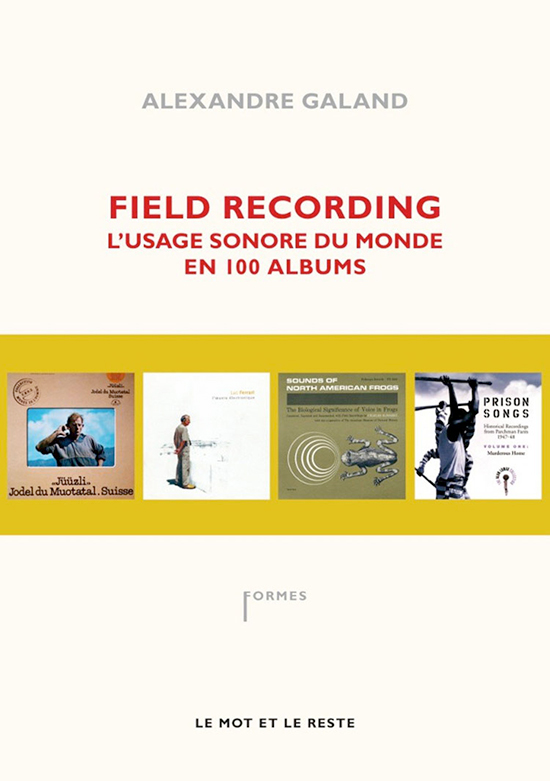
Initially, as a particular field in sound production, field recording was the result of a scientific and technological approach aimed at collecting the sounds of the world before becoming an aesthetic and artistic practice that started to use these very sounds as creative material. Over time, both approaches have reintroduced the noises of the world at the centre of creation. The publication of Field Recordings, l’usage sonore du monde (field recordings, the sonic use of the world) by Le Mot et le Reste editions was an opportunity to reflect upon what it has been customary to call (since the birth of Musique Concrete in the 50s, ambient music in the 70’s, hip hop and the appearance of the sampler in the 90s) the « Art of Field Recording ».

The Field Recording practice, as literally “recording in a field » appeared at the end of the 19th century thanks to the implementation of the first operational and portable sound recording devices. The major names in contemporary Field Recording – Chris Watson (former-Cabaret Voltaire), Geir Jenssen (aka Biosphere), the Touch label, Yann Paranthoën, Henri Pousseur, Lionel Marchetti or the late Luc Ferrari – are, and were, the heirs of emblematic pioneers such as Nicolas Bouvier, a Swiss writer, photographer, iconographer and traveller.

Equipped with his antiquated Nagra, one of the first tape recorders invented by Stefan Kudelski, throughout his life Bouvier explored the world’s roads, especially in Iran and Pakistan. He notably recorded Persians and Gypsies instruments and vocals in the Middle East. As such, he belongs to this category of travelling researchers, anthropologists, sociologists, audio-naturalists and ethnomusicologists, scientific and music lovers, who recorded sounds for heritage archiving purposed, forever curious, struggling against oblivion and ignorance.

Some researchers are passionate about the singing of the lyre bird in Australia others about the melodies of the Solomon Islanders, whilst others still are focusing on the noise of the city or the exalted complaints of prisoners from North American jails. From the outset, Field Recording was as extensive operating area which consisted in  rich and varied challenges and purposes. On this subject, the book by Alexander Galand, Field Recordings, l’usage sonore du monde en 100 albums (field recordings, the sonic use of the world through 100 albums), is a well of knowledge. The author – rightly – insists on the  scientific/artistic dichotomy, which turns out to be complementary over time. Comprising a long historiographical essay, three interviews (Jean C. Roché, Bernard Lortat Jacob and Peter Cusack) and a solid discography, this book is a first of his kind in French and an excellent introduction for the amateur wishing to dive into this ocean of sounds.

The technical origins of an art practice

Whether it be sound techniques or studies, collections used as archives or testimony of the anthropological heritage, initially field recording specifically used a scientific approach. In the beginning at least, the practice of field recording involved an important part of research: whether to investigate the nature of sounds, to collect sound curiosities or more specifically to test new techniques and recording equipment. From this point of view, these techniques and their evolution obviously had a lot to do with the birth of an art which was yet to rise at the time.

In 1876 Alexander Graham Bell invented the telephone, managing to transform the sound into an electrical signal. A year later, Thomas Edison was declared to be the « inventor of the phonograph » (although in reality he was just quicker at filing a patent of his in invention than his French competitor Charles Cros). This major invention marked the beginning of an era where reproduction of natural sounds (even as a series) had become possible. The phonograph was the first device to play sounds. Users then spoke into a metal horn, while operating a needle which engraved the pattern of the waves caused thereby onto a rotating cylinder covered with a sheet of tin that could then be payed back. This did not prove very malleable and was quickly replaced by a wax film.

Finally the acetate appeared and was used with the gramophone of Emile Berliner, inventor of the process. Nevertheless, Industrial production was laborious and only truly started in 1889. For his part, the Danish Valdemar Poulsen, following the discoveries of the German Heinrich Hertz on electromagnetic waves in 1887, invented a form of magnetic recording on a flexible wire in 1898. But the German chemical company BASF managed to store sounds on a « wire » recorder from 1930. This technique improved with the advent of the pre-magnetised tape provided by the same company (which incidentally was to be used a lot by the Nazi regime).

From Field Recordings to the soundscape

As we can see, since its inception, the art of Field Recording has relied on the constant technological evolution. The « audio-naturalists, » (name then given to the pioneers who practiced this type of research), could only use the available means, always seeking higher quality, portability and accessibility. This singled out several categories of practices and several approaches within Field Recording.

Some practitioners opted for rough, in situ, audio recordings in nature, choosing not to exclude « parasite sounds » and other natural sounds that surrounded the subject and observer. This is a well known problem faced by lovers of songs and animal sounds, as well as those who record and archive ethnographic sounds (the « natives » of various regions of the world, prisoners’ songs, sailors, bluesmen, folk songs and instruments) or naturalistic sounds.

Such a problem is inherent to the sound environment induces different approaches. Some prefer to isolate the recorded object, which requires access to a studio. This is where electroacoustics and sound processing come in. With the widespread production and reproduction tools (the gramophone, the phonograph and then the tape recorder) came the era of the acoustic, electroacoustic and acousmatic experience. The initial and basic field recording turned into « acoustic ecology », « landscape of sounds », « cinema for the ear » or « microphony », sometimes reproduced and « tweaked » in the studio. With the rise and accessibility of the home studio, these practices started spreading and gaining importance. Technically, everything is good to turn the world into an ocean sounds. The art of Field Recording is a quasi-infinite audio exploration of the world.

Soundind the world

The Field Recording practice really took a different turn in the 50s. In the footsteps of the great discoveries of contemporary music: from Arnold Schoenberg, Alban Berg and Anton Webern’s serialism to Musique Concrète, conceptualised by the French Pierre Schaeffer and electronic music as represented by the German Karlheinz Stockhausen, the approach evolved. In this regard, it is important to note the fundamental theoretical contribution of Pierre Schaeffer and Musique Concrète to the aesthetic and creative evolution and approach taken by Field Recording. If music history is inevitably linked to the history of technology, then Pierre Schaeffer was a true pioneer.

From 1948, the French man founded the Groupe de Recherches de Musique Concrete. It started as a simple radio recording studio but then actively took part in the development of a new form of music: a « concrete » music which he later renamed « electroacoustic » music. Schaeffer was one of the first to dare to master the art of manipulating sounds with the emerging technology of the early tape recorders. After much trial and error, he elaborated a theory that involved challenging the notions of « music », listening, timbre and sound. He wrote these ideas in his Traité des objets musicaux (treatise on musical objects), in 1966. Following the lessons taught in this clear and founding text, composers started to try new experiences.

In the domain of Field Recording another French composer, Luc Ferrari, stood out even more, using the electroacoustic manipulation of sound and recordings and calling it « anecdotal » because their mundane and daily life qualities. With Schaeffer, Ferrari and later other composers like Michel Chion or Lionel Marchetti, it is indeed truly the sounds of the world, of the whole world, urban sounds, domestic sounds, tiny or supposedly « uninteresting » sounds that entered the scope of musical creation.

Field Recording and sample art: an aesthetic (r)evolution

Today more than ever, the Field Recording practice is at the heart of sound creation. From the ambient music invented in the ’70s by Brian Eno to techno and via experimental projects by various artists and musicians from the above-mentioned scenes, the Field Recording practice responds to a multiplicity of genres, approaches and trends. Ambient music, for example, was conceptualised by chance by the British musician Brian Eno when lying in bed he played an LP at the wrong speed.This micro-event was to give him the idea of an « ambient » or “wallpaper” music, which initially did not meet any of the (admittedly very free) requirements of Field Recording. It was techno musicians such as the English of The Orb, or the more industrial Cabaret Voltaire, 23 Skidoo and other bands who blended together relatively slow rhythms with sound recordings, dialogues, sounds of wind and waves for some or urban cacophony and information flows for others.

The emergence of noise in pop music, which dates back to the Beatles and the Beach Boys, became widespread through techno. In the 90s, artists from this scene were inspired both by Schaeffer’s Musique Concrète and urban or natural soundscapes from the ambient music forefathers to create their own sonic universe. This is the case for Geir Jenssen (aka Biosphere) who with a handful of truly unforgettable albums set up the basis for a unique genre, almost single-handedly creating a music school. In addition, former artists from the industrial or techno scenes, such as former-Cabaret Voltaire’s Chris Watson fully embraced this art-form, quickly making a name for themselves in this marginal field. Meanwhile, numerous major artists have tried this genre, providing the listener with pure Field Recordings records as is the case with Moondog, Yann Paranthoën, Jana Winderen or Peter Cusack. They, too, followed the footsteps of great pioneers such as Luc Ferrari, Henri Pousseur, Steve Reich or Alvin Lucier.

From its worldview, its freedom, the multiplicity of its related practices, the ongoing active evolution of means of recording the world around us, exploring « micro” and “infra” sounds, the different goals pursued by artists specialised in it, Field Recording still has a bright future ahead. Like the productions it offers, it continues to be a window looking out onto the world and creation.

Maxence Grugier
published in MCD #70, “Echo / System : music and sound art”, march / may 2013

> Version Française

or how to draw sound lines

Whenever we describe music, outside of its technical aspects, we quickly revert to a physical, geographical, landscape vocabulary. Is strictly musical rhetoric insufficient, or does there exist an intimate relationship between sound and image that makes such comparisons inevitable? Here is a subjective and necessarily incomplete overview of synesthetic musical pieces.

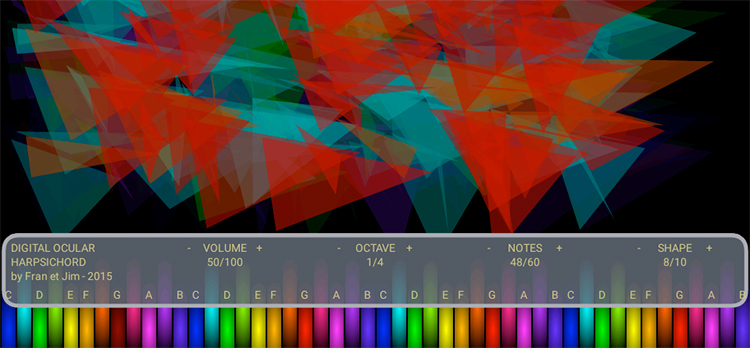
Jean-Michel Rolland, clavecin oculaire numérique conçu d’après les écrits du père Castel de 1735. Photo: D.R.

In February 1809, Ernst Florens Chladni was invited to the Tuileries palace by Napoleon Bonaparte. The German physician and musician came to present to him his extraordinary invention, or rather his discovery, which all the courts in Europe were talking about. Spurred by his curiosity and love for sound, in 1787 this father of modern acoustics had done an experiment in which he sprinkled some sand on a metal plate and rubbed it with a bow. Depending on the location, length and frequency of the resulting sounds, geometric shapes appeared, disappeared and transformed, offering the marvelous spectacle of music becoming lines.

It was no coincidence that this discovery rose to fame at the height of German romanticism, when appreciation for analogies between various resonances of the world was already setting the stage for another movement to appear a good century later: surrealism. At that time, romanticism aimed ideally to synthesize the arts. Meanwhile, shining a light on these intimate relationships between sound and image fit right into the Zeitgeist of the budding 18th century.

More than 150 years later, another scientist, Hans Jenny, expanded on Chladni’s experiments by placing oscillators on quartz sand, as well as on fluids. Jenny described the resulting cymatics—acoustic shapes—as following orderly patterns. Surprising images, reacting immediately to the sound, formed in the powders, but also in water, in alcohol. They could only be referred to, without hyperbole, as sound images.

Henceforth, the correlations between the harmony of sounds and the harmony of lines were scientifically, physically, confirmed. But it didn’t take these two ingenious installations for people to make images from every flutter of sound. Every description of music sooner or later uses a landscape vocabulary. How many skies, waves, sands, branches do we hear in the humming of strings, in the drops of a piano, in the vibrations of a synthesizer, in the friction of metal…

Still others feel this link intimately, and the complicity between image and sound stems from deep within, at the very root of their perceptions. This phenomenon, known as synesthesia, is rare, but some people “see” sounds in certain colors, while others “hear” certain sound frequencies when they see red, blue, green…

Poetry or neurology, the senses concur to entangle seeing and hearing, from Rimbaud (Voyelles) to Kandinsky, from Baudelaire (Correspondances) to Scriabin. This last artist, a Russian composer who dreamed of a great project associating colors and music, reappropriated the ideas of Father Castel, who in the 18th century had designed an “ocular harpsichord” for the deaf, whereby the succession of colors on the eye produced the same effect as musical notes on the ear.

Such audacious attempts, not always successful, were scorned by some, admired by others. Nonetheless, the 20th century witnessed the explosion of technology, just as it welcomed creative works where music merged with other movements well beyond the musician on his instrument.

It was the age of the theremin, named after its inventor. This pioneer instrument of electronic music owed its fame not only to its sounds, or even its technology, but above all to its futuristic mode of “remote” execution, anticipating the remote sensors that surround us today. The theremin player literally manipulates space: he keeps his hand within a few feet of the antenna, which picks up his movements and converts them into sound, controlling the pitch of the note with his right hand, the volume with his left.

The instrument has lived on through the century, and far from being classified as a curiosity of music history, it can still be heard today on albums by Squaremeter, The Damned, Radiohead, Cevin Key (Skinny Puppy)…

Some artists scratch space, while others (finally) make light or colors sing. Such is the case of the laser harp, invented in 1980 by Bernard Szajner. The interrupted light beam determines the pitch. Here again, other musicians, including some very successfully, have reappropriated this synesthetic invention that owes its existence to electronic technology.

From sensors to motion capture, astonishing artworks are expanding the field of musical possibilities. We have only to see the manipulating musicians of Biomuse, led by Atau Tanaka, as they move their arms like conductors of an invisible orchestra to knead a subjugated texture from this ghost ensemble. Biomuse, the fruit of much labor by researchers Hugh Lusted and Benjamin Knapp at BioControl Systems, is a “biomusical” interface that senses electric energy in the forearms and converts its movement and tension into sounds and music.

BioMuse Trio, in which Ben Knapp wears the biosensors, with violonist Gascia Ouzounian and Eric Lyon on laptop, gives an example of the installation’s fantastic dynamic, playing off violin samples captured digitally in almost real-time. Gestures trigger the imagination as if engraving on emptiness. Theremin, laser harp, Biomuse: the avatars of these spatial arm gestures all have the same objective, no matter their degree of sophistication: to transgress a law of physics, where one must touch in order to provoke…

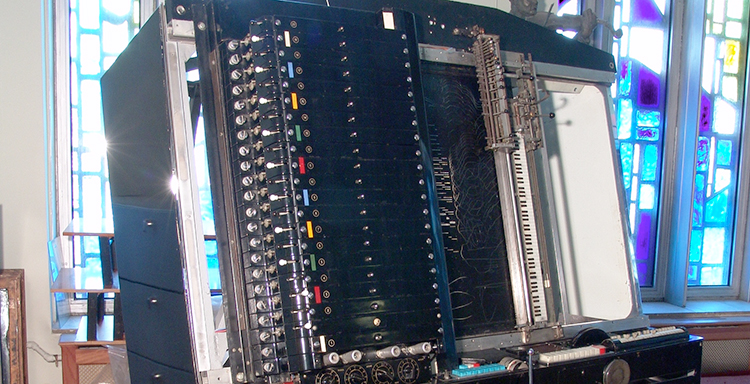
Much more adventurous was the path that extended from Father Castel’s ocular harpsichord, which Scriabin had also explored, which involved positively linking sound to image. From 1937 to 1957, the Russian engineer Evgeny Murzin developed such a device. Not only did he imagine it, he made it. The resulting ANS (in a tribute to Aleksandr Nikolaevich Scriabin) achieved the opposite of the discoveries of Chladni and Jenny—it converted images into sounds. Monumental, rustic and esoteric in appearance, this synthesizer (which Ivan Pavlov of CoH described as a “cross between a time machine from the future and a magic, antique, mysterious engine”) embodied a two-way concept: when played, the ANS could produce drawings and lines corresponding to sound data, like “musical landscapes” painted by the musician; but it could also react musically by synthesizing a sound from its graphical representation. The graphic was drawn on glass plates coated in black resin that were slid into the device, which reacted as programmed with purely synesthetic momentum.

There is only one ANS left today, conserved in Moscow at the Museum of Music, and has long been presented by Stanislas Kreichi, former assistant of Murzin. Little by little, the machine sweeps across the engraved glass plate, instantly converting lines into music, assimilating the stack of prepared drawings to a musical score.

Le synthétiseur ANS conçu par l’ingénieur russe Yevgeny Murzin. Photo: D.R.

In short, thanks to the ANS, shapes “take sound” in the same way that the discoveries of Chladni gave shape to sounds. Artemiev (for the soundtrack to Tarkovski’s Solaris), A. Schnikte, Coil and Cisfinitum have all used ANS sounds that seem to have emerged from the cosmos in the form of an austere chant full of light. The coldness of space, which we admittedly associate with Soviet epics, draws a halo around the delicate humming of the machine, its fragile whistling, and its medium waves.

Indeed, the music of the ANS is astonishing in its process; it is also unheard of (both literally and figuratively) in its texture. The Coil box set of 3 CDs and 1 DVD, which revisits the group’s 2002 experiments with the Russian synthesizer, gives a wide panorama of the machine’s potential.

The ANS made a dream come true: instantly converting drawing into musical vibration. It was a triumph of the romantic spirit, of surrealist audacity over realistic rigidity. Each step of this importance pushes back further the limits of the impossible. Just yesterday, a synesthetic device such as the ANS seemed crazy. Before that, space travel was only a fantasy. We know the giant step that mankind has made since… Space, and why not time? Maybe it’s the next phase. And we can only dream when we consider what Nobel prize-winning physician Georges Charpak very seriously suggested, that the ancient vibration of sounds emitted by a potter of antiquity could have engraved the pot as it spun, like grooves on a record made of wax or vinyl (1). If the future has yet to be written, the past is still overflowing with treasures to decode…

Denis Boyer
published in MCD #70, “Echo / System : music and sound art”, march / may 2013

Denis Boyer is Editor-in-chief of the review Fear Drop > www.feardrop.net

(1) These “paleo-acoustics” (or archeoacoustics) follow the research of Richard Woodbridge, who had done four such experiments in 1969. The first succeeded in transcribing a sound precisely produced by the spin of a potter’s wheel on a piece of pottery. This sound could be reproduced through headphones with the help of a wooden tip and a piezoelectric cell.

> Version Française

hypnotherapy method…

The presence and continuous development of technology in the music field will not have gone unnoticed, yet one could wonder about the lack of consideration as concerns the impact on contents, i.e. the normative trend induced by the generalisation of the computer tool as a means of production, distribution and listening.

Through the « modelling » phenomenon, this global and deep movement indeed conditions the entire music sector so as to de facto exclude some music. Eventually, with regard to the deployment of new media, the frantic emergence of new products, the fetishism about equipment, etc., one can also question the nature of listening and relating to music …
The vinyl or K7 revivals, as nice as they may occasionally be, are often expressed as a misunderstanding of digital formats (no, the CD is not bad; yes, digital amplifiers are on a par with transistor or tube equipment etc..) whilst they are still being conditioned by the latter, not to mention a form of nostalgia or a fad accompanied by a fantasy of subversion …
If the plurality of modes of production, distribution and listening seem conducive to a diversity of creation (including the auditor’s active involvement), unfortunately, in some respects, it also conceals standardisation phenomena. The audio hardware market is experiencing some effervescence … It may not be customary to pay for acquiring music itself, but it is usual to purchase €300 headphones so as to listen to MP3s…

The technique is the dominant factor in our society, it fundamentally shapes it (even before economics – that guides its applications, enhances some of its effects etc. –  and politics). We are referring to Jacques Ellul on this topic (instead it is usual to observe this kind of influences: economical, political, scientific, cultural). Any technique integrates negative and positive aspects, but in such a way that it makes it hard to separate them.
Faced with the usual arguments of the advent of new audio techniques (the accessibility of production, distribution and, lastly, the works), one should note how the technique does not only induce emancipatory effects. How can we be blind to the fact that technology is also a catalyst for the continuous flow of the global machine in an automatic mode, continuously fed by a succession of interchangeable contenders and their farmed music; obviously sustained by the market and the disguised monopolies of large groups?

Regarding production, unlike what the digital context may suggest, we do argue that setting up « labels » still has some relevance (even more so) today but let us remember that when the profile of such activity (or a publishing house) is akin to craftsmanship, it is not supposed to exist in relation to the established systems. This is an impossible economic model –  if we put a little awareness in the ins and outs – even though one can find tricks, play with constraints, integrate the « crisis » into the project. In this context, the technical facilities have not made the practice more viable (on a global scale), nor do they guarantee a quality of production.
A development which has repeatedly been commented upon involves a single individual, who without leaving home, can consolidate the entire music production chain from composition to the negotiating of rights via the promotional clip and up to public retailing. Faced with the idiocy of majors labels, this easy « all-in-one » solution is obviously attractive (though dominant circuits were quick to adapt and incorporate this aspect), but it can also overshadow the interest in collaborative modes inherent to former processes (sound engineer, producer, arranger, etc.)..

Here, we encounter the human propensity to opt for an easier practice, and the question of creative freedom. If it is possible to overcome the tutelage of a producer or a label, one nevertheless suffer the constraints of a technical (and commercial) system…
Production can be formatted both by the used tools as by the prospect oft the practical distribution. This standardisation – which, of course, may also result from a collective deed – of the project to the limits of a dominant system (excessive compression, etc..) is not necessarily conscious …
It is, of course, out of the question to validate the principle of division of labor whose horrors we know well. Functions should not be closed up – a history of provisions not of assignments. Besides, a single author might impose on himself a division of labor not dedicated to the artistic project… Projects must define the systems and not vice versa – which does not prevent anyone from toying with the established conventions. Cinema is full of examples of producers and writers who have demonstrated skills specific to each other’s field, etc.. As stated elsewhere, what makes art is constantly shifting and is not the sole fact of authors (questions of freedom). It is always enlightening to move between the different levels (author, label, distributor, store …), trying for example to examine the functions of each one in the light of the others (this also applies to other areas).

When it comes to audio media, unlike the dominant ideas, the CD is still the easiest way to listen to properly rendered music. Once again, we encounter the human propensity to search for convenience before the best option, if this was not the case, the MP3 would have been restricted to non-musical uses. If you however wish to use a « dematerialised » file (which always requires a great amount of equipment), a « correct » audio rendering still shows a significant difference with the simplicity and reliability of a CD set up (to near the CD quality, you will be faced with quite a few technical issues), knowing that we must also take into account the cost of HD tracks when cheap CD availability is infinite. This, of course, only applies if you are caring about things like fine orchestral works, etc.. Obviously when it comes to pop music calibrated for the MP3, differences are smaller …
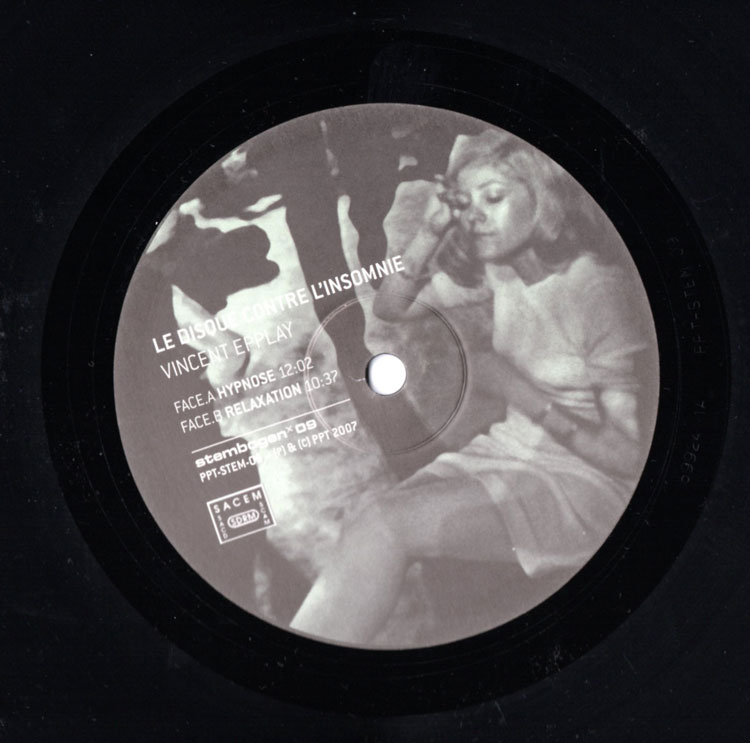
A vinyl / CD quarrel from another era is no longer relevant, and in fact I can not imagine some projects (such as Epplay on our label) or music (such as the skweee) other than on vinyl. However one should avoid comparing the sound of a cheap CD player to an upscale turntable… In many ways the CD has advantages we cannot all list here. For example, for some music, not to hear the surface friction is more important than what vinyl (sometimes deceivingly) provides. Finally, when observing the vinyl trend, one will notice countless new followers who share their disappointment on dedicated forums… Eventually, there is nothing intrinsically wrong with the vinyl and this is just about balancing the debate …

Dematerialisation might seem relevant with regard to arts and music … But something remains physical, a parasite aesthetic, etc.. Some projects rather opt for integrating the physical elements, to toy with them rather than suffer by convention. Therefore no objections should be maintained between the media; we should rather see a range of resources whose specificities it may be interesting to explore and mix to reach various objectives. The contribution of digital tools is undeniable in terms of field for experiments they opened for modes of composition, collaboration, sharing, listening… From a « consumer »‘s point of view, there is also a complementarity between the different proposals for different uses.
To return to the questions of sound reproduction, one can avoid falling into the trap of an elitist delirium – besides the hi-fi has become more accessible and we can enumerate many other unnecessary expenses, destructive ones even, that will end up costing more. On the other hand, numerous music are clearly being distorted by their means of diffusion to the point of losing their interest, their singularity. On occasion, on could also hear a clumsy performance or composition which in fact was caused by a weak rendering of the attacks or fades of the notes…

This is not about asserting how music should be listened to, or fantasise about a piece in its pristine origin, but about noting that this music is often altered without one having the choice or being aware of it: we can choose to read a book by fragments, but no one would accept a book that was distributed with modified vocabulary or missing sentences… However, many items of music only exist though their media. So if the quest for the identical sound from a studio to a listener is unrealistic (and what is more not necessarily desirable), we postulate that there is a decent, but relative, subjective, empirical minimum.
By improving the quality of reproduction we could certainly attract further audiences, the music is primarily a phenomenon of sound and not to properly render its carnal dimension will result in the indifference from the listener. Faced with these sound quality problems, there is also the lo-fi production option, usually a sign of an emergency, an indifference to « clean » sound or a rejection of digital tools, but this posture – bound to generate as much fetishism – does not solve the problem of rendering: are we to listen on a lo-fi or hi-fi system (which perfectly replicates the nature of the project)?

Our listening process is so tied to the technique that we sometimes listen more to the technique than to the music. For instance, in some concerts the amplification power compensates for the poverty of artistic proposal (and/or responds to a dominant/submissive game beyond any musical concerns, unless a reality of the concert, obvious in some cases, is being expressed there). One could see here an unexpected attraction to the noise experienced by transfer… just like a repressed sexual orientation experienced by transfer.
In this sense noise music is a significant link to our world, and though this direct confrontation with the technique, if properly conducted, it constitutes its aesthetic awareness, touching sensitive areas the dominant musical purr cannot fathom… This is the use of technology as a (re)activation of sensitive and mental areas versus the « prothesis » or « atrophy » techniques.

Denis Chevalier
Cofounder and Art Director of PPT et of the Stembogen label
> www.e-ppt.net

published in MCD #70, “Echo / System : music and sound art”, march / may 2013
> Version Française

A transversal label

What is the scope of action for a label in the current context where music, is dematerialised but still reified, constantly losing its commercial and aesthetic value in the “mesh of the web”? Pierre Beloüin, Optical Sound’s label-manager, answers to this question, and some others. The label is a structure that goes beyond the framework of music publishing to claim other artistic territories, as its subtitle indicates: records & fine arts.

My initial motivation for creating Optical Sound was to extend what I had already been doing, just like any other music lover, as a teenager, in the form of compilation cassettes: a way of giving a sonic point of view, but this time in a more professional manner, by producing groups, with a real distribution, visual identity and editorial line.
On the other hand, of course, I had in mind great labels that are still models for me, like Touch, 4AD, Mute, Mille Plateaux, Mego, L’invitation au Suicide, Sordide Sentimental, Giorno Poetry System, V.I.S.A, Bondage, Some Bizarre, Factory…  and I’ve left out some of the best!
Another essential motivation was also to link my work as an artist to my passion for music, starting with the first edition of Optical Sound which was created for individual listening (see: OS.000 Programme Radio), but also with one of my installations which was initially presented for my diploma at the Beaux-Arts de Paris and was called Optical Sound.

As far as I am concerned, music has always been intimately linked to visual arts, and I can continue to quote, in a very basic way, Mike Kelley and Sonic Youth, the Velvet Underground and Warhol; there are so many examples… Transversality wasn’t invented in the 1990’s.
These two areas, and many others, have always informed my research, in both directions. It forms a whole with all the cultural domains that drive me; it seems to me essential to have a certain coherence and a line of conduct.
Optical Sound is not a label for just electronic, experimental, alternative, cold wave, rock, dark dub, exotica, concrete or acousmatic music, but rather all of them at the same time, otherwise, what good would it be…
However, Optical Sound is above all a sprawling structure which, as well as physical releases in the form of sound objects, also organises exhibitions, concerts, books and journals, screen prints, DVD’s, iPad applications, performative listening devices, sound architecture, funerary audits, etc.

At the same time Optical Sound has a conservation function with archives (RGB~Transfer, etc.), trace archives (Légion Cérébrale, live act for 23 headphones)… For the RGB~Transfer or Echo Location, it was about paying tribute to my peers, (forefathers) not in a purely nostalgic form, but with a contemporary pendant of auto-reinterpretations for Echo Location: what happens in artists’ creative processes between their early works and their most recent ones? What view do they hold of their own work twenty years on?
For the more than three hours long DVD of RGB~Transfer archives, it was about showing exactly that, despite the lack of broadcasting and audiovisual facilities at that time (1979-1991) a burgeoning and creative French scene was very much present. Paradoxically, one can see that even with all the current available tools, there is a certain creative poverty now…
Concerning the relics and archives of  live shows ( such as the Légion Cérébrale concert for my own exhibition at the FRAC PACA, for example), they are part of the Optical Sound editorial line. I’m not just producing artists’ works, but I also collaborate with them regularly in the creation of tracks for my own work. These productions are autonomous extensions of my exhibition projects, which still exist in a physical form as catalogues, long after the dates of the exhibitions or residencies (see Special Kit produced following my residency in Canada and then at the Villa Arson).

It is often said that Optical Sound only produces visual things because it’s a reference to  cinema. Perhaps but not only: the choice of the name was above all a way of bringing to light all the mental images that are generated by listening to a sound piece.
I hate labelling and constraints: everything pushes people into clearly identifiable boxes, even in artistic fields, when all it takes is to study a content to understand how it works; but what is cruelly missing today is the time to listen, to look, and a return to desire…
The artists produced by Optical Sound are multifaceted – video artists but also musicians, etc. Yet, for a moving visual form, I would rather opt for a return to one-off screenings as part of concerts performed in unusual places, like I have already done so during the Ososphere festival, for example, or will soon do it again with the Fimé in the PACA region.

interviewed by Laurent Diouf
published in MCD #70, “Echo / System : music and sound art”, march / may 2013

Optical Sound > https://optical-sound.com/wp/

> Version Française