Archive d’étiquettes pour : MCD#66 v eng

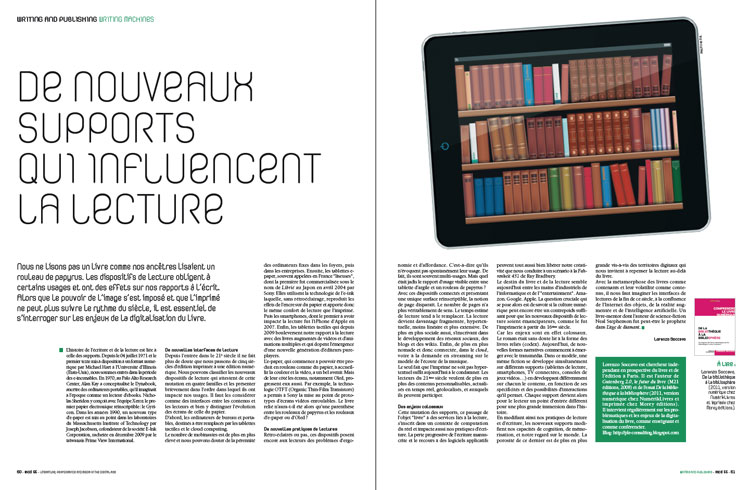
We don’t read a book the same way our ancestors read a papyrus scroll. Reading formats demand specific usages and influence our relationship with the written text. While images dominate and print can no longer keep up with the accelerated pace of this 21st century, the issues surrounding the digitization of books are more relevant than ever.
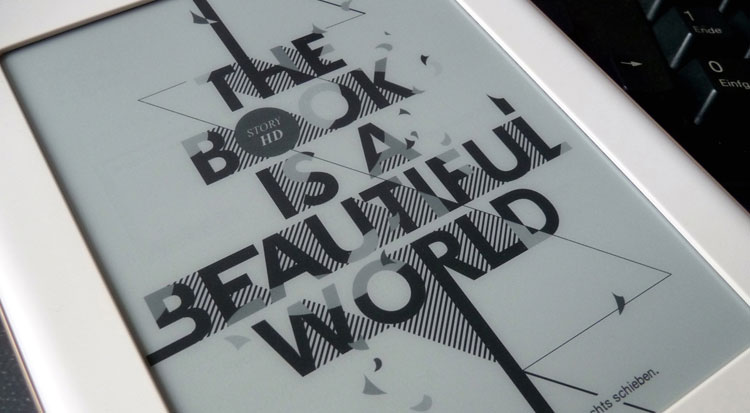
Photo: D.R.

The history of writing and reading is linked to the history of formats. Ever since the first text was made available in digital format by Michael Hart at the University of Illinois on July 4, 1971, we have entered the period of e-incunabula. In 1970, at the Palo Alto Research Center, Alan Kay conceptualized the Dynabook, the ancestor of portable computers, which he imagined at the time as an e-reader. Nicholas Sheridon and the Xerox team designed the first rewritable electronic paper, the Gyricon. By the 1990s, a new kind of e-paper was developed in the laboratories of the Massachusetts Institute of Technology by Joseph Jacobson, cofounder of E-Ink Corporation, acquired by the Taiwanese company Prime View International in December 2009.

New reading interfaces

Ever since we entered the 21st century, there has been no doubt that we are transitioning from five centuries of print publishing to digital publishing. The new reading devices representative of this mutation can be classified into four families, presented briefly in the order in which they have impacted our usage. We should consider them as interfaces between the content and the readers, and distinguish the evolution of screens from that of paper.

First, office computers and laptops, destined to be replaced by touchscreen tablets and cloud computing: As mobile computing is on the rise, the permanence of desktop computers in homes, then in offices, is doubtful. Next, dedicated e-readers, of which the first was commercialized under the name Librié in Japan in April 2004 by Sony: Their use of e-ink technology, with no backlight, reproduces the effects of ink on paper, thus offering the same reading comfort as print. Then smartphones, among which the first to have had an impact on reading was the Apple iPhone in 2007. Finally, touchscreen tablets, which since 2009 have changed our relationship to reading through books enhanced with videos and multiple animations, driving an emerging generation of pure-player publishers.

E-paper, which is starting to be produced in rolls like paper, with color and video, has a bright future ahead. But screens, such as Oled, are also making progress. For example, Sony has used OTFT (Organic Thin-Film Transistors) technology to develop prototypes of rollable video screens. Has the codex book been nothing more than a parenthesis between papyrus scrolls and rolls of Oled e-paper?

New reading pratices

Backlit or not, these devices still pose the human problems of ergonomy and affordability. They don’t elicit spontaneous usage as e-readers. Actually, they are often multi-purpose. But what was the visible relationship in usage between a clay tablet and a papyrus scroll?

With connected devices offering a single rewritable surface, the notion of page disappears. The number of pages no longer has any real meaning. It tends to be replaced by the estimated reading time. Reading becomes more fragmented, hypertextual, less linear and more extensive—as well as more and more social, along with the development of social networks, blogs and wikis. Lastly, it becomes more and more nomadic and therefore connected, in the cloud, or even streaming on demand, like listening to music.
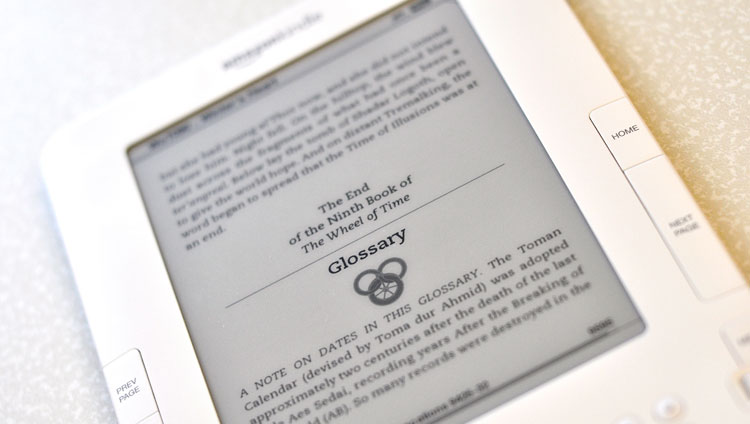
Photo: D.R.

The mere fact that print is not hypertextual is enough to condemn it. Readers of the 21st century want content that is more and more customizable, updated in real time, geolocalized and participative.

Enormous stakes

This mutation of formats, this transition from « book » as object to services linked to reading, is all part of our computing reality, while it impacts our writing practices. The gradual loss of handwriting in favor of software applications can just as well liberate our creativity as lead us to a Fahrenheit 451 situation.

The destiny of books and reading today seems to be in the hands of the online and entertainment industries. Amazon. Google. Apple. The crucial question now is whether digital culture can still be enough of a counterweight so that new reading devices can be emancipating, just as print was, beginning in the 16th century.

The stakes are indeed enormous. The novel was undoubtedly linked to the codex format. Today, new narrative forms are starting to emerge with transmedia. In this model, the same fiction is simultaneously developed on various platforms (e-readers, smartphones, connected TVs, game consoles, etc), with platform-specific content exploiting the particular merits of each one. Each format then becomes a different entry point that immerses readers even deeper into the story.

By modifying our reading and writing practices, these new formats also modify our capacity for cognition and memorization, as well as our vision of the world. Our changing worldview is particularly unstable, as digital territories invite us to reconsider reading beyond the book.

With the metamorphosis of books as containers and their volatility as contents, we must imagine reading interfaces for the end of this century, at the confluence of the Internet of things, augmented reality and artificial intelligence—a mentor-book, of which science-fiction author Neal Stephenson was perhaps the prophet in The Diamond Age.

Lorenzo Soccavo
published in MCD #76, “Writing Machines”, march/may 2012

Lorenzo Soccavo is an independent researcher of books and publishing in Paris. He is the author of Gutenberg 2.0, le futur du livre (M21 éditions, 2008) and the essay De la bibliothèque à la bibliosphère (2011, digital edition published by NumérikLivres and in print by Morey éditions). He regularly speaks about the issues and challenges of digitizing books, as a teacher and a lecturer. Blog: http://ple-consulting.blogspot.com

between technology and art

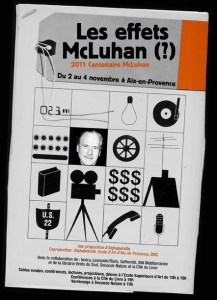
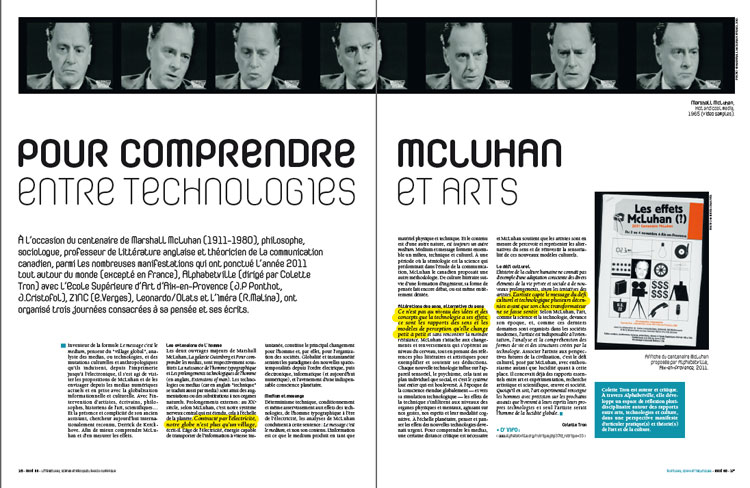
On the occasion of the centenary of Marshall McLuhan (1911-1980)—Canadian philosopher, sociologist, professor of English literature and communication theorist—among many other events which have taken place in 2011 around the world (except in France), Alphabetville (directed by Colette Tron), along with Ecole Supérieure d’Art d’Aix-en-Provence (J.P Ponthot, J.Cristofol), ZINC (E.Verges), Leonardo/Olats and Iméra (R.Malina), have organized three days dedicated to his thoughts and writings.

Marshall McLuhan, Hot and cool media, 1965 (video samples). Photo: © Marshall McLuhan Speaks, 2012.

McLuhan was the man behind the formula the medium is the message and the notion of « the global village »; he was an analyst of media (or technology) and of the cultural and anthropological mutations they induce, from print to electronics. Today we revisit his theories in light of the current state of digital media, in an era of globalized information and culture—with presentations by artists, writers, philosophers, art historians and scientists, as well as the complicity of McLuhan’s former assistant, the now internationally renowned Derrick de Kerckhove—in order to better understand McLuhan and measure his influence.

Extensions of man

Marshall McLuhan’s two major works, The Gutenberg Galaxy and Understanding Media, are respectively subtitled The Making of Typographic Man and The Extensions of Man. Technology, or media, are thus augmentations or substitutions of our natural organs, external extensions. According to McLuhan, in the 20th century our central nervous system was extended to the scale of the planet. Contracted by electricity, our globe is nothing more than a village, he writes. The age of electricity, energy capable of transporting information instantly, constitutes the major change for humans, and consequently, for the organization of societies. Globalization and immediacy are the new paradigms of space and time ever since the age of electricity, followed by electronics, computers (and today digital media), along with an essential awareness of the whole Earth.

Medium and message

Technical determinism, conditioning and even subordination to the effects of technology, of the typographic man in the age of electricity… McLuhan’s analyses culminate in this sentence: The medium is the message, not the content. Information is what the medium produces as physical and technical material. Content is of another nature, is always another medium. Together, medium and message form a technical and cultural space. At a time when communication studies were dominated by semiology and science, McLuhan the Canadian proposed another methodology. From a background in literature followed by engineering studies, McLuhan’s way of thinking is still under debate, or even wholly denied.

Altered senses, alternative meanings

It’s not ideas and concepts that are affected by technology; it’s the relationships between the senses and models of perception that technology changes little by little and without meeting the least resistance. McLuhan focuses on the changes and reversals that take place inside our brains, while making more literary and artistic references to exemplify and support his claims. Each new technological medium influences our senses, our psyche, both within the individual and within society; it’s the whole system that is upset. At a time of global awareness—and of a technologically simulated conscience—the effects of media infiltrate our physical and mental organs, acting upon our movements, our minds and their cognitive modalities. On a planetary scale, considering and blotting the effects of new technologies becomes urgent. To understand media, a certain critical distance is necessary, and McLuhan believed that artists are able to perceive and represent alternative meanings as well as reappropriate the sensory dimension of these new cultural models.

Cultural challenge

The history of human culture knows no example of diverse elements of private and social life consciously adapting to new extensions, if not the attempts of artists. The artist gets the message of the cultural and technological challenge several decades before its transformative shock is felt. According to McLuhan, art, like science and technology, is ahead of its time, and as these last two are organized in modern societies, artists are essential to the orientation, analysis and comprehension of lifeforms and structures created by technology. Associating artists with the future prospects of civilization is the cultural challenge that McLuhan poses, with as much enthusiasm as clarity on their status. He was already elaborating the fundamental relationships between art and experimentation, artistic and scientific research, artwork and society. In any case, experimental art informs people precisely how their own technologies will assault their minds, and only the artist is the man of global clarity.

Colette Tron
published in MCD #76, “Writing Machines”, march/may 2012

Colette Tron is an author and critic. Through Alphabetville, she develops a space for multidisciplinary thought around the relationships between art, technology and culture, with the aim of articulating practices and theories of art and culture. Info: www.alphabetville.org/rubrique.php3?id_rubrique=33

Subject: Re : interview questions
Date : Saturday, December 3, 2011 00:43
From: Jean-Pierre Balpe <xxxxx@gmail.com>
To : emmanuel guez <xxxxx@yahoo.fr>

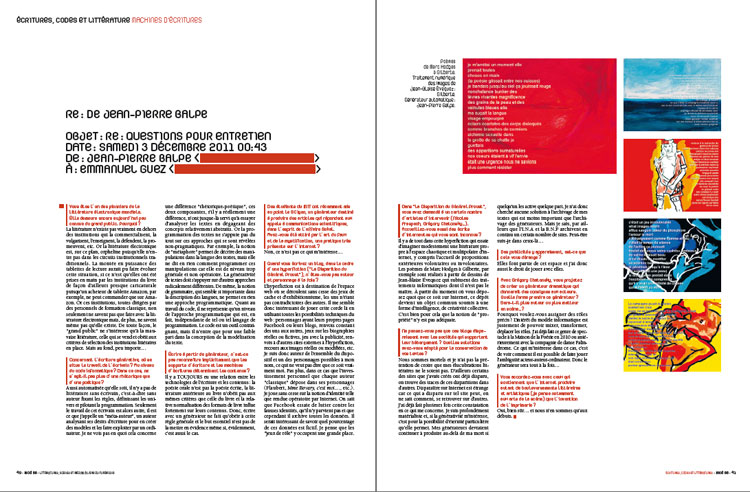
Jean-Pierre Balpe ou les Lettres Dérangées, 2005. Photo: D.R.

You’re one of the pioneers of world electronic literature. It still remains relatively unknown to the general public. Why?

Literature doesn’t really exist outside of the institutions that commercialize it, vulgarize it, teach it, defend it, promote it, etc. Electronic literature is an orphan in this case, as it doesn’t fall within traditional institutional channels. The rise in power of e-readers could have changed this situation, except that they were taken over by book institutions in an almost caricatural way—an Amazon Kindle buyer, for example, can only order from Amazon. Moreover, these institutions, which are all directed by staff with conventional training, not only don’t know what to do with electronic literature, they don’t even know that it exists. Anyway, the « general public » is only interested in bad literature, the kind that sells and corresponds to the selection criteria of established literary institutions. But in the end, it doesn’t really matter…

In regards to generative writing, where does the writer’s work come in? During the coding? In this case, isn’t it more about rhetoric than poetry?

No matter how automated, there is no literature without a writer, that is to say, without an author determining the rules, defining the world and piloting the programming. Only, this writer’s job is more than that, he’s what I call a « meta-author », an author who analyzes his writing desires in order to create models and exploit them with a computer. I don’t see how this is about the difference between rhetoric and poetry; these two elements, if there really is a difference, have so far only served people trying to analyze texts by extracting relatively abstract concepts. Programming texts is not at all based on these approaches, which aren’t practical. For example, the notion of « metaphor » allows us to describe manipulations in the language of the texts, but it doesn’t say anything about how to program these manipulations, because it’s on a level that’s too general and non-operative. Generating texts must rely on other, radically different approaches. Similarly, the notion of grammar, which seems so important in describing languages, doesn’t in any way inform a programming approach. As to the coding, it only represents one level of the programming approach, which is actually independent of any one programming language. The code is a restrictive tool, but it only plays a small part in designing the modelization of the text.

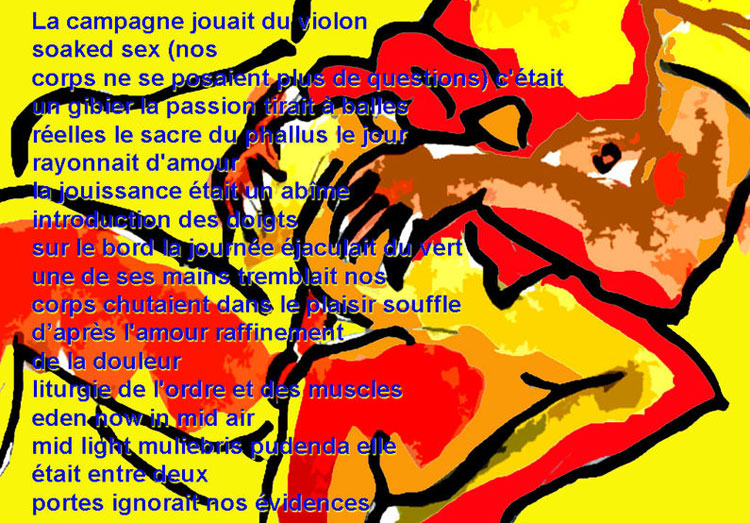
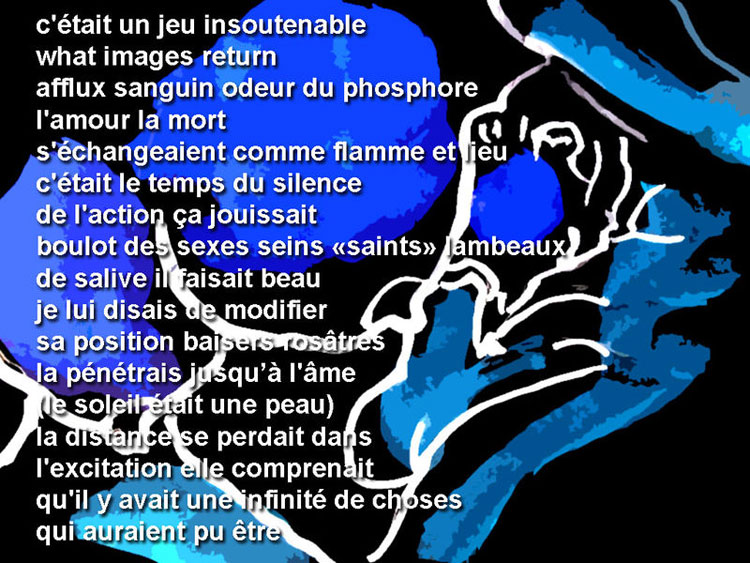
Poèmes de Marc Hodges à Gilberte. Traitement numérique des images de Jean-Blaise Évequoz : Gilberte. Générateur automatique : Jean-Pierre Balpe. Photo: D.R.

Isn’t writing from a generator implicitly recognizing that writing media and writing machines determine the content?

There has ALWAYS been a relationship between writing technologies and content. Oral poetry is not written poetry, literature before the book doesn’t follow the same criteria as after the book, and the relative standardization of book formats strongly influences their content. So, writing with a generator simply follows this general rule, and the main goal is not to make it obvious, even if, obviously, it’s also the case.

Some MIT students developed SCIgen, a generator of Computer Science research papers that can be submitted to conferences, in the spirit of the Sokal affair. Have you been attracted to the art of forgery and spoofing, a practice that is rampant on the Internet ?

No, that’s not what I’m interested in…

When you write a blog for a hyperfiction (La Disparition du Général Proust), are you not both author and character?

Hyperfiction is made for the Web, a space of constant games of hiding and exhibitionism, where none of these are contradictory. I thought it would be interesting to play with that aspect by using all the technical possibilities of the Web: characters with their own Facebook pages or blogs, constant references among themselves, ambiguities between real and fictitious biographies, advertising spoofs, links to other sites outside the hyperfiction, employing both real and modified images, etc. I am therefore the author of the whole set-up and one of the possible characters who bears my name, which doesn’t mean that it’s really me. Not any more in this case than the personal investment that every « classic » author puts into his characters (Flaubert, Mme Bovary, c’est moi…, etc). I am always playing with the notion of identity as it is rendered operational on the Internet. We know that Facebook tries to combat false identities, that it hasn’t succeeded and that meanwhile it archives all the data. It would be interesting to know what percentage of this data is fictitious. I believe that « role-playing games » take up a lot of that space.

For La Disparition du Général Proust, you asked a few artists (Nicolas Frespech, Grégory Chatonsky…) to participate. Do you also welcome writing from people on the Internet who are unknown to you?

There’s a bit of everything in this hyperfiction, which modestly tries to imagine a literature specific to the chaotic and multipolar space of the Internet, including welcoming voluntary or involuntary outside suggestions. The poems of Marc Hodges to Gilberte, for exemple, were based on drawings by Jean-Blaise Évequoz which underwent digital treatment that was beyond his control. From the moment you upload anything to the Internet, it becomes a common object that is subject to a form of collective intelligence and creativity. This is precisely why the notion of « property » is inadequate.

Poèmes de Marc Hodges à Gilberte. Traitement numérique des images de Jean-Blaise Évequoz : Gilberte. Générateur automatique : Jean-Pierre Balpe. Photo: D.R.

Aren’t you afraid that these blogs will disappear along with the companies that host them? What solutions have you found for the preservation of your texts?

We are mortal, and I don’t have the pretension of believing that my literary lucubrations will be any exception. In fact, some of the sites that I created have already disappeared; you can find traces of these disappearances on other sites. Disappearing on the Internet is strange, because what has disappeared on one site can somehow turn up on others. I’ve already noticed this several times concerning my own work. I am deeply materialistic, and if I’m interested in generativity, it’s for the particular possibility of eternity that it allows. My generators should continue to produce beyond my death if someone activates them somewhere. For this reason, I haven’t searched for any solution to archive my texts that is less important than archiving the generators. But I also know that the Institut national de l’audiovisuel (INA) and the National Library of France continuously archive a certain number of sites. Perhaps I’m already among them…

Advertisements appear, does that bother you?

They are part of this space, and I’m allowed to play with them too.

You’re planning to work with Grégory Chatonsky in creating a drama generator that will give directions to the actors. What form will this generator take? Will it be more author or more director…?

Why do you want to assign specific roles? What’s interesting about the computer model is precisely being able to mix, transform, shift the roles. I already did this type of show at the Maison de la Poésie in 2010, or before with the Palindrome dance company. What interests me in this case is to see how I can play on the actor-author-computer ambiguities. So the generator will be everything at once…

Do you agree with those who claim that the Internet will produce as many great changes in literature and the arts (I’m thinking especially of the performing arts) as the invention of print?

Yes, of course… and we’re only at the beginnning.

Emmanuel Guez
published in MCD #76, “Writing Machines”, march/may 2012

in French, and a few others too…

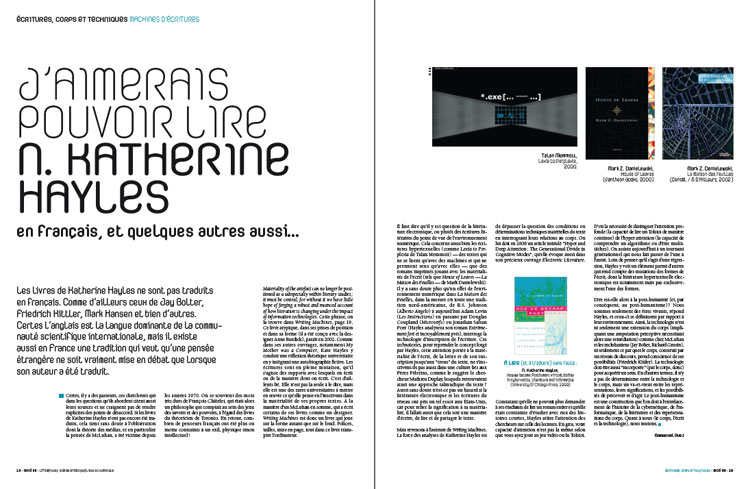
Katherine Hayles’ books are not translated in French. Neither are those of Jay Bolter, Friedrich Kittler, Mark Hansen and many others. English may be the dominant language of the international scientific community, but in France, foreign theories are traditionally not debated until after their author has been translated.

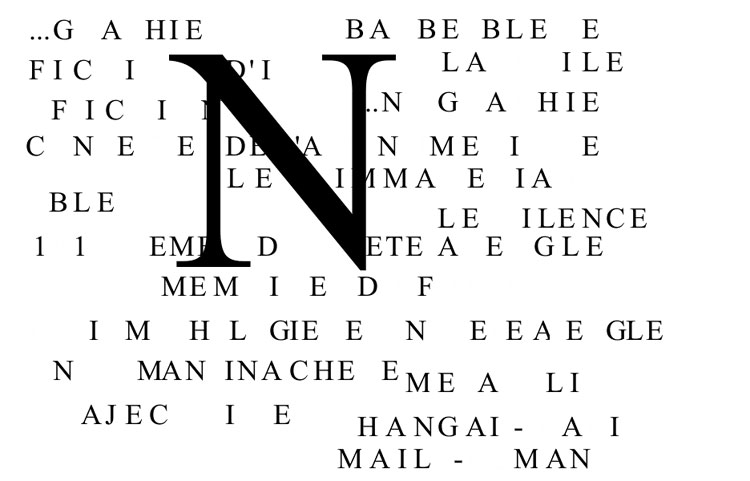
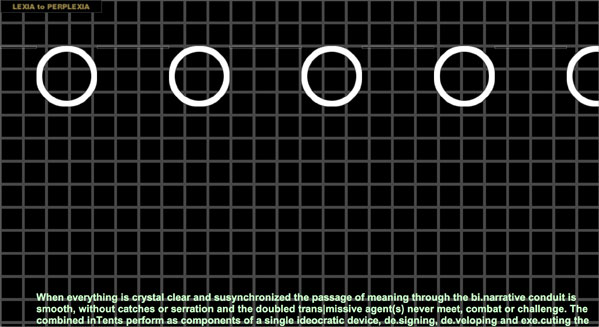
Talan Memmott, Lexia to Perplexia, 2000. Photo: D.R.

Of course, there are the smugglers, those researchers who in exposing their topics also quote their sources and are unafraid of making explicit points of disagreement. If Katherine Hayles’ books have not yet been translated, it is undoubtedly due to the same obliteration suffered by media theory, and in particular the theories of McLuhan, since the 1970s. We may recall the harsh words of François Châtelet, then a philosopher at the center of knowledge and power circles, regarding the Toronton theorist. In return, how many French thinkers have been more or less forced into physical if not intellectual exile!

Materiality of the artefact can no longer be positioned as a subspecialty within literary studies; it must be central, for without it we have little hope of forging a robust and nuanced account of how literature is changing under the impact of information technologies. This sentence appears in Writing Machines, page 19. This atypical book, with its opinionated views and particular format (designed by Anne Burdick), was published in 2002. As in her other works, such as My Mother was a Computer, Kate Hayles integrates fictitious autobiography into her academic theory. The act of writing is mutating, from the devices on which we write to the way in which we write. It’s all connected. She may not be the only one to say it, but she is one of the rare academics who practices what she theorizes by inscribing it into the materiality of her own texts. Much like McLuhan, who wrote many of his texts like a designer. Writing Machines is one such book that plays with both form and content—fonts, size, layout, everything in this book conveys the computer.

We are talking here about electronic literature, or rather, literary writing from the perspective of the digital environment. This concerns as much hypertext writing (such as Lexia to Perplexia by Talan Memmott)—texts that can only be read with machines, which give them their meaning—as printed novels that play with the material aspects of writing (such as House of Leaves by Mark Danielewski). No doubt more than the digital environment played a role in House of Leaves, however, as there has been a whole tradition of North American novelists—from B.S. Johnson (Alberto Angelo) to today Adam Levin (The Instructions), Douglas Coupland (Microserfs) and Jonathan Safran Foer (Hayles analyzed his novel Extremely Loud and Incredibly Close)—questioning the technology of writing itself. These technotexts, to reprise the concept forged by Hayles, this attention drawn to the materiality of writing, from the letter and its inscription to the « holes » in the text—is it not, as suggested by the researcher Mathieu Duplay, also part of a culture linked to the Pilgrims, who found in this focus a Talmudic approach to text? It’s also no coincidence that electronic literature and online writing have been so successful in the United States, for in order to link meaning to materiality, it also had to be a way of writing, of reading and of sharing the text.

But let’s come back to the author of Writing Machines. The strength of Katherine Hayles’ analyses is that they go beyond the material technical conditions or determinations of the text by questioning their relationship to the body. In 2008 she wrote an article titled « Hyper and Deep Attention: The Generational Divide in Cognitive Modes », which she also referred to in her great work Electronic Literature. After noticing that she could no longer ask her students to read a whole novel and was limited to studying short stories with them, Hayles called researchers’ attention to that of the readers. Basically, your attention capacity is not the same according to whether you have played video games or read Tolstoy. Hence the necessity to distinguish between deep attention (the capacity to read Tolstoy continuously) and hyper attention (the capacity to understand an algorithm or to multi-task). We are witnessing a generational turning point from one to the other. Far from considering it a form of regression, Hayles sees it as one of many elements demonstrating the mutation of writing forms, including electronic literary hypertext.

Have we then entered a post-human (and by extension, post-humanist) era? We are only living beings, replies Hayles, and we define ourselves in relation to our environment. Technology is neither a mere extension of the body (implying an amputated perception that needs to be remedied), as suggested by McLuhan and his disciples (Jay Bolter, Richard Grusin), nor that by which the body, constructed from a network of discourses, becomes aware of its possibilities (Friedrich Kittler). Technology must also be « incorporated » (by the body) to acquire meaning. In other words, there is no determinism between technology and the body, only a back-and-forth between representations, their meanings and the possibilities of perceiving and acting. As to us (body, writing and technology), we’re mutating.

Emmanuel Guez
published in MCD #76, “Writing Machines”, march/may 2012

Further reading:
Katherine Hayles, How We Became Posthuman: Virtual Bodies in Cybernetics, Literature and Informatics (University of Chicago Press, 1999)

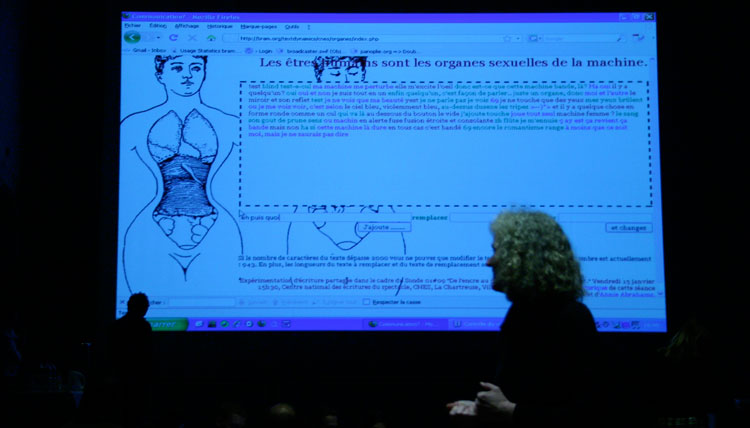
Three pages of php, 20 connected computers, just as many people writing together for 30 minutes, adding and deleting three texts. In 2009, at La Chartreuse in Villeneuve lez Avignon, the Net artist Annie Abrahams presented three experiments in shared writing.

The live audience observed a strange phenomenon: the act of writing in which they were participating had become a combat. The final text was destined to be read. That meant that, in order to be read, each participant had to elbow their way through, by modifying and deleting the words of others, by writing faster and longer than the others, by seizing the kairos, that opportune moment which leads the winner to victory.

As is often the case, Annie Abrahams’ devices and protocols make people write like crazy. « Make » them write, because for the past few years, her writing machines don’t write, they make people write. Annie Abrahams has been a Net artist for 15 years. Her digital literary works and online art (Being Human, 1997-2007) already spoke about the painful relationship between the body and the machine. Since 2007, the artist has been doing online performances that involve other people’s faces. In order to question loneliness.

It’s not obvious that interconnected machines have eliminated loneliness. On the contrary. Human relationships are built on one’s attentiveness to another, to their gestures, their rhythms, their face, and not on what they want to tell or show us through the intermediary of the Internet.

With extremely precise and repeated protocols, involving very diverse personalities, Annie Abrahams’ online performances, such as The Big Kiss (2007), Huis Clos/No Exit (2009) and Angry Women (2011), refuse to flatter the utopias of a society that is pacified and content with mere machine play. Annie Abrahams begins at the beginning, that is, with intersubjective relationships—the affects and affections, as Spinoza would say. In short, she starts with ethics to better meet politics.

Emmanuel Guez
published in MCD #76, “Writing Machines”, march/may 2012

Shattering Timelines

Reinventing the past in terms of the future, placed under the specter of the great Philip K. Dick, the most disjointed science-fiction and fantasy uchronias shatter the linear timeline of literary narratives. Now, they link to the samples and hypertexts of the digital age…

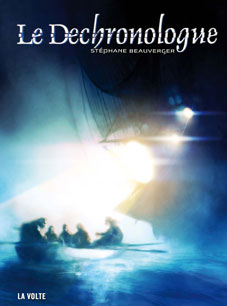
1648. Here we are in the pirate world of Stéphane Beauverger’s Le Déchronologue (1). François Le Vasseur, a former privateer turned governor of Turtle Island, is literally obsessed by these maravillas yanked from the future: true-to-nature geographic maps, turntables, electric lamps, radio transmitters and other tubes of cinchona. Henri Villon, a freebooter whose ship expels from its own century the temporal interferences of fleets from other eras, offers the autocrat a poisoned gift: a book from future times to bear witness to the destiny of the illustrious characters who will make Caribbean history and where we duly find François Le Vasseur, governor of Tortuga since 1640, along with the year, place, day and manner of his death. Fatal consequence: after a night of mental suffering faced with the inevitable announcement by ink on paper, the candidate shoots himself in the head, finally relieved to have invented a different demise from the one history had promised him.
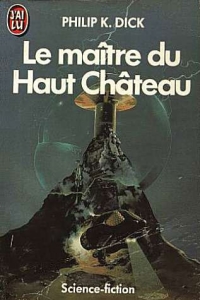
Fallen into the past, the history book of the buccaneers changes the character’s present, which should in return change history and therefore mess up this book of the future bearing (false) witness to Le Vasseur’s past. Like the other maravillas, this rare object is at once a sample and a virus. It’s a specimen from the future, where the sample is first a theoretically well-determined ersatz product from the past, used in the present for creative means. And it’s a virus digging a hole in time. In fact, it shatters the unshakeable logic of its timeline as in another book within the book—in Philip K. Dick’s The Man in the High Castle (2), a uchronia where World War II has been won by Germany and Japan, an illicitly distributed book affirms that the conflict has been won by the Allies: The Grasshopper Lies Heavy.

The sequential logic is broken by theoretically impossible intrusions from a time to come in the today of the book, and even a yesterday reinterpreted by the author, for example the breakthrough of Alexander the Great, imagined in 1640 in the oceans of Le Déchronologue. In an elegant find, Stéphane Beauverger’s printed book begins from chapter I (1640) to chapter XVI (1646), then goes back down from XX (1649) to IX (1641). In other words, its « linear » flow is « delinearized ». It’s possible to read Le Déchronologue while disregarding the timeline, according to the sequential logic suggested by the author, or on the contrary in the classic way, from chapter I to XXV, but while building one’s own narrative flow beyond the order of the pages.

In a way, the patchworked YouTube collage matches that scene in the second novel of Michael Moorcock’s trilogy The Dancers at the End of Time, where a dandy from the distant future and musket-toting extraterrestrials raise havoc in London, in the Café Royal frequented by H.G. Wells at the end of the 19th century. As B-literature for fantasy or science-fiction series, the uchronia doesn’t try to revolutionize the form of the printed text itself in the now legendary manner of a Raymond Queneau or experimentations by Oulipo. Of course, we do find nice ideas, like these excerpts of more or less invented novels which seem to live their own lives in bold type at the heart of Jasper Fforde’s The Eyre Affair (4). But the double-page blank that suddenly interrupts the original edition of Charlotte Brontë’s novel Jane Eyre, following an offense to fiction, is staged, not at the heart of the book… but on Jasper Fforde’s website!
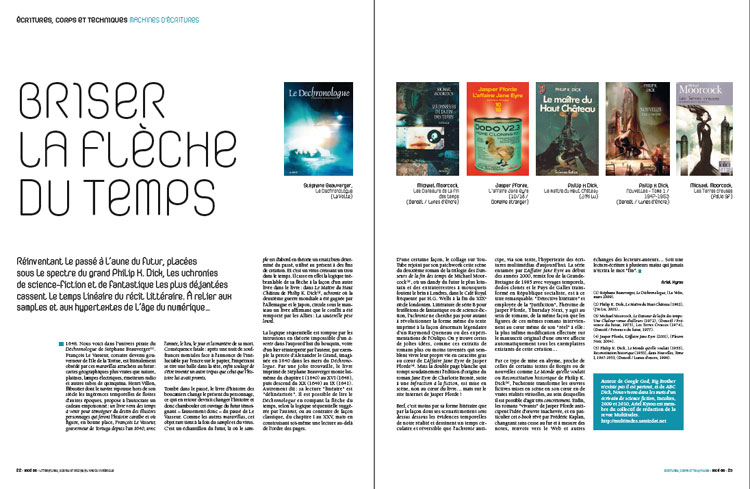
In short, it’s not so much through their literary form as the way their plots turn our chronological reality upside down and elaborate a circular, reversible time that uchronias anticipate the multimedia hypertext writing of today. As such, the series that begin with The Eyre Affair in 2001, crazy remix of Britain in 1985 featuring time travel, cloned dodos and Wales as a socialist republic, is particularly remarkable. A « literary detective » employed by the « Jurifiction », Jasper Fforde’s heroine Thursday Next operates within novels, while the characters in these same novels intervene in her own « reality »—the most infinite change in the original manuscript of a work automatically affects all existing copies…

Through this approach in perspective, similar to that of certain texts by Borgès or of short stories such as Philip K. Dick’s The World She Wanted and Exhibit Piece (5), uchronias transform fictitious works set within them into true virtual realities, in which it is possible to act very concretely. Finally, Jasper Fforde’s « living » novels anticipate the concept of an unfinished work, and in particular the e-book dreamed by Frédéric Kaplan, which changes constantly according to notes, Web links and other exchanges between readers and authors—in other words, reading and writing by many hands, which will never write the words « The end ».

Ariel Kyrou
published in MCD #76, “Writing Machines”, march/may 2012

Author of Google God, Big Brother n’existe pas il est partout, and of ABC Dick, Nous vivons dans les mots d’un écrivain de science fiction, Incultes, 2009 and 2010, Ariel Kyrou is a member of the writing collective of the review Multitudes. http://multitudes.samizdat.net/

(1) Stéphane Beauverger, Le Déchronologue, (La Volte, March 2009).
(2) Philip K. Dick, The Man in the High Castle (1962).
(3) Michael Moorcock, The Dancers at the End of Time: An Alien Heat (1972), The Hollow Lands (1974).
(4) Jasper Fforde, The Eyre Affair (2001).
(5) Philip K. Dick, The World She Wanted (1953), Exhibit Piece (1953).