Archive d’étiquettes pour : MCD#66 v eng

there is no predicate « this is literature »
Several times in your texts, you emphasize the strength of the ecosystem of reading. As a publisher, how do you feel our digital environment has changed our relationship with reading?

I’ve been working with texts in digital format almost since I’ve had a computer, in 1988. But it was a work relationship. The first e-readers (for me, the Sony, in 2008) allowed us to read continuous prose as comfortably as a paper book. But the ergonomics weren’t really perfected yet. Now, both because we know how to make epubs that are comfortable and stable (more or less the same on any reading device) and because the devices themselves have evolved, we can forget about them. You have it in your pocket, you don’t think about going to buy a newspaper or a paper book anymore. The iPad became the first companion for personal reading, but since the recent arrival of the Odyssey, the Kobo, I’ve gone back to reading on dedicated e-readers. These devices are good, because now we forget them—it’s paper books that we find annoying, when we have to shlep one around, or when we have the reflex to click on a word with our finger to call up the dictionary or the search engine.

Again, as a publisher, you strongly oppose DRM. Aren’t you afraid that the same thing will happen to e-books as with music, that is, widespread sharing with free access via P2P (what we commonly call « piracy »)?

Let’s stop using the word « afraid ». I’m afraid to walk down the stairs, so I stay upstairs. It’s not about being afraid of piracy, it’s about continuing to make contemporary literature desirable and demanding. The notion of ecosystem is used in the context of the Internet, where we offer access to our creative studio, and thus to a large free portion of our works. But with e-books—for example, but not only—we can offer a « service », a commodity of access, which can also include shared annotations, updates, expanding works that make peer-to-peer dissuasive or useless.
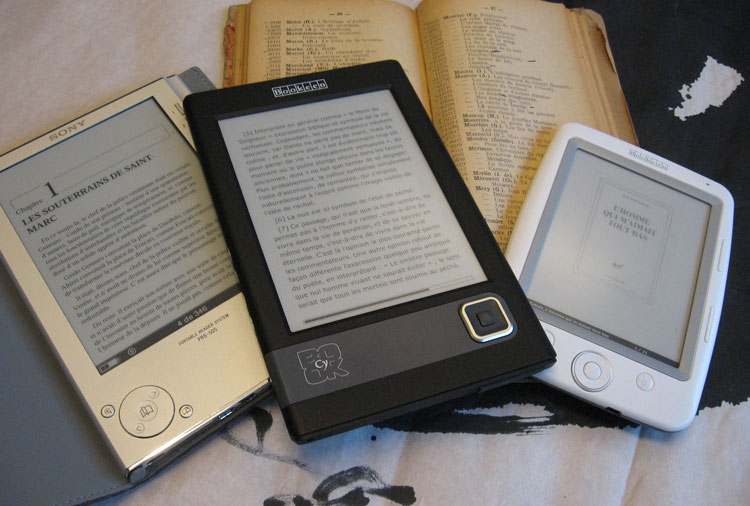
Liseuses électroniques. Photo: D.R.

Liseuses électroniques. Photo: D.R.

Considering the philosophy of access rather than possession, aren’t you afraid that access to books—and therefore to knowledge, culture, art—is concentrated in the hands of companies, which are themselves quite concrete and can disappear from one day to the other, thus depriving readers of access to the texts?

There it is again, the word « afraid »: I’m afraid of Nestlé, so I don’t buy milk for my kids. Yes, we face a centralized distribution system, whose reason for being is far from humanistic. It’s the same for car sellers. But we can tell ourselves, on the contrary, that we invest in them, that we use their tools not only to authorize access to our work, but also to promote it. That’s what we do, and often in dialogue with them. The question  is confusing; perennial access has nothing to do with it. The role of libraries, having our own servers complement or mirror those of digital libraries, even if my computer gets run over by a truck, or if Apple stops distributing e-books tomorrow, makes no difference.

Aren’t libraries the guarantee? Meaning that libraries will also have to go through their digital revolution?

Why use the future tense? Fortunately, they didn’t wait for the shockwaves to rethink their profession in digital terms. It still involves the tasks of mediation, orientation, the notion of public service in access (when large university campuses such as Nice, Montpellier or Strasbourg give each connected student integral access to Publie.net). If the librarian’s job were only to index, bind and lend books, what’s the point?

As a writer, in a 2006 interview for Le Magazine Littéraire, you wrote: It’s surprising how much the literary world distrusts the Internet. Do you believe that it’s still true?

It seems evident to me, at least if I compare it with artistic professions such as musicians, or scientific professions (excluding academic literary departments, which are even more behind). Most print writers tend to have the polar bear syndrome, with their claws firmly gripping the melting, drifting glacier. But of course, the environment has changed in the past five years. The authors who have emerged, and who have begun publishing since then, came with their digital habits, their blogs, and they know very well that if you want to know what’s going on, best go online.

In a way, couldn’t we say that the Internet « transpires » through today’s writers? I’m thinking of the recent cases of plagiarism: « Hegemann » in Germany and « Houellebecq » in France?

Those plagiarism cases are nothing but headline fodder for failing newspapers. We always write with what has already been written.
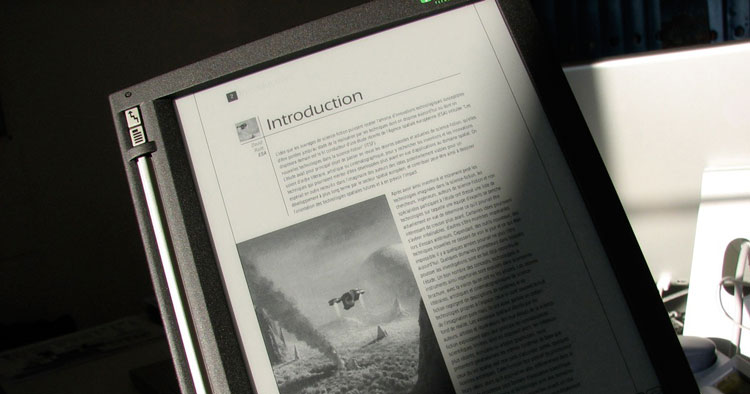
Liseuses électroniques.

Liseuses électroniques. Photo: D.R.

One of your articles, reprised in your latest work, after the book, is titled (writing) that comments are not writing at the bottom. It’s a beautiful formula. Do you think that comments enrich the text as an integral part of it? In other words, that writing a blog entry is more of a process than a definitive act? Do you think we’re returning to a form of orality in writing?

Literary history, and not just Jewish tradition (like the Zohar), has always included its own commentary, what Maurice Blanchot called « the infinite conversation ». The difference is that reading/writing in one word can now fit on the same device, be perfectly symmetrical in those positions, and intervene before publication, where it’s the construction site itself that is published. We don’t change the collective body of literature, which is also compatible with the « essential solitude » of the author—I’m thinking of the conversations noted by Kafka, the 3,000 letters left by Beckett—but this collective body can go beyond the private sphere, not have to wait for publication as hierarchy.

A question for both the publisher and the writer in you, one that you’ve been asked many times, but I can’t resist: Do you think that the notion of author has evolved under the influence of not only digital publishing but also digital writing?

The notion of author, no. The notion of writer, yes. This term was invented in the 17th century, in the context of a specialized function and what it generated. Over the course of the 19th century, with the commercial development of literature, it gradually gained a more fetichistic or symbolic value. Of course, with the Internet, we start over again at zero.

Now I’m thinking about the art of mixing, appropriation, sharing… Do you think that the notion of authorship has changed with the flow and Web 2.0? In other words, don’t you think that with the Internet, collective writing has become reality?

Collective writing didn’t wait for the Internet to become reality. Examples abound, beginning with the surrealist adventure. What is fascinating—and I say this more as a viewer—is to see Web experiments that allow very new forms of collective realization, and that it’s quite compatible with the deep, solitary commitment of those who participate in it.

Do you think that hypermedia literature is literature? Don’t you think that this type of literature suffers from a lack of publishing? Why hasn’t Publie.net done anything about it? Is it an economic problem?

There is no predicate « this is literature ». That’s why we need to constantly verify our assumptions. Neither Madame de Sévigné, nor the bishop Jacques-Bénigne Bossuet, nor Saint-Simon wrote for literature. It’s a constantly retrospective construction. On the other hand, I seriously invite you to come visit Publie.net, as the iPad is a great invention for « hypermedia » experiments—except that, precisely, we don’t need to call them anything so barbaric. We simply call them « books », period.

Writers have always integrated their medium (without always questioning it). In France, writers such as Mallarmé and Apollinaire questioned the letter and the page. In American literature, B.S. Johnson cut holes into his Albert Angelo, Douglas Coupland played with fonts and pagination, Mark Danielewski turned the book upside down, etc. In what way is e-publishing a new medium for writers to explore?

You’re a child in front of a candy store. A very serious man asks you the question: In what way is a candy store a new medium for children to explore?
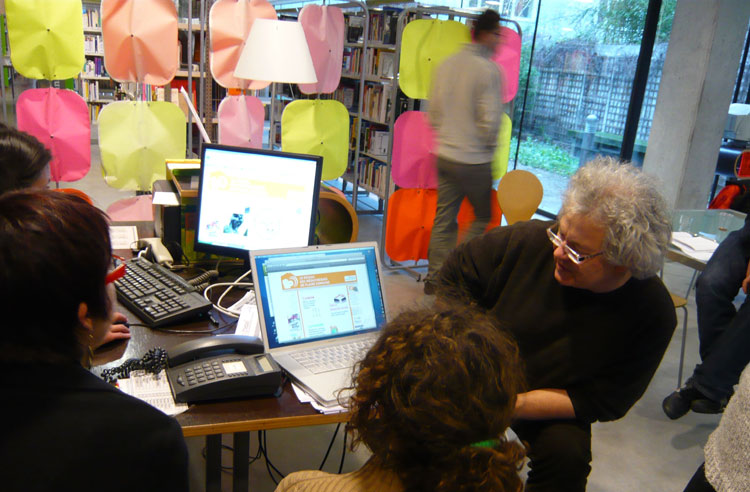
François Bon à la médiathèque de Bagnolet, 2009.

François Bon à la médiathèque de Bagnolet, 2009. Photo: D.R.

Literary and media Friedrich Kittler wrote in 1985: literature, which formerly ruled under the name of poetry above all other media, is now defined by other media. What do you think?

Couldn’t care less. Patter for a professor paid in career points after publication. If that’s the exact sentence, taken out of context, then this guy must not have read a whole lot.

In general, do you think that writing and reading machines (printing, typewriters, PCs and now tablets…) determine the way we write?

No, it’s our head that determines it. And urgency. And the notion of beauty. And the notion of our own experience among others. And our passion in language. And what we make from it.

Bonus question: You are one among that rare breed of writer-publishers. How do the writer and the publisher live together?

It’s the Old World that determines these partitions. They’re very recent. There are dilemmas that are never easy to resolve, for anyone, anywhere, regarding the relationship between work and personal time, including the tunnels, in relation to more collective involvement. Similarly, we don’t read the same way if we’re in the middle of writing something, or in a certain phase of writing. I launched with some friends a digital publishing cooperative, because we vitally needed to experiment, to have our own space for textual invention—including (but not only) because of the inaction or frigid hostility of our own publishers (it’s different now, they smell the cake). But it wasn’t in order to play out an entrepreneurial model, or the paternalism of publishing houses that we had known, or even the « economic models » and other bullshit. Writing is intransitive, said Maurice Blanchot. Let’s assume this intransitivity where we « already » have our territory for reading, writing and experiencing the world: online.

Interview by Emmanuel Guez
published in MCD #76, “Writing Machines”, march/may 2012/p>

François Bon: www.tierslivre.net
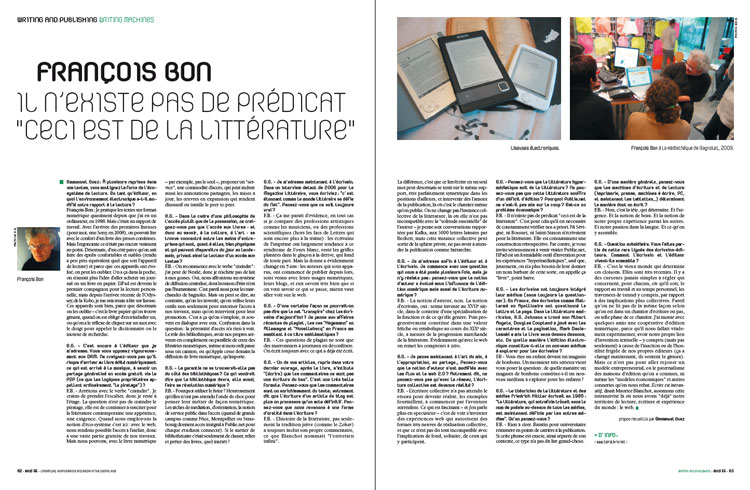
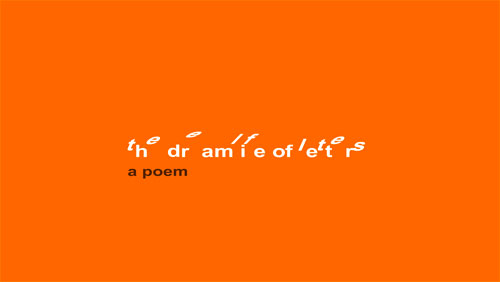
the dream life of digital letters

This will kill that. Such were the words used by a distraught priest in Victor Hugo’s Notre-Dame de Paris to express his anxiety over the fact that books would one day replace religious architecture. These days, there are fears that « this »—digital media—will lead to not only the disappearance of « that »—books—but above all the degeneration of certain forms of expression, and more specifically, of literature.

The Dreamlife of Letters, Brian Kim Stefans, 2000. Photo: D.R.

At a time when tablets are still transforming our reading habits, it seems particularly important to question the existing forms and potential of digital literature. I will not, however, establish any type of competitive relationship. Certain forms of literature continue to be writtern and read on paper; others have begun (ever since Theo Lutz’ Stochastische Texte in 1959) to experiment with the new dimensions brought to text by digital media. I will review of a few of these dimensions, with regard to their poetic potential. Literature written for digital media first took off in the 1980s and ’90s with the appearance of magazines (such as alire) and the creation of authors’ associations (such as the Electronic Literature Organization). The last few years have seen a growing number of festivals and anthologies.

Poetic machines before the letter

While digitally native, this literature belongs to the avant-garde tradition of trangressing the frame of the paper page with hypertexts and randomness « before the letter ». As early as the 1950s, the authors of OuLiPo (Ouvroir de Littérature Potentielle) had cut up poems into strips to show the importance of randomness in the creative process (see Raymond Queneau’s Hundred Thousand Billion Poems) and were among the first to consider computers as « automatic generators » of poetic texts. In terms of narration, the first digital experiments were often inspired by the tradition of the Nouveau Roman. Hypertext seemed like the dream machine to allow the text to expand in a complex web of interlaced temporalities and causalities. Today, the paradigms of the « poetic machine » and hypertext-fragmentation are still relevant; I would even say that we are only beginning to know how to « read » hypertext. Nonetheless, the arrival of hypermedia has also given rise to emerging literary forms that explore the borders between literature and visual arts.

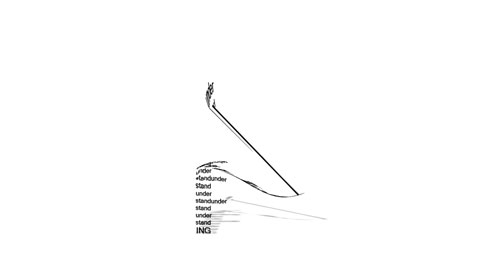
Stand under, Glia.ca, 2009. Photo: D.R.

Moving text

Certain works experiment with moving words and letters, which more or less act upon the meaning of the text. In Alison Clifford’s The Sweet Old Etcetera (1), the word « grasshoppers » hops onto the screen, and the double « o » of the word « look » appear and disappear like blinking eyes. I’ll call this quasi imitative relationship between text and movement « cine-gram » (in reference to the calligram). In other cases, the movement not only imitates the meaning of the text, it opens it up to new meanings, in a non-illustrative manner that recalls figures of speech such as metaphor. These I would call « cine-tropes ». For example, in David Jhave Johnston’s poem Stand Under (2), the words « under » and « stand » are unbearably stretched out and then compressed. Both inseparable and incompatible, the relationships between text and movement seem, at least in part, to escape interpretation. What remains then between text and movement is an impression of (de-)coherency: a free space in which I would situate the poetic potential of animated text.

Touch text

Other spaces of (de-)coherency have emerged from the relationship between texts and interactive gestures. In Philippe Bootz’ Le Rabot poète (3), the reader is invited to literally « plane » the surface of a poem using the cursor as a tool. This relationship between the gesture and « erased » effect visible on the screen could seem purely imitative, and thus constitute a « kine-gram » (again in reference to the calligram). However, certain words have a surprising relationship with the gesture—for example, the reader is invited to « plane » the words « you part these waters », even though water is not a planable material. Does this (de-)coherency between gesture and text escape all understanding? Perhaps not. Contrary to what online scratch games would have us believe, digital matter never gives in to our interactions. Thus, Le Rabot poète seems to warn the reader that his gesture is effectively futile. This impression of futility is further reinforced by the fact that the poem continues in the same way if the reader stops planing. This is how digital literature can sometimes be impertinent, resistant, even political—far from inviting the reader to play a frivolous word game, the interface challenges the reader’s reflexes and expectations, prompting him to question the « givens » of digital media. This questioning is all the more salutary when digital literature is occasionally accused of collaborating with the economic world, already using its machines and creative tools.

Bordering on disappearance

A third characteristic of digital literature is its multimedia nature. I won’t go into the complex relationships between text, image, sound and video in these « e-forms », but I will cite an emblematic example that shows both the potential and the possible risks for text. In Reiner Strasser’s In the white darkness (4), the reader activates images and fragments of text through a graphical interface. The word « remember » emerges, for instance. The letters are filled with images; « m » contains a child’s face. In a brief note, the author explains that he observed the development of Alzheimer’s disease over a period of several weeks. Based on that experience, he created this interactive visual poem, which sensitizes people to the fragmentation of memory, the slowness and despair of (de-)coherency, but also to the fading softness of the last memories. The result is a magma in which the text inexorably dissolves into graphical material, even if it remains present in the computer program of the work.

Programming text

This relationship between the visible text and the computer program is sometimes difficult to apprehend. Every work of digital literature depends on a program, even if the reader doesn’t see it in action on the screen. Because of machines’ ever-increasing processing power, the program is not necessarily executed in the same way on every computer, making digital literature fundamentally fragile, even ephemeral. Some 20-minute animations created in the 1980s are now almost unreadable as they speed across the screen in a matter of seconds. It’s a problem for conservation, but also a challenge for the authors. Some works are thus designed to slowly « decompose » on the screen. It’s this ephemeral nature that I’m experimenting with in my own pieces (Tramway (5)), by studying this increasing (de-)coherency between visible text and programming in the context of memory. This personal note ends my brief survey of experiments in digital literature. Instead of concluding, I invite the reader to take possession of these free spaces, between empty and meaningful, where digital literature’s poetic potential awakens a new « dream life of letters », always bordering on disappearance.

Alexandra Saemmer
published in MCD #76, “Writing Machines”, march/may 2012

(1) http://duck-egg.co.uk/sweetweb/sweetoldetc.html
(2) http://glia.ca/mp4/standUnder_MainConcept%20AVC-AAC_HI_qtp.mp4
(3) http://www.sitec.fr/users/akenatondocks/DOCKS-datas_f/collect_f/auteurs_f/B_f/BOOTZ_F/Animations_F/rabot.htm
(4) http://collection.eliterature.org/1/works/strasser_coverley__ii_in_the_white_darkness/index.html http://revuebleuorange.org/bleuorange/02/saemmer/
(5) http://collection.eliterature.org/1/works/stefans__the_dreamlife_of_letters.html

about Fréquences – project for iPhone

As soon as I acquired a smartphone, I searched for everything it offered under the term « book ». The applications which resulted from this search were just as numerous as they were disappointing.

Photo: © André Baldinger

Their content: reprises of the great classics (Arthur Conan Doyle, Edgar Allan Poe) or bestsellers (Dan Brown, Mary Higgins Clark). Their form: an outdated animation esthetic, with sepia-toned pages akin to those of a spellbook, accompanied by a page-turning sound effect. Or, in a poorer version, barely formatted raw text, universally accessible and often free, but visually similar to an rtf. What I discovered was frankly an insult to the history (both graphic and editorial) of the book, without anything gained. I dreamed of something more—of a book truly designed for smartphones, which would exploit all its possibilities (visual, audio) and fully assume its format. A portable experimental book that would also be a beautiful book.

Fréquences was born from this desire. It also came out of my encounter with André Baldinger, visual designer and typographer, Sébastien Roux, composer, Martin Blum, multimedia designer, and Graziella Antonini, photographer. Together, we imagined an unclassifiable electronic book that was independent of any standard (eReader, Stanza, etc). After a first stage version of this text initially conceived as an opera libretto (produced in 2004 at La Chaux-de-Fonds, Switzerland, with music by Claude Berset, directed by Fabrice Huggler), we continued to explore this text by imagining it being broadcast on another stage, which would associate creative radio composition and graphic design. The story: a man drives across a winter landscape. We follow the driver’s journey from nightfall to daybreak. He listens to a radio program during which speakers confide fragments of life, pieces of intimacy (see illustration 1).

The text conceived for the stage (with alternating recitatives and arias) was rewritten. Stage directions became sounds or graphic motifs (snow, see illustration 2). We invested in linear, black and white, landscape format, touch-screen buttons triggering images or sounds that act as speed bumps, or offering real pauses, suspensions, in reading. The work is meant to be heard exclusively through headphones for optimal immersion and intimacy. And for each character, we created a particular sound color, or a little melody, as a leitmotiv.

For me, writing for a smartphone was an unprecedented, collective, experience. An experience where the text became an element of a landscape that was both bigger than the text and generated by the text itself. Fréquences is a sensory and cognitive score that has all the elements of a miniature stage play. In this sense, it is an extension of other digital writing experiments, such as the interactive multimedia work by Xavier Malbreil and Gérard Dalmon, the (very beautiful) Livre des Morts.

Célia Houdart (December 2011)
published in MCD #76, “Writing Machines”, march/may 2012

Fréquences – projet pour iPhone. Photo: © André Baldinger

Fréquences – project for iPhone
> www.frequences-livre-audio.net/
text: Célia Houdart
visual design and typography: André Baldinger
sound design: Sébastien Roux
photography: Graziella Antonini
direction and development : Martin Blum | Blumbyte Design
iPhone sdk development: ELAO
production monitoring: Grand Ensemble
production: Stanza
coproduction: Cie D. Houdart-J. Heuclin, Le Phénix Scène Nationale de Valenciennes, éditions P.O.L, La Muse en circuit, Centre national de création musicale
with the participation of Ministère de la Culture et de la Communication-DICRéAM, Bourse Orange-Beaumarchais/SACD formats innovants 2010

short history of radiophonic times

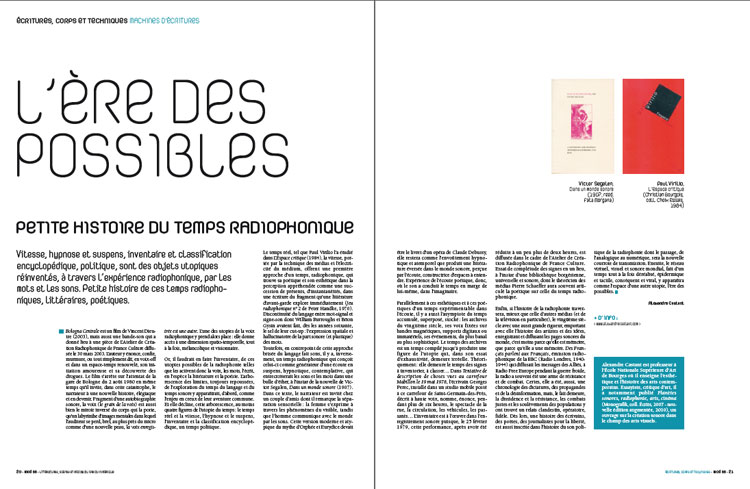
Speed, hypnosis and suspense, inventory and encyclopedic classification, politics, are all utopic objects that can be reinvented through radio by words and sounds. A short history of these radiophonic, literary and poetic times.

Bologna Centrale is a film by Vincent Dieutre (2003), but also a soundtrack that resulted in a piece for France Culture’s Atelier de Création Radiophonique, broadcast on March 30, 2003. In it, the author states, confides, murmurs, or quite simply tells, in voiceover and in a renewed time-space, of his initiation to love and his discovery of drugs. The film ends with the Bologna train station attack on August 2, 1980, just as in the middle of this disaster it invites the narrator to embark on a new story, elegiac and evolving. As a fragment of a sound autobiography, the voice (the grain of the voice) is also an inverse mirror of the body that carries it, a labyrinth of mental images in which the audience gets lost; as close to the microphone as to a new skin, the recorded voice is another. Hence, one of the utopias of the radiophonic voice: it allows access to a dimension of space and time both melancholy and visionary.

Moreover, we would have to inventory all these possible utopias of radio as they are activated by voice, words, writing, in this case literature and poetry. The arborescence of the ever-expanding limits of the exploration of language-time and sound-time would first appear as the deep-rooted essence of their common adventure. And this arborescence would expose at least four figures of the utopia of time: real time and speed, hypnosis and suspense, inventory and encyclopedic classification, political time.

Real time, as studied by Paul Virilio in L’Espace critique (1984), and speed, buoyed by media technology and the electricity of the medium, offer a first approach to a radiophonic time that finds its poetry and its esthetics in a perception apprehended like a succession of presents, of instantaneities, in fragmentary writing that is immediately explored by avant-garde literature (Jeu radiophonique n° 2 by Peter Handke, 1970). This same discontinuity of language between word-signal and sign-sound was in the 1960s what William Burroughs and Brion Gysin made the salt of their cut-up: the spatial and hallucinatory expression of the sound (and plastic) part of words.

Conversely, in counterpoint to this fragmented approach of language made into sounds, there is a radiophonic time that uses this language to generate a suspended, hypnotic, contemplative state of listening, which intercrosses sounds and words in a bubble of ether, as in the short story by Victor Segalen, Dans un monde sonore (1907). In this text, the narrator is invited to the home of a couple whom he remarks are separated by the senses—the woman expresses herself through visible phenomena, while the man communicates with the world by sounds. This modern and atypical version of the Orpheus and Euridice myth should have been the libretto for an opera by Claude Debussy; instead it will endure as the hypnotic and timeless spell produced by a literature everted into the world of sound, perceived by listening, as it builds sonorous spaces. In this experience of poetic listening, sound has led time astray into the imagination.

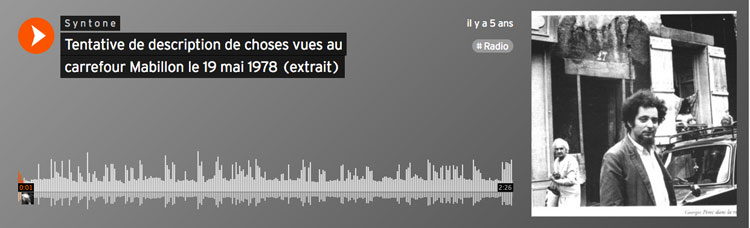
Parallel to these esthetics and poetics of a time experimented through listening is the asymptote of accumulated, superimposed, stored time: archives of the 20th century, their voices fixed on tape, digital and immaterial media, their events, from the most ordinary to the most sophisticated. The time of the archives is a time compiled to produce a face of utopia which, in its attempt to be exhaustive, remains unreal. Theoretically, it remains the time of signs waiting to be inventoried, classified… In Tentative de description de choses vues au carrefour Mabillon le 19 mai 1978, the writer Georges Perec, from inside his mobile studio parked at this intersection of Saint-Germain-des-Prés in Paris, describes aloud, names, states, for more than six hours, the spectacle of the street, traffic, vehicles, passers-by… Inventory is at work in sound recording, as, on February 25, 1979, after being reduced to a little over two hours, this performance was broadcast on France Culture’s Atelier de Création Radiophonique. It was an attempt to convey the completeness of signs in one place, much like a Borgesian, universal sound library, whose poetry the media theorist Pierre Schaeffer has often placed above that of radiophonic time.

Finally, if the history of radio, more than that of other media (and television in particular), has spanned the 20th century so thoroughly, carrying along with it the history of artists and ideas, recording and broadcasting the sound pages of the world, it is not so much because it is memory, but because it has a memory. From Les Français parlent aux Français, a BBC radio show (Radio London, 1940-1944) that broadcasted messages to the Allies, to Radio Free Europe during the Cold War, radio has often been a weapon of resistance and combat. Of course, it has also been a chronology of dictatorships, propagandas and disinformation, but the fact remains that dissidence and resistance, fights for justice and uprisings of people have seen it as a clandestine, operative and loyal relay. From then on, a history of writers, poets and journalists for freedom has also been inscribed in the history of radio’s political sound, whose conversion from analogue to digital will be its new belt-drive. Thereafter, the virtual, visual and audio global network, made of a time at once derealized, epidermic and tactile, consequential and viral, will appear as the space of another utopia, the age of possibilities.

Alexandre Castant
published in MCD #76, “Writing Machines”, march/may 2012

Alexandre Castant is a professor at École Nationale Supérieure d’Art in Bourges, where he teaches the esthetics and history of contemporary arts. As an essayist and art critic, he has published Planètes sonores, radiophonie, arts, cinéma (Monografik, coll. Écrits, 2007 – new enhanced edition, 2010), about creative sound work in the field of visual arts. Website: www.alexandrecastant.com

literature in all its media

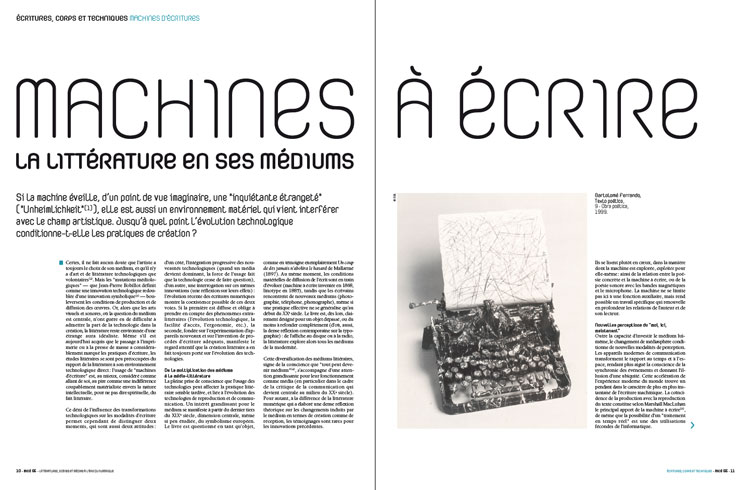
If machines awaken in the imagination an « uncanny strangeness » (Unheimlichkeit (1)), they also constitute a material environment that interferes with the arts. To what extent does the development of technology condition creative practices?

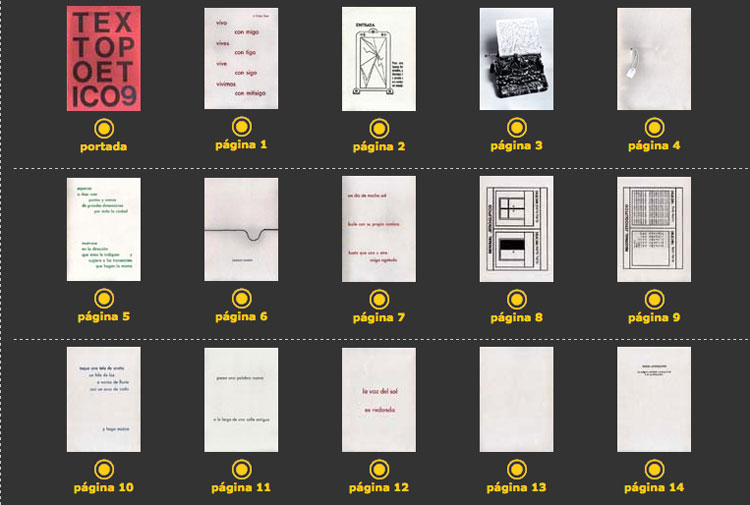
Bartolomé Ferrando, Texto poético, 9 – Obra poética, 1999.

Bartolomé Ferrando, Texto poético, 9 – Obra poética, 1999. Photo: D.R.

There is no doubt that artists have always had a choice in their medium of expression, and that there is only voluntary technological art and literature (2). However, « mediological mutations »—which Jean-Pierre Bobillot defines as a technological innovation reinforced by a symbolic innovation (3)—are radically changing the conditions for producing and distributing works. But whereas visual and sound arts, for which the medium is essential, have had no difficulty admitting the role of technology in their creative process, literature remains surrounded by a strange aura of idealism. Even if it is generally accepted today that the transition to the printing press or mass media has considerably marked writing practices, literary studies have hardly been preoccupied with the relationship between literature and its immediate technological environment. The use of « writing machines » is regarded, at best, as self-evident, at worst, as a guiltily materialistic indifference toward the intellectual, if not spiritual, nature of literary art.

This denial of the influence of technological transformations on the modalities of writing does, however, reveal two distinct movements, which are also two attitudes: on one hand, these new technologies are being gradually integrated (when a medium becomes dominant, its common usage makes technology less of an issue); on the other, these same innovations (and their effects) are being questioned. The recent development of digital writing shows that it is possible for these two movements to coexist. If the first, widespread, takes into account extra-literary phenomena (technological development, accessibility, ergonomics…), the second, founded on experimentation with new devices and the invention of adequate writing procedures, manifests the attention that literary creation has always paid to the development of these technologies.

From multiplying media to media-literature

Full awareness that the use of technology could affect literary practices comes late, and is linked to reproduction and communication technologies. A growing interest for these media emerges in the last third of the 19th century, as an important, if poorly studied, dimension of European symbolism. Books are questioned as objects, as in Mallarmé’s exemplary Un coup de dés jamais n’abolira le hasard (« A roll of the dice will never abolish chance ») in 1897. At the same time, the material conditions for distributing writing evolve (invention of the typewriter in 1868, linotype in 1885), just as writers encounter new media (photography, telephone, phonograph), even if their use is not widespread until the early 20th century. Thereafter, books are clearly designated as outdated objects, or at least to be completely reconstructed (along with a dense contemporary analysis of typography). From poster to record to radio, literature explores every medium of modernity.

As literary media diversify, a conscious sign that « everything can become a medium » (4), they attract more attention to their function as media (particularly in the context of communications criticism, which has become dominant since the mid 20th century). But contrary to digital literature, which developed rich theories on the changes brought about by the medium in terms of both creation and reception, reports on the preceding innovations are rare. Those that do exist are shallow, focusing on the way the machine is explored, exploited for what it is—the same relationship that exists between concrete poetry and the typewriter, or between sound poetry and magnetic tapes and the microphone. Here, the machine is not limited to an auxiliary function but makes possible a specific work, which in turn renews the relationship between the author and the reader.

Bartolomé Ferrando, Texto poético, 9 – Obra poética, 1999.

Bartolomé Ferrando, Texto poético, 9 – Obra poética, 1999. Photo: D.R.

New perceptions of « me, here, now »

Besides its capacity to invest in the medium itself, the changing mediasphere conditions new modalities of perception. Modern communication devices transform our relationship with time and space, sharpening our awareness of the synchrony of events and giving the illusion of ubiquity. This accelerated experience of the modern world finds a parallel in the increasingly instant nature of machine-based writing. According to McLuhan, the coincidence of text production and reproduction is the main advantage of the typewriter (5), just as « real-time processing » is one of the more fruitful uses of computers.

This immediacy, which has also led to the gradual disappearance of crossed-out text (industrially produced paper favors it, while typewriters make it complex and computers erase it), is paradoxically accompanied by a distancing effect. The common characteristic of these communicating machines, which both fascinate and perturb the latter part of the 19th century, is that they lead to depersonalization, or literally, disembodiment. The typewriter obliterates the traces of the handwritten gesture, just as the telephone and the phonograph detach the voice from the body, and photography and film separate one’s appearance from the being that animates it—a phenomenon that recalls the immobile projection of logging in to cyberspace. In the act of writing itself, this dematerialization is also expressed by the growing distance between the artist and the artwork, which Abraham Moles analyzes, in the case of computers, as an « objectification » of language (6).

The paradox is reversed, however, when the double effects of dissociation and exteriorization imposed by the machine bring the body back. Just as the plume or the pen is grasped like a tool and an extension that adapts to the body (the plume fits the hand), typewriting assumes an adaptation of the body (a constraint) that involves a rhythm, a « gesticulation » (7). The rising practice of sound in literature and, to a greater extent, in performance, confirms that machines not only amplify but also reveal the body by manifesting its interiority (François Dufrêne, Henri Chopin). The return of the body through the machine and the emphasis on immediacy coincide with a new way of considering an artistic act, not as that which produces beauty, but as that which, like machines, transforms the world. Hence the more valorized definition of art as « intervention » or « action », which is a common trait among avant-garde practices.

Writing informed by technology

In this rapid overview, we must finally consider the consequences of technology on writing procedures. Many studies attest to the stylistic changes that have accompanied the changing technosphere. Friedrich Kittler reports the claims of several writers who, because of the typewriter, have gone « from rhetoric to telegraphic style » (8). For ergonomic reasons, as much as the intent to translate modern modes of perception or material effects related to the machine, a « technological style » has developed, focused on mechanical procedures. In response to the efficiency, absence of emotion and rhythm of the machine, we find concision, objectivity or a taste for permutation in literature. Language is transformed and accelerated—we « abolish syntax » (9), prioritize the word, even the letter, as this elementary link of language; we give precedence to verbal material, which echoes the new materiality of the act of writing.

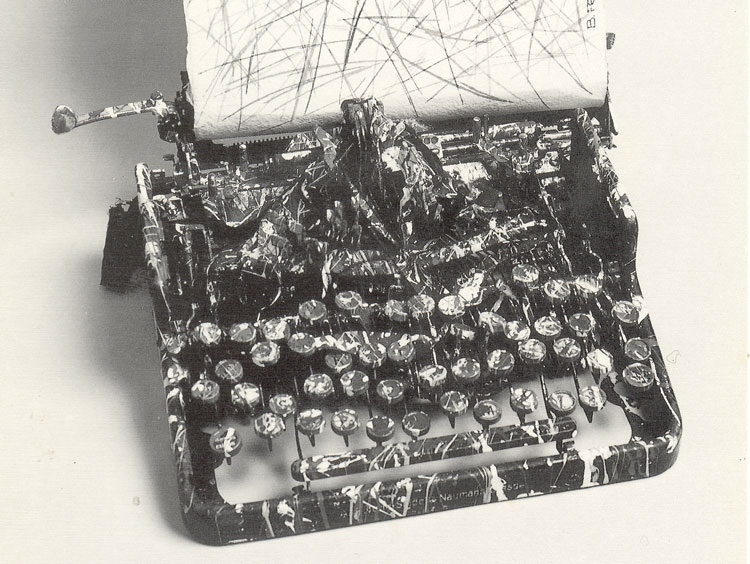
In addition to this « translation » of mechanics, some writers question their relationship with these new media and develop new literary forms, voluntarily dependent on their chosen format. But while the historical avant-garde of 1920-1930 live it as a euphoric fusion, the neo-avant-garde of 1950-1970 seem to consider the relationship between the artist and the medium as a power struggle. The two attitudes are opposed, even if the machine always appears as a constraint. On one side are those who use the tool according to its potential—concrete poetry adopts the minimalist aspect of the impersonality and stark visual style of the typewriter, while in the audio field, literature integrates the sounds that can be recorded and fixed. On the other side are those who intervene on the machine in order to thwart its use—interventions on magnetic tapes and sound collages blur audibility, while delinearized, even illegible texts produced by « typist-poets » mirror the useless machines of the dadists and the self-destructive machines of Jean Tinguely. In both cases, the machine is reappropriated to produce art and becomes an esthetic object in itself. In this sense, even as literature develops under the constraints of technology, it offers in exchange new uses that invite reflection.

If McLuhan’s affirmation that « the medium is the message » may seem extreme, at least this research invites us to recognize the medium in the production of meaning. In the face of « passive » literature, which requires a tool for mass production, « media-literature » (10) emerges, going beyond technological concerns to focus on the medium’s impact in the creative process as well as its use to challenge academicism and social attitudes regarding esthetics.

Isabelle Krzywkowski
published in MCD #76, “Writing Machines”, march/may 2012

(1) This was the term used by Sigmund Freud in the essay Das Unheimliche (1919), referring to the automaton in E.T.A. Hoffmann’s short story, The Sandman (in The Night Pieces, 1816), an essential text about the relationship between human and machine.
(2) According to Raymond Queneau, there is only voluntary literature (quoted in OuLiPo, La Littérature potentielle: créations, re-créations, récréations, Gallimard, 1973, coll. Folio essais, 1988, p. 27).
(3) Jean-Pierre Bobillot, POésie & MEdium (2006), p. 2. Accessible online at:
http://www.sitec.fr/users/akenatondocks/DOCKS-datas_f/collect_f/auteurs_f/B_f/BOBILLOT_F/TXT_F/Doc(k)s-Bob.htm
(4) Trois leçons de poésie: du bru(i)t dans la pointCom, films by Jean-Pierre Bobillot and Camille Olivier (2006 / 2008) : www.youtube.com/watch?v=ylcxSz33c2w — www.youtube.com/watch?v=dwxjgXwALn4
(5) Marshall McLuhan, Understanding Media: The Extensions of Man, (McGraw-Hill, 1964), Chapter 26:  The Typewriter: Into the Age of the Iron Whim.
(6) Abraham Moles, Art et ordinateur, (Casterman, coll. Synthèses contemporaines, 1971, p. 108).
(7) Adriano Spatola, Verso la Poesia totale (1969) — Vers la poésie totale, (Éditions Via Valeriano, 1993, p. 112).
(8) Friedrich Kittler, Grammophon, Film, Typerwriter, (Berlin, Brinkmann & Bose, 1986, p. 294).
(9) Filippo Marinetti, Manifeste technique de la littérature futuriste (1912).
(10) This term was inspired by the anthology Media Poetry conceived by Eduardo Kac in 1996.

where does literature come in?

According to grammar sticklers and purists, text messages and tweets pose a real threat to our language. As to suggesting that they might actually have some literary value, we know better than to bring up the topic if we want to stay on good terms with our friends, even the ones we have on Facebook (if we have any).

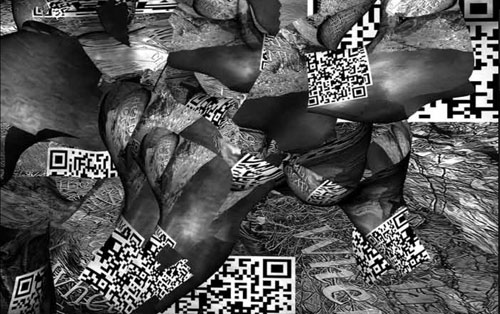
Peter Ciccariello, QR_poem, 2011. Photo: D.R.

For once, let’s look beyond our national borders to Japan, Germany and Finland, countries which are hardly lacking in brillant writers. There we find novels written especially for mobile phones, of which the first, Deep Love, in Japan, dates back to 2003. Some may say that it’s not « great » literature, that it’s (sub-)literature for teens. And they’re right. But, first, it’s a true success (some of these novels have been downloaded several tens of thousands of times); second, it’s a good idea to reach teens directly on their own turf; and third, the advantage of mobile phones (and today tablets) is that they offer us text, sound and video on a single device. This exactly what the successful novelist and dramatist (and theater director…!) Terry Deary was thinking when he published on mobile devices The Perfect Poison Pills Plot, a short story enhanced with video clips by the rapper Chipmunk.

Over the last two or three years, the target, as marketers call it—yes, I know, (sub-)literature is marketing—has changed. Many authors write novels, short stories or narratives by and for mobile phones to be read by adults, just as others make movies with their mobiles (www.festivalpocketfilms.fr). No, SMS are not reduced to ASCII art or Cute & Funny. For the past two years, Annabelle Verhaegue has been sharing an extimate fiction via text messages addressed to dozens of readers. Her literary world recalls the threads of Sophie Calle, the early days of the webcam and the pseudo-intimist texts of Sabine Révillet or Carole Thibaut. There seems to be no beginning and no end to this flowing text. The young author (dramatist) tantalizes our voyeurism by sharing her intimacy. But she is the one who invites us to come inside, rather than us peeping through the keyhole. Here, the SMS acts as a disrupter—it comes unexpectedly—and introduces a false proximity, which is even stronger than that of a blog. It’s a strange feeling that no other medium has managed to achieve.

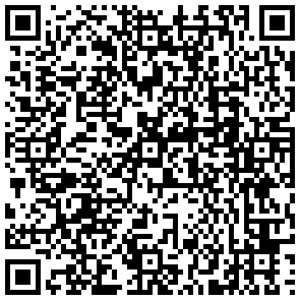
To wrap up, a word on QR (Quick Response) codes, those two-dimensional bar codes that pop up everywhere, on all kinds of ads and political campaign posters. QR (under free license) can be read by any last-generation mobile phone. Encapsulating texts, sounds and images, QR are a new format and a new medium for poets who love to play with the material aspects of writing. Putting a poem into a QR is playing with your own invisibility. In France, there have been a few rare attempts of varying interest (by Stéphane Bataillon, for example). With his background in graphic design, the American artist Peter Ciccariello takes the game farther by placing a QR (containing a poem and a first image) into a second image, which is generated by a computer. Facinated by the relationship between words and images, Ciccariello produces visual artworks that usually include poems which have become almost unreadable in linear form, as a result of their insertion in sophisticated collages esthetically reminiscent of the 1980s and ’90s. In QR Poem, the artist reiterates Mallarmé’s gesture of randomness, generating poems that are decrypted and de(QR-)coded rather than interpreted… Or how, with a roll of the dice, to write a poem using technology that was initially designed to manage your stocks!
Emmanuel Guez
published in MCD #76, “Writing Machines”, march/may 2012

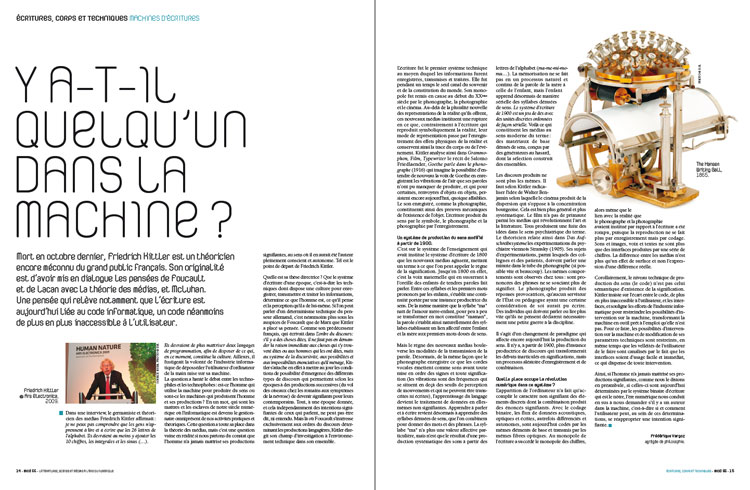
is there anyone in the machine?

The theorist Friedrich Kittler, who died last October, is still relatively unknown in France. His originality was to create a dialogue between the ideas of Foucault and Lacan and media theory, especially McLuhan. His own theory postulates that today, writing is linked to computer code—code which has become increasingly user-unfriendly.

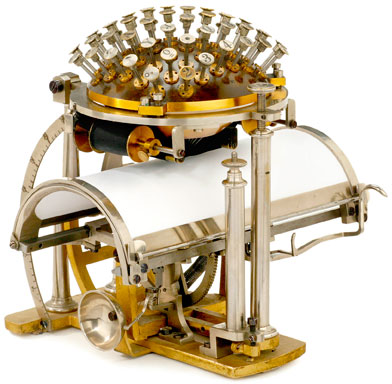
The Hansen Writing Ball,1865

The Hansen Writing Ball,1865. Photo: D.R.

In an interview, the Germanist and media theorist Friedrich Kittler stated: I can’t understand why people only learn how to read and write the 26 letters of the alphabet. They should at least add the 10 digits, the integrals and the sinuses (…). They should also master two programming languages, in order to possess what, at the moment, constitutes culture. Elsewhere, he denounced the computer industry for wanting to rob users of their grip on the machine.

The question has haunted the debate between technophiles and technophobes: Are humans using machines to produce meaning or is it the machines that are producing humans and their productions? In a word, who are the masters and the slaves of our digital century, where computers have become the ubiquitous managers of our practical and theoretical activities? This question may still be relevant in media theory, but not so much in reality, considering that humans have never mastered their own meaningful productions, in the sense that they would have been fully aware and autonomous. This is the starting point for Friedrich Kittler.

What is his dominant thesis? That the writing system of a period, i.e. the techniques used by a culture to record, transmit and treat information, determines what we are, what we think and how we see ourselves. But while we may speak of Kittler’s technical determinism, his theories were more inspired by Foucault than by Marx. Like his French predecessor, who wrote in The Discourse on Language: If there are things that are said, do not ask for an immediate reason of the things that have been said or of the people who have said them; first consider the system of discourse, its possibilities and impossibilities of enunciation, Kittler is dedicated to shining a light on the conditions that would make possible different types of discourse allowing successive productions, by period, (from the flight of birds among the Romans to the symptoms of neurosis) to become meaningful to their contemporaries. In any given period, and independently of the speakers’ intentions, not everything can be said, or heard. But where Foucault is exclusively interested in the orders of discourse that determine language production, Kittler expands his field of investigation to the technical environment as a whole.

Writing was the first technical system used to record, transmit and treat information. For a while, it was the only channel for memory and the constitution of the world. Its monopoly was challenged in the early 20th century by the phonograph, photography and cinema. Beyond the fact that they offered a new plurality of representations of reality, these new media caused a break—contrary to writing, which reproduced reality symbolically, their mode of representation consisted of recording the physical effects of reality, thus preserving the traces of the body or event. In Grammophon, Film, Typewriter, Kittler analyzes this in Salomo Friedlaender’s story Goethe parle dans le phonographe (1916), which imagines the possibility of hearing Goethe’s voice again by recording the vibrations of his speech, among which some, bouncing from object to object, still persist today, albeit much weaker. Recorded sound, like photography, was thus mechanical proof of the object’s existence. Writing produces meaning through symbols, the phonograph and photography through recording.

A new system for producing meaning in the 20th century.

The new media acted on the education system that had instituted this writing system of 1800, putting an end to what could be called the rule of meaning. Up until 1800, it was the mother’s voice murmuring gentle words into her children’s ears that taught them how to speak. Between these syllables and the first words pronounced by the children, continuity was established from an instance of meaning. In the same way that the syllable « ma » was born from maternal love, little by little transforming into the word « mom », speech came about naturally from syllables establishing the affectionate mother-child relationship from the very first meaningful words.

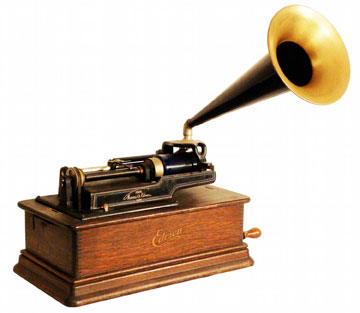
Thomas A. Edison, Home phonograph, 1906.

Thomas A. Edison, Home phonograph, 1906. Photo: D.R.

But the rule of new media has changed the modalities of speech transmission. Now, just as the phonograph records the sounds emitted from the vocal cords before any ordering of signs or meaning whatsoever (vibrations are frequencies that escape our perception of movement and cannot be transcribed or written), learning language consists of processing data, itself devoid of meaning. Learning to talk and write has become a process of learning meaningless syllables, which are combined to form words and sentences. The syllable « ma » has lost its emotional value to become little more than the result of a systematic production of sounds based on the letters of the alphabet (ma-me-mi-mo-mu…). Children no longer memorize through a natural and continuous process of language spoken by their mothers, they acquire language through a series of syllables with no meaning. The writing system of 1900 rolls the dice with discrete units ordered in series. This is what media are in the modern sense of the term: meaningless building blocks, designed by random generators, selected to form arrays.

The resulting discourses are no longer the same. According to Kittler, we must radicalize Walter Benjamin’s idea that cinema produces dispersion, which opposes bourgeois concentration. This is much more general and systematic. Film has no primary role among the media that are revolutionizing art and literature. All are provoking a flight of ideas in the psychiatric sense. In Das Aufschreibesystem, Kittler relates the experimentations of the Viennese psychiatrist Stransky (1905). The subjects of his experiments, including both colleagues and patients, had to speak into the tube of the phonograph for one minute (if possible quickly and profusely). He observed the same behavior among all of them: saying sentences with no regard to meaning. The phonograph produced provocative responses, which no self-respecting civil servant or educator would dare to write. Individuals who must talk or read faster than they can think necessarily wage their own little war against discipline.

This new paradigm is still affecting the production of meaning today. Since 1900, the instance of producing discourse that transforms inarticulate babbling into meaning has been replaced by a random process of recording and combination.

A new role in the system for the digital revolution?

Computers have only served to accomplish the meaningless aspect of discrete elements which combine to produce meaningful statements. With binary code, the flow of acoustic, optical and written data, formerly differentiated and autonomous, are now coded by the same basic elements and transmitted by the same fiber optics. The monopoly of writing has been succeeded by the monopoly of numbers, while the link to reality introduced by the phonograph and photography has been broken— reality is no longer reproduced by recording, but by coding. Sounds and images, voices and texts are nothing more than interfaces created by a series of digits. The differences between media are only superficial.

Logically, the technical level of producing meaning (the code) is not the semantical level of the existence of meaning. Kittler emphasizes the gap between the code, becoming increasingly inaccessible to the users, and the interfaces, and points out the efforts of the computer industry to restrict consumer access to the machine, transforming the computer into a ready-to-use tool, which it is not. Thus, the possibilities of intervening on the machine and modifying its technical parameters are limited, while users’ desire to do so is channeled by immediate and easy-to-use interfaces.

If humans have never mastered their meaningful productions, as stated earlier, if today we are only determined by our own binary system of writing, the digital era leads us to ask ourselves if there is an author in the machine, that is, if and how users can overcome these digital determinations to reappropriate a meaningful intention.

Frédérique Vargoz
Associate of philosophy
published in MCD #76, “Writing Machines”, march/may 2012

between evolution and sanctification

Can text be saved by the book? As writing and reading practices evolve within the digital environment, French theater defends itself above all logic of the printed text…

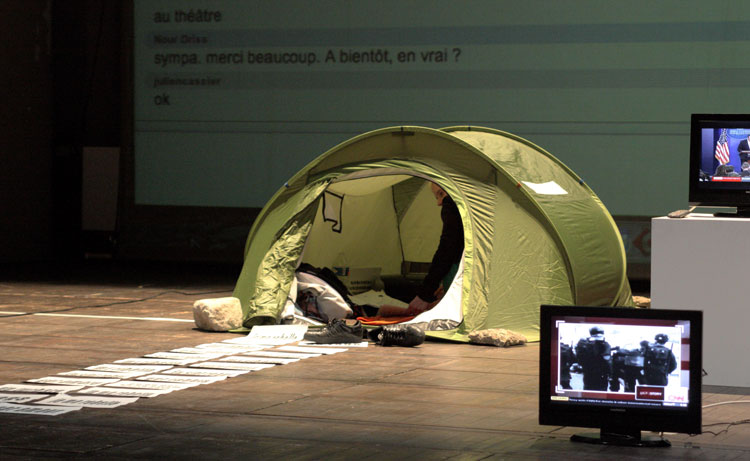
Illusion.com, 2009.

Illusion.com, 2009. Photo: © La Chartreuse de Villeneuve-lès-Avignon

Theater of text or theater of the book?

Now that the profound changes which have transformed writing and reading practices have finally been acknowledged, theater is more than ever reaffirming literary values linked to book culture as a way of legitimizing itself. While new artistic practices develop in relation to digital technology, « text » stands as the last bastion of theater. Or perhaps it should be the book—after all, those who support theater of text refer primarily to theater of the book. In this context, it is sometimes difficult to convey that textuality is evolving on new formats which contribute to renewing and opening up theater art.

Claiming the primacy of text accompanies a complementary discourse that values the interdisciplinary, transdisciplinary and transversal natures of theater, but only to assign them ancillary roles, where issues surrounding text are most often diluted. Recent developments in writing have thus troubled our cultural « networks of discourse » structured more around collection of data than openness to ideas. There is no specific difference by which they can be indexed and categorized; instead they produce new effects, which have yet to be evaluated. Therefore, a historical approach is best suited to renew these issues and put them into perspective.

It was in this context that I directed for four years at La Chartreuse – Centre National des Écritures du Spectacle a project entitled Levons l’encre, in order to give perspective to developments in textuality and writing for theater. Within a cultural structure dedicated to writing, it may seem only natural to take into account current writing technologies, as well as necessary to adapt to the evolving practices of authors and artists. While the myth of the writer’s hand scribbling away on a blank page still exists, the fact is that the vast majority of authors today write on a computer.

This approach aims to radically re-examine the issue of text in theater by confronting it with the history of writing and its current developments. It suggests that text, far from being one of the fundamentals of theater, is changing in ways that have a crucial effect on all theatrical components. Separating text from print denounces our typical confusion of text and book. If we replace the notion of theater of text with theater of the book, we will no doubt see more clearly. The problem is that many people tend to sanctify theater in relation to digital technology—through « text », although in reality through print—rather than explore ways in which new forms of writing can contribute to mapping out new territory for theater.

Writing spaces beyond the book

If text written for theater was not originally presented in the form of a book, we can just as well imagine dramatic text that is not printed. Has print influenced theatrical practices? If so, what is it like to write for theater without following the logic of print? If digital technology offers new forms of writing, can it create new spaces for writing that call for new forms of composition and other ways of making theater?

This angle of attack goes against the usual ways of thinking. While it overlaps in several points the post-drama debate, which has contributed so much in recent years to esthetic debates concerning theater in Europe, it filters the topic through the materiality of writing. It does not specify theatrical forms related to images and screens on the stage. Writing and reading media are all part of the debate on writing for theater. In short, by revealing a blind spot, we attempt to spotlight a new territory to be explored, both invisible and ubiquitous, where writing and reading in digital environments are nothing short of routine.

As we were experimenting with these topics at La Chartreuse, it occurred to me that we could try to reread the history of theater through successive changes in the history of writing. If historians put new writing modes into perspective through the history of the alphabet and printing, have these textual milestones had any effect on theater?

sonde03#09 - Chartreuse News Network.

sonde03#09 – Chartreuse News Network. Photo: © Alex Nollet, La Chartreuse de Villeneuve-lès-Avignon.

Several works by historians and anthropologists have made evident a constitutive and structuring relationship between writing media and the history of theater practices. The emergence of new media for writing invites us to reconsider the articulations between writing and theater that underlie and organize theater practices. We have developed this historically themed research elsewhere, placing particular emphasis on the complex articulations between theater and print, which are key in understanding the extent to which digital technology is deconstructing practices and devices linked to print.

While theater persists in theorizing, administrating, gaining expertise and perceiving itself primarily through the framework of print, a coherent series of mechanisms that link page and stage, and in fine a way of instituting theater practices, is obsolescent. After the specific typographic conventions of the drama script, we are discovering a burst of diverse materialities of writing for theater. Some authors—to mention only those in French theater: Noëlle Renaude, Matthieu Mevel, Sonia Chiambretto…—are digitally reinvesting print and exploring new materialities of drama writing that incorporate typographic wordplay, graphic design and singular layouts.

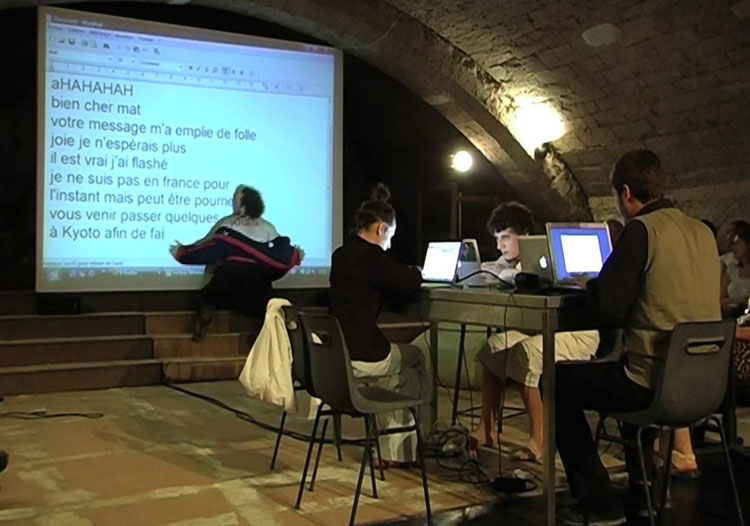
In parallel, some authors are experimenting with new media writing online, in social networks, projected on various types of screens on stage, on mobile devices. La Chartreuse encouraged this exploration of the field by commissioning four authors to create an online work (Illusion.com by Joseph Danan, Sabine Revillet, Eli Commins and Emmanuel Guez), by producing an audio journey by Célia Houdart, and by supporting Eli Commins’ Breaking, which uses Twitter testimonies to write about world events such as political resistance in Iran, the earthquake in Haiti, etc.

Opposing the affirmation of authorship in theater is the reality of multiple forms of practices, which lead the author to develop the text directly in relation to the physical and technological environment of the stage. While print distanced the author from the stage, new media for writing have reintroduced the author into the theatrical creative process. They reactivate theater as a collaborative process, neither structured hierarchically around the author’s message, nor directed and controlled remotely by the text. Far from institutionalized routines and lack of curiosity, these transformations call upon a new dynamic that welcomes experimentation, research and innovation.

Theater as a metaphor of the computer, not the book

The evolution of writing is also the evolution of reading. The viewer as displaced reader—more precisely, reader of books—is joined by the viewer as displaced TV viewer, moviegoer, Web surfer, hypertext reader or gamer.

More generally, we can compare today’s emergence of theater within the digital environment—from control room to communication, from set design to video archive—to the way it once took possession of print. The revived motif of theater of the world, which leads the way for theater and books, revolves around the idea of the stage as a metaphor of its technological, media and cultural environment, where it is critically confronted.

Theater of the book remains the central paradigm of theater today. But it can no longer be the only paradigm. As a metaphor of the book, the stage is becoming more and more of a metaphor of the computer, or even a metaphor of the relationship between the two, influenced by a new relationship between writing and orality. Linearity or simultaneity/discontinuity, prioritizing stage materials to serve the text or hybrid writing, remote or active participation of the audience, constructing meaning or constructing a sensitive and intelligible experience… are all contrasting cultural conceptions of the theatrical arts. They refer to the way the media informs our practices.

Theater coordinates writing techniques, ways of thinking, diverging perceptions. It’s a rich asset. It reflects the complex situation of writing within our society. But it can also be an invaluable vehicle to explore the evolution of writing throughout our society.

Franck Bauchard
researcher and critic, artistic director of La Chartreuse (2007-2011)
published in MCD #76, “Writing Machines”, march/may 2012

Bernard Stiegler, through his critical approach to Western intentionality in Réenchanter le monde, perfectly demonstrates that behind the turning point of democratized technology also lies a turning point in human sensibility, characterized by a lack of attention and the transformation of identification processes.

Internet_Encephalography, Art of failure.

Internet_Encephalography, Art of failure. Photo: D.R.

Technology in context

However, far from indulging in a purely negative observation, he shows that what may be a poison, through the reversibility of any pharmakon, can also become a remedy. If technology obliterates attention to the point of preventing any true investment in one’s activity, especially through the industry of mass entertainment, it can also, as a potential means of existence, clear the horizon for some form of reversal. From the passivity implied by technology, where humans are factory workers chained to cybernetic logic, weapons can also emerge to challenge the dominant ideology that determines the use of these technologies.

Before discussing the issues of integrating digital technology into the performing arts, we must first explain why it is necessary. For the past 30 years, control of individuals, bodies and desires, in both the individual and collective memory, has increasingly developed using technology that extends well beyond the simple computer, as Critical Art Ensemble pointed out in their Electronic Civil Disobedience manifesto. From videosurveillance to our own livelihoods, the possibility of digital control has enveloped our very existence. Heidegger was right when he wrote that we have gone from the age of truth of the reduced being to the essence of technique.

For this reason, our metaphorical relationship with technology has gradually become the medium of research itself. Such is the case in performance art with Stelarc’s Third Hand (1), as well as in poetry, where humans are transformed into technology, as in Anne-James Chaton’s Événements 99 (2). The poet is the mechanical membrane articulating all the codes accumulated during the day, linking this list to the current flow of events. Avoiding any dichotomy between proper and improper, Anne-James Chaton is both one who is articulated by a society of commercial codes and one who creates its micro-plans, micro-movements, and disturbances.

Writing accidents

In this technical age, performance has transformed itself and, more or less following what William Burroughs already announced in The Electronic Revolution, has questioned various media in order to produce forms of accidents. While it is possible to question the medium and how it relates to control by emphasizing the development and derailment of the relationship between writing and technology through the staged representation of theater, as does Magalie Debazeilles in C2M1 (3), for example, performance questions the resistance of media by doing so within a presentation through the very medium in question. What all these current technologies have in common is coding, algorithmic logic. Code as a processing procedure is itself considered to be an intangible format that allows for infinite reproduction and inalterable memory. Nonetheless, some works question the materiality of this material illusion. They also challenge the implicit ideology of controlling the world, beings and objects in terms of digital potential and its pseudo-dematerialization.

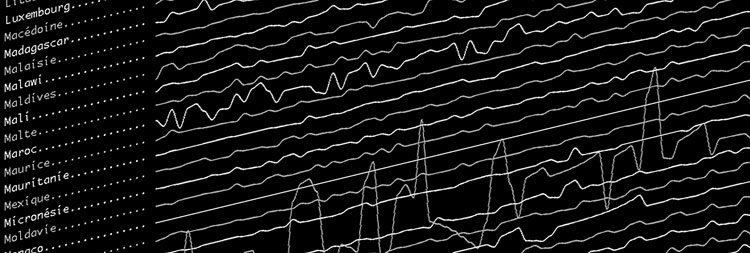
Internet_Topography, Art of failure.

Internet_Topography, Art of failure. Photo: D.R.

Code then becomes the place where the writing of power is disrupted; it becomes the matter and the stage for these new forms of writing. Démolécularisation—Jean-François and Jérôme Blanquet (4)—tests and produces this disturbance of performing arts technologies. The two performers are on stage, close to each other, lost in electro-analogue interfaces of audio and image processing. By taking pornographic texts, filtering them through voice recognition and little by little introducing the specificities of the active technologies, the artists disrupt the spectacular hyper effect of pornography, radically destroying the audience’s attention and their captive expectations of it in the interference. The image is projected like sound, demolecularizes, dilates, erases what it contained so that the medium appears as nothing more than a medium.

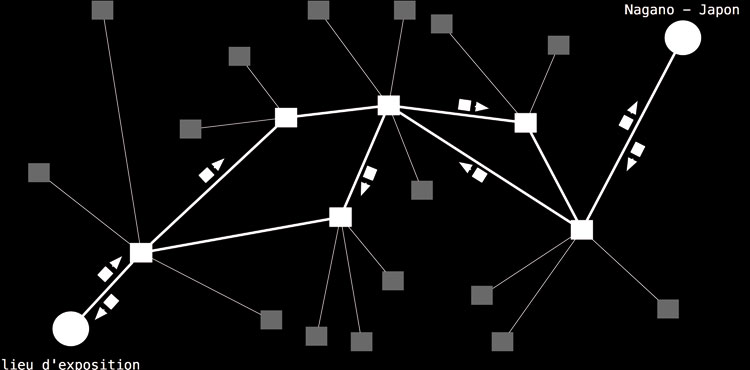
Art of Failure—Nicolas Montgermont and Nicolas Maigret (5)—radicalizes the “bugged” performance genre in 8 silences, which at first seems to be a sound piece, but is actually about writing. Beginning with a silence, a series of 1, little by little, code sent from server to server distorts then destroys itself, until all that is left is a sonorous mass of hyper noise. The computer message is not immaterial, not virtual, it travels and then destroys itself, it obeys interfaces and is altered by them. These performances show that the transparency and immateriality of information is an illusion caused by blindness to technology. As Theodor Adorno wrote regarding the attention given to the medium which favors bugs, the dissonances that scare [the audience] speak to them about their own condition; it’s for this reason alone that they are intolerable (in Philosophy of New Music).

Flesh

But at the heart of criticism of technical domination is the relationship with the body, the possibility of alienating, identifying and controlling it. The Spanish performer Jaime Del Val (6) highlights this in Anticuerpos, where he questions and criticizes the determination of the body as identified with a genre. As a militant homosexual, he stages himself naked in the street, loaded with cameras and pico-projectors, and neutralizes the definition of the body by projecting details that prevent it from being identified. Much like the first page of Jean-François Lyotard’s Libidinal Economy, the desiring and desired body, in terms of its impulses, is neither male nor female; no longer contained in its envelope, it unfolds into space, its limits and boundaries almost imperceptible. It decharacterizes the perception of the body and repolarizes it through wandering fragments. Jaime Del Val criticizes one of the primary pretensions of our society of control and surveillance: control of the body, and by extension, the possibility of categorizing identities.

Hypomnesis feedback

Lucille Calmel (7) undermines another illusion of technology: archives. After archiving all her online correspondances from 2000 to 2008 in Identifiant Lucille Calmel, which was realized for the Open festival at Paris Villette in 2011, she created an installation involving the body, real space, online space and motion sensors such as Kinect, to show exactly how this hyper memory of the Internet is fragmented, deformed and can only be revived through a new form of writing, which would itself produce a new archive. In a fine example of différance as defined by Jacques Derrida, she uses bugs and saturated writing to spotlight the indissociability of organic and digital material, then through feedbacks and flashbacks, she shows how digital archiving contracts and materially alters itself.

Identifiant : Lucille Calmel, avec Philippe Boisnard (kinect hacking, programmation), Cyril Thomas (sélections textuelles), Thierry Coduys (conseil en interactivité, mastering sonore), Open festival des scènes virtuelles, Paris-Villette, juin 2011.

Identifiant : Lucille Calmel, avec Philippe Boisnard (kinect hacking, programmation), Cyril Thomas (sélections textuelles), Thierry Coduys (conseil en interactivité, mastering sonore), Open festival des scènes virtuelles, Paris-Villette, juin 2011. En coproduction avec le Théâtre Paris-Villette. Photos © Corinne Nguyen

In the same vein, Hortense Gauthier’s hp process (8) critiques the supposed relationship between communication networks and the lisibility of their traces. In her performance Contact, a man and a woman write to each other, but their writing is presented according to an esthetic logic of stacking and on-stage interlacing, as well as live online, redeploying this correspondence in space. Behind the assumed control and transparency of writing, these two performances demonstrate how writing life, live writing, escape the determinations of control by playing with the media in question.

Transforming the ideology of means

It is no longer just a question of spectacularly representing political power. Politics, which has abdicated its power to economics ever since the 20th century, forces us to consider the very means of production. Capitalism is dominated by property, it relates to the world through appropriation, and therefore through substracting possibilities from other people, in real life. At the moment, large computer companies are driven by patents. This ideology of copyright not only takes on an economic dimension, it has become the ideological foundation of our relationship with being, of our personal inventory. Every perspective on being can be patented, displaced from public access to private property.

The performances presented here are all built on other ideological possibilities. Not only are they an explicit criticism of what has happened, they have also transformed their relationship with their means of realization. Whether it’s by reappropriating technologies or developing open source programs and freeware, the above-mentioned artists link what they make to their own practice. How credible can one be, criticizing the very medium in which they choose to operate? It is therefore important to stress that the artworks mentioned here (by Art of Failure, Lucille Calmel, hp process) were all programmed using open source code, itself resulting from the criticism of capitalism and its logic of appropriation: Pure Data created by Miller Puckette.

Unconscious decisions and education

We can see in many of these performances how criticism is not possible without first understanding the means of domination as well as the development of techniques that rival these means, while offering other forms of relational and economic models. But it should also be noted that few institutions integrate these new practices. Pure Data appears to be a perfect example. Far from being confined to a small community, this programming language has been used by many artists for professional stage performances, workshops and installations.

However, the languages that dominate most computer courses in France are ActionScript linked to Flash, and Max/MSP. Both languages are proprietary and require licences in order to be exploited. Hardly open-source, they are open to a form of commercialized algorithms… which means that we are unconsciously educating students to reproduce this intentionality of copyright and private property, against the collective intelligence of open source. And thus, unconsciously, are we preventing certain types of questioning and critique concerning the ideology of technological media.

Philippe Boisnard
published in MCD #76, “Writing Machines”, march/may 2012

(1) stelarc.org/?catID=20265
(2) aj.chaton.free.fr/evenements99.html
(3) www.desbazeille.fr/v2/index.php?/projects/c2m1
(4) projectsinge.free.fr/?paged=2
(5) artoffailure.free.fr/index.php?/projects/laps
(6) www.reverso.org/jaimedelval.htm
(7) www.myrtilles.org
(8) databaz.org/hp-process/?p=105

unreadable literature?

While language is central to computer arts (from programming languages to artificial intelligence, character recognition and text generators), the possibility of a literary or poetic computer language remains problematic.

Bumby, LifePl, 2005.

Bumby, LifePl, 2005. Photo: © Bumby

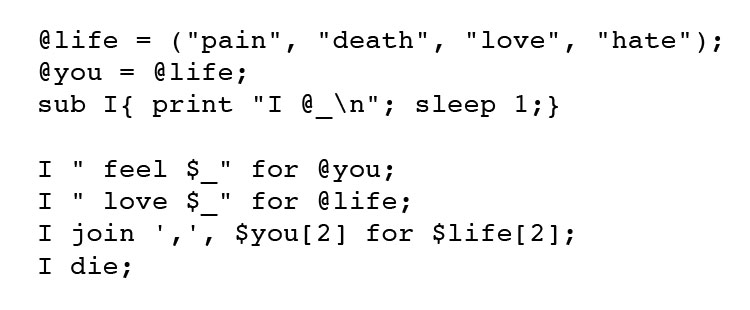
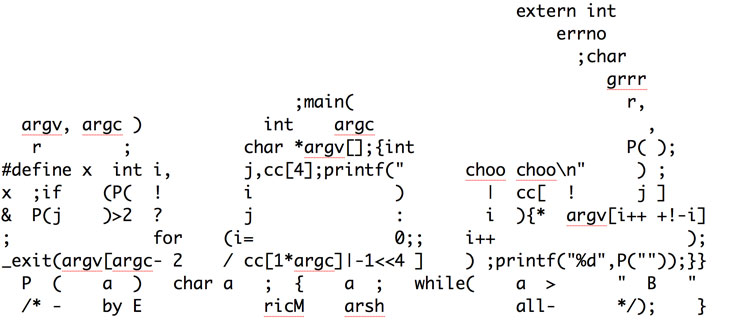
The problem lies in the perception and the understanding of what makes literature: the text. Computers function on numerous texts that obey their own logic, which we call program scripts or computer code. Florian Cramer, who pioneered the discovery and analysis of code from an esthetic standpoint, claims in Words Made Flesh: Code, Culture, Imagination (2005) that the scriptable dimension of computer code (the instructions and processes that cannot be read on the interface) is the same as that which Roland Barthes assigns to literary texts in Le plaisir du texte (1982). This scriptable dimension joins a second dimension, similarly perceptible in esthetic terms: the executability of the code (the text containing the list of instructions must be executed). We will examine some aspects of these two dimensions.

The relationship between literature and computers is most often reduced to language generators, programs which process linguistic data in order to produce original texts. The textuality (in the literary sense) of these generators is difficult to pinpoint in the resulting texts, which are usually too obvious or too obscure.

Too obvious? The program is very good at execution, especially in the art of reproduction and imitation. It can generate very classic texts, which would have delighted the academic poets of the Enlightenment who were particularly skilled in metrics—poetry that is relatively depreciated today for its lack of originality, considered poor in terms of linguistic experimentation and pre-formatted. Yet, as the Oulipo literary school and its computer-based ALAMO heritage has demonstrated, mathematical manipulation of words and sentences is indeed a form of experimentation, even if it realizes above all the fantasy of combinatory literature—of absolute control over the form by the author who becomes the program, as Jean Clément explains in his article Quelques fantasmes de la littérature combinatoire (2000).

Too obscure? It’s often the case with generators that are also chatbots, a classic case of artificial intelligence programming, which results in rather strange conversations. It may be because the robot is incoherent and doesn’t know how to adapt to its human interlocutor, or, more commonly, because it’s robotic, trapped in loops and fixed attitudes (flagrant with Eliza, the famous robot psychoanalyst). We don’t understand the robot’s intentions, very simply because it doesn’t have any. The machine doesn’t « understand » what it is saying, explains the philosopher John Searle, therefore it is not intelligent. Generators are virtual authors whose language is focused on empty intentions. The program that writes is nothing more than a machine for processing and transmitting information; it does not communicate meaning, unless it’s mathematically, according to the cybernetic theory of Claude Shannon. But this hardly rules out its poetic effect, as Roland Barthes points out: Writing is not at all an instrument of communication… It always appears symbolical, introverted, ostensibly oriented toward the secret side of language.

Of course, best concentrate on the code to better appreciate this « secret side ». If what Barthes considers readable constitutes standard representations of cultural productions, what is scriptable can then be defined by the code responsible for this production (or statement in the case of speech). Many authors working with computers decide to focus more on arranging the products of this code, inasmuch as these products demonstrate the possibilities (or virtualities) at work in the programming. This spotlights another quality of language generating: the differential emergence of language, which is also a poetic quality, according to Jacobson. In his Virtual Muse, Charles O’Hartman suggests that the value of computer scripts is revealed by this emergence, which implies that reading is important to give the product meaning: Language is created all by itself from a simple statistical interference. You choose the order of n, you observe the meaning stumble and find its balance again. It’s not very clear where this meaning comes from. Nothing is created from nothing, and the principles of nonsense require that we keep readers in their place, as co-responsible for the relevance of the text.

Photo: © Marshall

For the poet Alan Sondheim, computer languages offer tools to think about writing and new ways to play with words and meaning: I rarely leave the program to its own devices, I don’t really care how the text is produced, so I come back to the program and rearrange the elements. In other words, the commands are catalysts for a textual production, with the goal of delivering not a final text, but a body of text that I can work on. For the creators of the program JanusNode, language generators allow us to realize Lautréamont’s slogan Poetry for all! By presenting useful functions in order to explore this interesting phenomenon that emerges at the intersection of the fundamental dualities of the human condition: the dynamic boundary that separates order and chaos, law and anarchy, meaning and absurdity. The attention given to all these possible produced texts at the intersection of computer and human manipulation gives rise to the second fantasy of combinatory literature according to Clément, hailed by the avant-gardes, which consists of losing control as a condition for creativity. But also regaining control through the interpretative choices of the author, and even of the reader in some cases (hypertext literature, for example). As in many situations of everyday speech, sentences are waiting to be interpreted, or waiting for a driver, a master to give them direction, as Wittgenstein writes.

However, this approach to code remains very conceptual, even abstract in the sense that the principle of uncertainty in textual generation is still perceived as a production device, and not a text to be read and appreciated for itself. Who reads computer code? Computer programmers first, as its primary fans. But not only for practical reasons. The desire to code in your spare time, exercise your skills, amuse yourself, impress others, solve a difficult problem, etc., is at the heart of programming esthetics, which has largely fueled hacker culture. These esthetics also feed the ideology of open code, which advocates actively displaying and distributing computer code. It helps even out the balance between readability and unreadability, providing functional evidence of language structures and formally destabilizing these scripts. It develops the pleasure of coding and reading code that is very close to Barthes’ pleasure of the text. Finally, it shines a light on the processes which lead to cultural behaviors and social standards.

The pleasure of coding stems from the idea that code can be beautiful. Elegant code is concise, coherent, well-formulated code; ugly code is obscure and difficult to decipher by fellow coders. Between these two value systems are a variety of writing games that can be assimilated to veritable infra-literary activity within computer subcultures. It finds its most formal expression in coding competitions such as OCCC (Obfuscated Code Competition in C), which revive writing games such as calligrams, anagrams and cryptography or in poetry collections written in code that parodies the most caricatural forms of romantic and lyrical poetry (for example, Perl Poetry, very present on www.perlmonks.org). Constantly finding a balance between a moral vision of efficient and elegant code and a grotesque vision of crazy code that is enlightening through its disorder and creativity, these forms of esthetic coding maintain an ambiguous relationship with serious programming work, as evoked by Donald Knuth, one of the fathers of programming, upon accepting an award from the members of the prestigious Association of Computing Machines in 1974, in a passionate speech entitled Computer Programming as an Art: We shouldn’t shy away from « art for art’s sake »; we shouldn’t feel guilty about programs that are just for fun. […] I don’t think [it’s] a waste of time […], nor would Jeremy Bentham […] deny the « utility » of such pastimes. « On the contrary, » he wrote, « […] To what shall the character of utility be ascribed, if not to that which is a source of pleasure? »

Writing beautiful code or funny code is a way of rethinking didactics through folklore: by coding experimentally, by dialoguing creatively with the computer, perceived in this case both as interlocutor and system, the apprentice poet is also and above all an apprentice coder and a user of a system in a situation of learning or even initiation. The esthetic dimension of computer code is thus an art of the initiated—but not so much more than the most experimental poetry, which is touched upon only by those who love deciphering (both in the literal and the metaphorical sense) the most unreadable literary texts. This was also what the poets of « Codeworks » (including Alan Sondheim) thought as they invaded artistic networks of the Web in the 1990s with chaotic logorrhea which borrowed a lot, sometimes completely, from programming languages. At a time when code has taken on an important role in terms of not only technology and culture but also economics, politics and legal matters (Lawrence Lessig’s Code is Law, 1999), examining these texts doesn’t seem like such a crazy idea after all.

Camille Paloque-Berges
published in MCD #76, “Writing Machines”, march/may 2012

Camille Paloque-Berges developed these issues further in Poétique des codes informatiques, published in 2009 by Archives contemporaines.