Hope for Africa

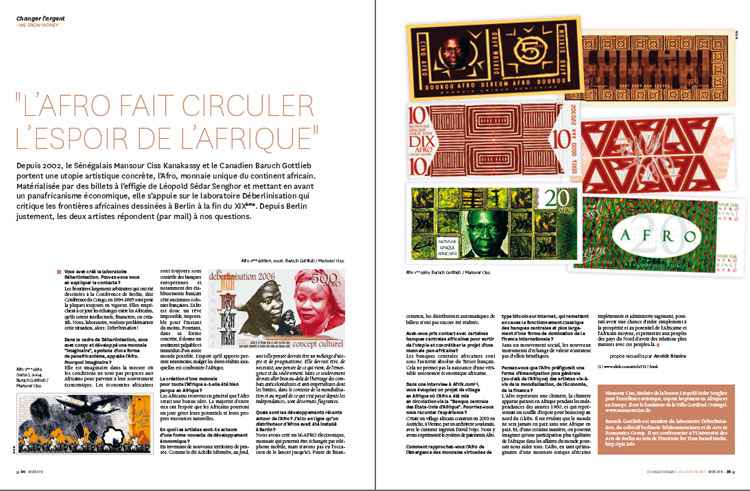
Since 2002, Mansour Ciss Kanakassy from Senegal and Baruch Gottlieb from Canada have been nurturing a concrete artistic utopia: the Afro, a unique currency for the African continent. Materialized on bills featuring Léopold Sédar Senghor and promoting an economic pan-Africanism, it shares a common goal with the Déberlinisation laboratory, which criticizes the African borders established by Berlin at the end of the 19th century. From Berlin, the two artists answered our questions (by e-mail).
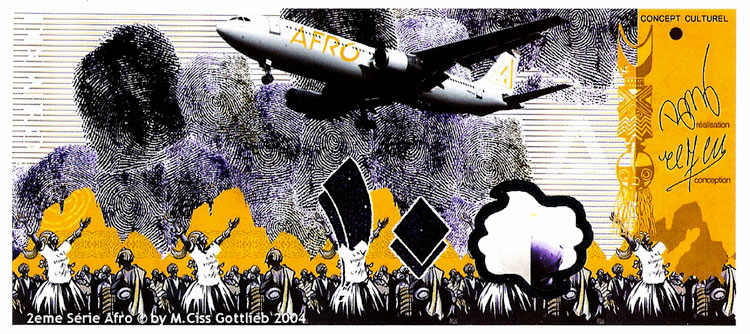
Afro 2ème série (verso), 2004. Baruch Gottlieb / Mansour Ciss. Photo: D.R.

Could you explain the context in which you founded the Déberlinisation laboratory?

The mostly arbitrary borders that were established at the Berlin Conference, or Congo Conference, in 1884-1885 are more or less still in place. To this day, they prevent exchange among Africans, whether it’s on an intellectual, financial or creative level. As a laboratory, we want to troubleshoot this situation, so: “Déberlinisation”!

For Déberlinisation, you designed and developed an “imaginary” currency as a symbol of pan-Africanism called the Afro. Why imaginary?

It’s imaginary in that current conditions are not favorable for Africans to achieve economic sovereignty. African economies are always under the control of European banks, especially French banks for the former French colonies. The Afro is an impossible dream, at least for now. However, in its concrete form, it gives people an immediate and tangible feeling of another possible world. The hope that it brings persists, despite the harsh realities that Africa faces.

Was creating a common currency for all of Africa well received in Africa

In general, Africans find that the Afro would be a good idea. The majority of Africans hope to one day manage their own potentials and natural resources.

How are artists actively involved in a new form of economic development?

By inventing new territories of thought. As Achille Mbembe says: “deep down, such a thought should be a mixture of utopia and pragmatism. It should be, by necessity, a thought of what is to come, of emergence and uprising. But this uprising should go well beyond our heritage of anticolonialist and anti-imperialist battles, whose limits, in the context of globalization and in view of what has happened since our independences, are now obvious.”
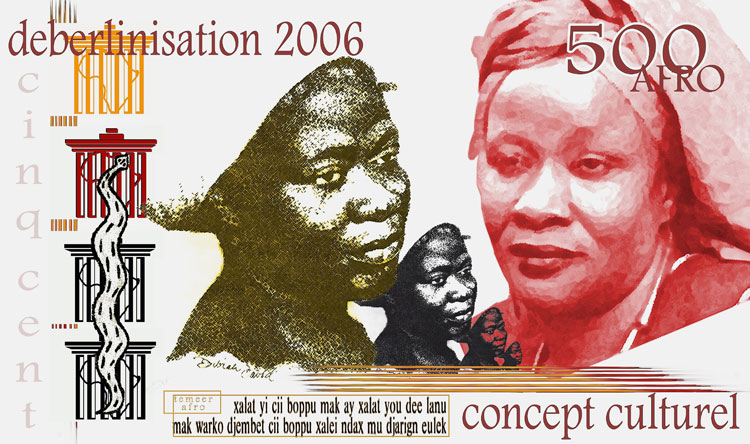
Afro 2ème édition, 2006. Baruch Gottlieb / Mansour Ciss. Photo: D.R.

What are the Afro’s recent developments? I read online that an Afro distributor was installed in Berlin?

We created M-AFRO, an electronic currency that could be exchanged via cell phone, but so far we haven’t had the chance to launch it. We currently lack the financing to make ATMs to distribute bills.

Have you contacted any central African banks in order to move from utopia to the concrete project of a pan-African currency?

Central African banks are under the absolute authority of the French Treasury. This prevents us from creating a truly autonomous African economy.

In an interview on Afrik.com (1), you talked about an African village where the Afro was circulated by the “Central Bank of the United States of Africa”. Could you tell us more about this experiment?  

It was an African village conceived in 2003 in Vienna, Austria, by a Sudanese architect, along with the curator David Nejo. We experimented with an Afro payment system there.

How do you relate the Afro to the emergence of virtual online currencies such as bitcoin, which challenge the conventional role of central banks and more generally the dominance of international finance?

Without a social movement to accompany them, new instruments for exchanging value would have no beneficial effects.

Do you think that the Afro prefigures a more general form of artist emancipation (beyond Africa) from globalization, economics, finance?

The Afro represents a chimera, the chimera that appeared everywhere in Africa during the independences of the 1960s, and that represented a breath of hope for many in the northern hemisphere. It’s evident that the world will never be at peace without a peaceful Africa. To a certain extent, we can imagine that Africa’s more egalitarian participation in world affairs could help us all. The Afro, as the fantasy of a unique African currency that is implemented and wisely administrated, could simply aid the prosperity and potential of average Africans, and allow countries in the North to have more mature relationships with these communities.

Interview by Annick Rivoire
published in MCD #76, “Changer l’argent”, déc. 2014 / févr. 2015

(1) http://www.afrik.com/article7317.html

Mansour Ciss, recipient of the Léopold Sédar Senghor grant for artistic excellence, exhibits widely in Africa and in Europe. He is the founder of the Villa Gottfried / Sénégal. http://mansourciss.de

Baruch Gottlieb is a member of the Déberlinisation laboratory, the Berlin collective Telekommunisten and the Arts & Economics Group. He is a lecturer at the Institute of Time-Based Media, University of Art in Berlin. http://g4t.info
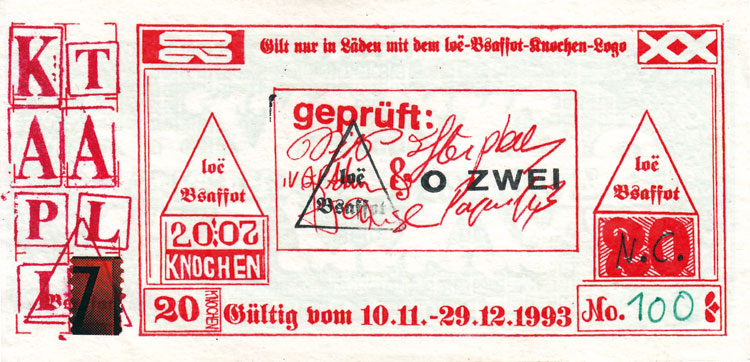
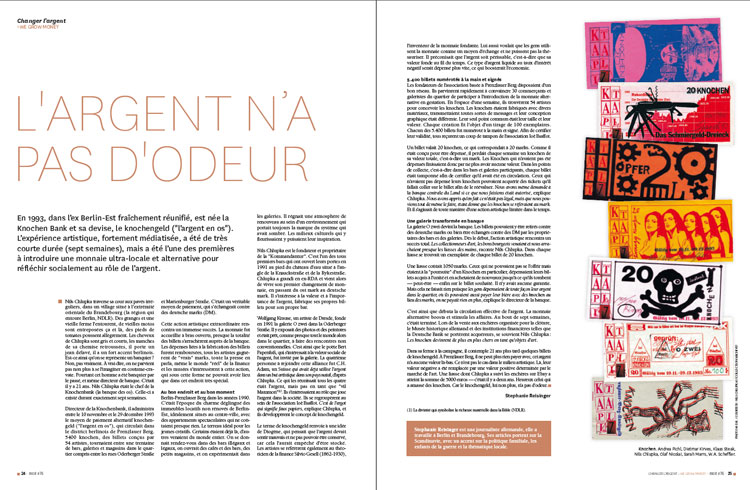
In 1993, a trendy neighborhood of newly reunited ex-East Berlin gave rise to Knochen Bank and its currency, the knochengeld (“bone money”). The highly mediatized artistic experiment lasted only seven weeks, but was one of the first to introduce an ultra-local alternative currency that challenged the role of money in society.

Knochen. Nils Chlupka. Photo: D.R. / Courtesy : Nils Chlupkas (collection/archive).

Nils Chlupka walks across his cobblestoned courtyard in a village situated in the far east of Brandenburg. He is surrounded by barns and an old farm, old motorcycles are parked here and there, tomato plants are growing peacefully. Chlupka’s hair is gray and short, his shirtsleeves are rolled up, he wears faded jeans, he has a heavy Berlin accent. Is this the image of a banker? Not quite. But we’re no closer when we try to imagine him in a suit and tie. And yet, this man was indeed a banker in the past, even the director of a bank. That was 21 years ago. Nils Chlupka was the head of Knochenbank (“bone bank”). It existed for exactly seven weeks.

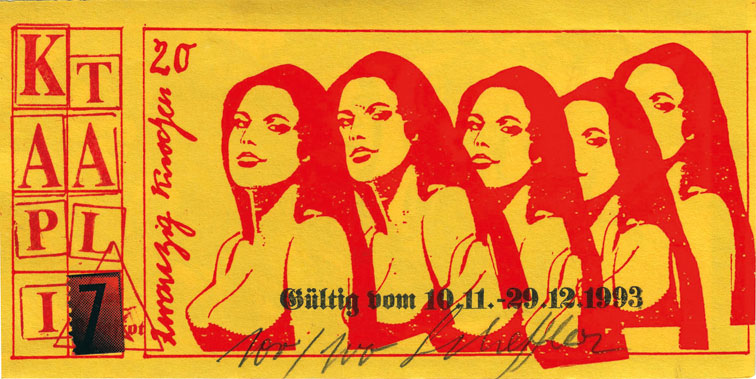
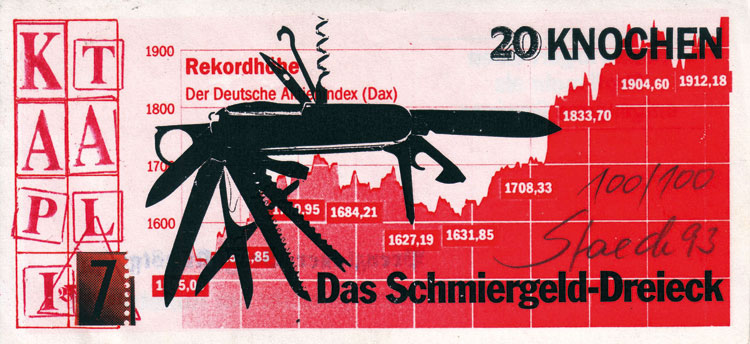
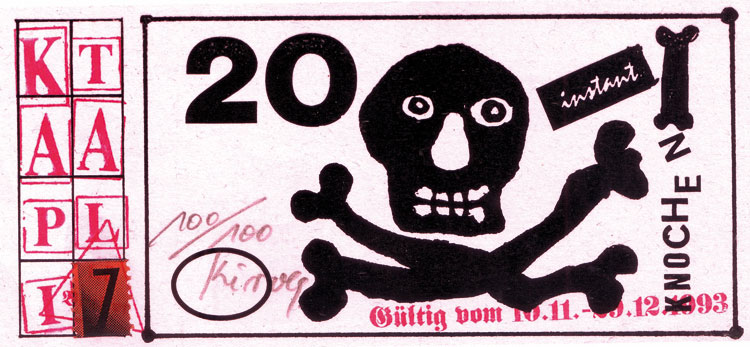
As the director of Knochenbank, from November 10 to December 29, 1993, he administered the alternative payment method “Knochengeld” (“bone money”), which circulated in the Prenzlauer Berg district of Berlin. 5,400 “Knochen” bills, designed by 54 artists, circulated among about 30 bars, galleries and shops in the neighborhood bordered by Oderberger Straße and Marienburger Straße. It was an authentic method of payment, exchangeable for Deutsche Mark (DM).

This extraordinary artistic action was extremely successful. The currency was welcomed with open arms, as people bought out the bank’s almost entire stock of the bills. All expenses related to manufacturing the bills were reimbursed, all the artists received “real” DM, it was covered by all the media, even the “real” world of finance and the museums were interested in the action, which in this form could only exist in this very special place.

Knochen. W.A. Scheffler. Photo: D.R. / Courtesy : Nils Chlupkas (collection/archive).

At the right place at the right time

Berlin-Prenzlauer Berg in the 1990s was characterized by the dilapidated charm of non-renovated apartment buildings in East Berlin, with spectacular apartments that costed almost nothing. It was the perfect breeding ground for young creatives. Some were already there, others came from all over the world. People met in illegal and legal bars, people opened bars, small shops, experimented in galleries. An atmosphere of renewal prevailed in an environment that was still marked by the failed system, which in turn inspired the cultural circles that flourished there.

Nils Chlupka was the founder and owner of «Kommandantur». It was one of the first bars that opened its doors in 1991 at the foot of the water tower located at the corner of Knaackstraße and Rykestraße. Chlupka grew up in former East Germany, and had just lived through his first currency change from the Ost-Mark to the Deutsche Mark. He was interested in the value and importance of money; he made his own bills for his own bar.

Wolfgang Krause, an artist from Dresde, founded the “o zwei” gallery on Oderberger Straße in 1991. He exhibited photos and paintings, and like almost everyone in the neighborhood, was prepared to make unconventional encounters. And so he invited Bert Papenfuß, who was interested in the value of money, to the gallery. The fourth person to join this alliance was C.H. Adam, a Swiss man “who had already used money for artistic purposes in his native country,” according to Chlupka.

What brought the four together was money, but not in the sense of vile Mammon, the biblical deity of material wealth or greed. They were interested in the role money plays in society. They gathered around the collective Ioë Bsaffot: “It’s slang for ‘fake papers’,” Chlupka explains; and they developed the concept of “Knochengeld”.

The term “Knochengeld” refers to an idea of Diogenes, who believed that money should smell bad and go bad, as that would prevent it from being stashed. The artists also referred to the financial theorist Silvio Gesell (1862-1930), inventor of “melting money”. He also wanted people to use money as a means of exchange and not be able to hoard it. He advanced that money is perishable—that its value “melts” over time. This type of liquid cash with a negative interest rate would be spent fast, which would boost the economy.

Knochen. Klaus Steak. Photo: D.R. / Courtesy : Nils Chlupkas (collection/archive).

5,400 bills numbered by hand and signed

The founders of the collective based in Prenzlauer Berg had a solid network. They were quickly able to convince 30 owners of shops and galleries to help introduce the gestating alternative currency. Within one week, they found 54 artists to design the Knochen. The Knochen were made with various materials, conveyed all sorts of messages, and the graphic design of each one was different. Their only common factor was their size and their value. Each creation was printed in 100 copies. Each one of the 5,400 bills was numbered by hand and signed. Their validity was certified by an official stamp of the Ioë Bsaffot collective.

One bill was worth 20 Knochen, which corresponded to 20 DM. As it was designed to be spent, each week it lost one Knochen of its total value, i.e. one DM. So the Knochen that had not been spent ended up being worth nothing. In the collection points of the participating bars and galleries, each bill was stamped to certify that it had been circulated. Those who had not spent their Knochen could acquire tickets that were pasted onto the bills in order to renew their value.

“We even asked the central bank of Land if what we were doing was legal,” says Chlupka. “We learned that in fact it wasn’t legal, but that we could do it anyway, given that Knochen referred back to DM.” Besides, it was an artistic action for a limited time only.

Knochen. Dietmar Kirves. Photo: D.R. / Courtesy : Nils Chlupkas (collection/archive).

A gallery transformed into a bank

The “o zwei” gallery became the bank. Bills could be withdrawn in exchange for Deustche Mark or exchanged for DM by the bar and gallery owners. From the start, the artistic action was a total success. “Art collectors and bourgeois came and almost tore the bundles out of our hands,” recalls Chlupka. Each bundle contained a sample of each 20 Knochen bill.

One bundle costed 1,050 DM. Those who could not afford it but who were “chasing” a particular Knochen spent the bills they acquired individually and bought new ones until they stumbled—or not—on the desired bill. There was no guarantee. But that didn’t matter, because “people spent their money in the neighborhood anyway, where they could pay for their beer with Knochen instead of DM, it didn’t cost anything more,” the director of the bank explains.

And so began the effective circulation of money. The alternative currency boosted and stimulated business. After seven weeks, it was over. During the auction organized for the closure, the German Museum of History and financial institutes such as the Deutsche Bank were buyers, recalls Chlupka: “Knochen became more and more expensive as art objects.”

On his farm in the countryside, he contemplates a few Knochengeld bills 21 years later. In Prenzlauer Berg, he can no longer use them to pay, as this money has no value there. Such is not the case in the art world, where their negative value has been replaced by a positive that is determined by the art market. One bundle that Chlupka followed on eBay reached the sum of 5,000 euros—and that was two years ago. Blessed is the one who has collected Knochen. For Knochengeld doesn’t smell either.

Stephanie Reisinger
published in MCD #76, “Changer l’argent”, déc. 2014 / févr. 2015

Stephanie Reisinger is a German journalist. Her themes are Scandinavia with focus on family policy and war Children and Local, she worked as a reporter in Berlin and Brandenburg.

The end of the Taboo on Money

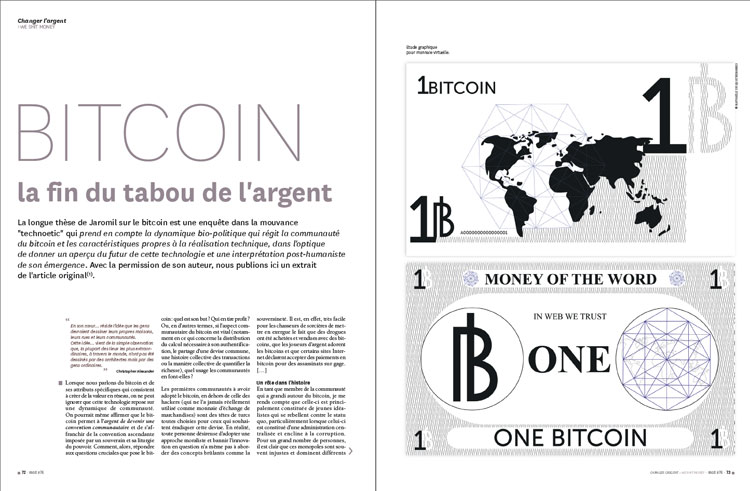
Jaromil’s lengthy thesis on bitcoin is a technoetic inquiry that “takes into consideration the biopolitical dynamics that govern the bitcoin community as well specific characteristics of the technical realization, aiming to provide insights on the future of this technology as well a post-humanist interpretation of its emergence.” With author’s permission, we are publishing an excerpt from the original article (1).

Photo: D.R.

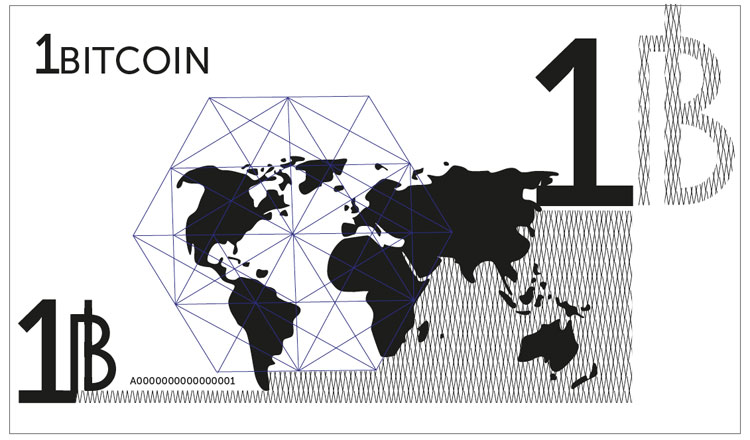
When talking about bitcoin, of its inherent qualities of networked creation of value, we can’t ignore the fact that this technology relies on community dynamics to the point one could state that bitcoin makes it possible for money to become a common and no longer a top-down convention imposed by a sovereign and its liturgy of power.

But then we are faced by a crucial question about bitcoin: what for? who benefits from it? Or, in other words, if the community aspect of Bitcoin is crucial (as in: distributing the computation needed for its authentication, sharing a common currency, a common history of transactions, a common way to quantify wealth) what do the communities use bitcoin for?

The earliest communities that adopted bitcoin, aside from the hacker community that never really used it much as a currency to exchange goods, are perfect scapegoats for those who want to turn bitcoin down. In fact, anyone willing to take a moralistic approach and prohibit the innovation that we are talking about doesn’t even need to approach itching concepts such as state sovereignty. It is very easy for witch-hunters to emphasize the fact that drugs were bought and sold with bitcoins, that gamblers love bitcoins and that some website claims to accept bitcoin payments for assassination missions. […]

Bitcoin has a role in history

Being involved in the community that has grown around bitcoin I can see that the community is comprised primarily of young idealists rebelling against the status-quo, especially when it consists of a centralized administration prone to corruption. It is clear to many how unjust monopolies are often dominating various contexts, curbing the possibilities of innovation that are in the hands of younger generations. The liberation of the medium of value exchange is an act we refer to as “breaking the Taboo on Money”. Bitcoin has a role in history: its epos coalesces in communities, new ethical reflections, new tales of passion, the glory in all the mystery around its origins. The will for liberation, decentralization and disintermediation is central to bitcoin–it is ethical and should not be seen as more conflictual than the concrete need to disintermediate many of the systemic functions that are governing modern society. Mind your own long-tailed problems, modern finance! […]

Every form of currency, since the very beginning of its earliest forms, has dealt with the grammar of power. It is the establishment of a sovereign and its glory that justifies the shared trust into a symbolic form of value circulation. The investment of power into currency, especially when its not backed by mineral values, is codified in mystery and glory.

Bitcoin is not exempted from such dynamics: it innovates the way the digital becomes tangible, a role with highly disruptive potential. Hence, even when choosing the iconography for its own currency, the bitcoin community shows a political rupture.

The intriguing mystery of the identity of its disappearing author Satoshi Nakamoto might seem a detail, but not for our analysis: it is of central importance to the bitcoin myth and that of future crypto-currencies. Bitcoin has no single monetary authority, but a shared pact and the underlying rationality of a mathematical algorithm–the intangible dream of neutrality. Being deflationary, Bitcoins exist within a finite range of possibilities, a quantity of value that is increasingly difficult to mine. No one can create more bitcoins than those established to be created in the first place, to the great horror of modern economists that regard fiat currency as a necessary tool to move within the troubled waters of contemporaneity, with good reason indeed. But there is no hierarchy in bitcoin: meaning literally that there is no sacred origin, no written fate, no single ruler, no second thought on its essence.

Photo: D.R.

Bitcoin promises to be the neutral medium for an economy based on participation, not the edict of a king, a central bank, or their authorized intermediaries–nevertheless, it must be said, bitcoin did create new riches, those who believed earlier than others in the promise of this algorithm. The rupture offered by this new perspective on money is not dealing with equality or welfare, it might not benefit society or help us get out of the crisis: it is a protest for network neutrality. […]

By now it should be clear that such a process of subjectivation as the one we are describing is not the simple emergence of a new innovative technology, it is not just , it goes well beyond. The enormous popularization of bitcoin is proof that the dimensions of this process of subjectivation are multiple and cannot be comprehended by adopting a single narrative, and even less so by using the categories of economic analysis.

The popularity of bitcoin as of today is enormous and still growing: this is a result of the biopolitical progression and its inscription inside a particular context, it is not a quality of bitcoin alone. Bitcoin is rooted in the protest movements that accompained the financial crisis through 2009 until now, namely the Occupy movement. While there can be reason to conceal this fact for those who hail the unconditioned and instrumental success of bitcoin, it is important to account this historically in order to understand what might happen in the future. […]

The branching of bitcoin

Being popular also means to be branched, forked, replicated, cloned, recombined and ultimately appropriated by the people: a popular icon will feed the mind of popular culture without consuming itself, but confusing its authenticity in the existence of new popular instances. This is already happening to bitcoin with very interesting consequences. Considering that its popularity is mostly among the hacker (or, should we say, young cyborgs?) community, the branching of bitcoin is giving birth to many valid technical implementations, that are both capable of functioning on large scale, and explore novel approaches to currency and networking. […]

With my own pet project in the bitcoin galaxy, called Freecoin15, I’ve started documenting the phenomenon of forking bitcoin since its early days and advocated within the community for the “configurability of the genesis code” and in general to leverage the possibilities of customisation for the technology underlying bitcoin. It is my belief that, while bitcoin represents a unique political rupture with the old establishment governing money, it is not the ultimate solution to it.

The need for digital currencies based on triple-signed receipts cannot be simply satisfied by bitcoin. Nevertheless, strengthened by the popularity and all consequences we have explored here, bitcoin might stand on the longer term as a fixed reference for future implementations: it is realistic to predict that its value will only grow in future. […]

Now that money seems to be either dead or dying, it is the time to dare this dissection. It might be the case that, by trespassing this taboo, we will find out ways to change things on a larger scale, especially considering the long due line of innovation in the field of accountancy that has still to be applied.

Ultimately, there are proofs to the rupture I’m pointing out here, in the wake of many new currencies born after bitcoin: with all irony and irreverence intended. The gates were left open by the mystery man: Satoshi the fool, Satoshi the saint, trespassed the line in front of everyone. There is no longer a taboo on money. Bitcoin is not really about the loss of power of a few governments, but about the possibility for many more people to experiment with the building of new constituencies.

Denis Roio aka Jaromil
published in MCD #76, “Changer l’argent”, déc. 2014 / févr. 2015

Jaromil is an activist, hacker and artist. Since the year 2000 he dedicates his efforts to build Dyne.org, a non-profit software house and digital community of critical makers and nomadic developers.
https://jaromil.dyne.org

(1) The whole article can be downloaded in PDF format at https://files.dyne.org/readers/Bitcoin_end_of_taboo_on_money.pdf

The Reflection of the Material Human Community of the Internet

Upon closer inspection, bitcoin reveals itself to be asking all the right revolutionary questions. The first one being: what is the relationship of currency to value, and currency to technology?

Bitcoins. Photo: D.R.

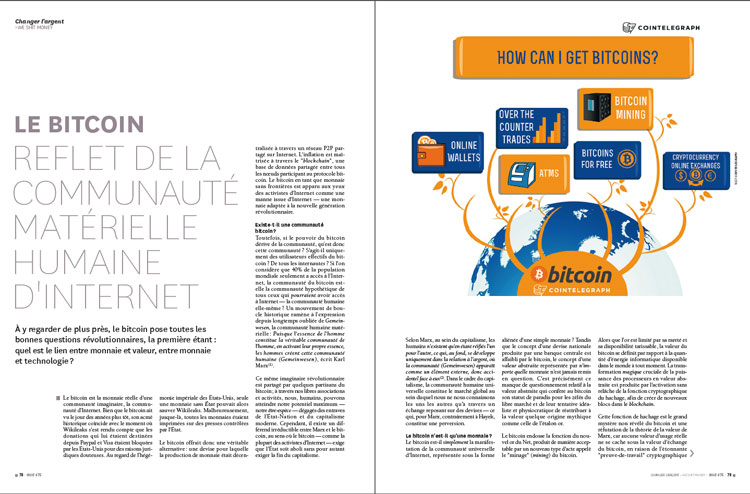
Bitcoin is the real currency of an imaginary community: the community of the Internet. Although bitcoin itself came into existence years earlier, the moment where bitcoin was propelled onto the historical stage was when Wikileaks found that its donations from Paypal and Visa were being blockaded on dubious legal grounds by the United States. Given the imperial hegemony of the United States, only a money without a state could save Wikileaks. Yet hitherto all currencies were printed using a state-controlled presses. This is precisely what bitcoin offered: a currency where the production of currency was decentralized in a peer-to-peer network shared via the Internet. Inflation is kept under control by a single decentralized ledge of all transactions, the blockchain. As a currency without borders, bitcoin appeared to Internet activists as manna from the Internet–a currency fit for the new revolutionary generation.

Is there a bitcoin community?

Yet if the power of bitcoin derives from the community, who is this community? Only actually existing bitcoin users? All Internet users? Since only 40% of the world even has Internet access, perhaps the community of bitcoin is the hypothetical community of all those who could have Internet access–the community of humanity itself? This brings us back in a full historical circle to a long-forgotten term, Gemeinwesen, the material humanity community: “Since the essence of man is the true community of man, men, by activating their own essence create this human community (Gemeinwesen),” writes Karl Marx (1).

This selfsame revolutionary imagination is shared by some bitcoin advocates; in their free association and activity, humans can reach our full potential–our species-being–unfettered by the chains of the modern nation-state and capitalism. However, there is a irreducible conflict between Marx and bitcoin, as bitcoin–and most Internet activists–demand for the state to be abolished without demanding the end of capitalism. For Marx, under capitalism humans “exist solely as reified for one another, something which is finally developed solely in the money relation, where their community (Gemeinwesen) appears as an external and therefore accidental thing opposite them” (2). The universal human community under capitalism is the global market where we only know each other through currency-based exchange–which for Marx, unlike Hayek, a perversion.

Photo: (CC) CoinTelegraph

Is bitcoin a mere currency?

Is bitcoin merely the idea of the universal community of the Internet, presented back in an estranged form as a mere currency? While the concept of a national currency produced by a central bank is undermined by bitcoin, the concept of abstract value which is represented by any currency is never questioned. It is precisely this lack of questioning of abstract value that leads bitcoin to be a haven of free-market zealots with their quixotic Physciocratic attempt to return value to some mythical origin like the gold standard. Bitcoin serves as the new gold of the Net, suitably produced by a new kind of act called in Bitcoin “mining.”

While gold is limited by its rarity and finite supply, the value of bitcoin is set in terms of the amount of computing power available in the world at any given time. The crucial magical transformation of computational processing power into abstract value is given by the running of crytographic hash function over and over again to create new blocks in the blockchain.

This hash function is the great unrevealed mystery of bitcoin, and a refutation of Marx’s theory of value, for there is no real use-value lying hidden beneath the exchange value of bitcoin due to the senseless cryptographic proof-of-work that defines the blockchain. The fetishistic nature of bitcoin reveals itself in all the arbitrary numbers embedded in its design, such as the arcane formula used to calculate transaction fees–not to mention the fact that the total amount of bitcoin is limited to 21 millions, as well as the curious language that has developed around its users: ATH (All-time-high), To the Moon! The only difference between medieval theology and bitcoinis that today a mystified algorithm reigns in place of God.

Although bitcoin’s ability to be used as a currency to exchange commodities is merely a side effect of its production of cryptographically-verifiable currency–global capitalism is already busy recuperating bitcoin; the primary use of bitcoin is not to purchase illegal items via sites such as Silk Road, but is to avoid currency controls as well as a speculative market for hedge funds. Given that bitcoin is literally unhinged from any material world except the size of its user community and processing power, bitcoin is the ideal commodity for speculative capitalism since its value can not readily be predicted, detached as it is from any “use value.”

This is also the saving grace of bitcoin, for bitcoin is also an engineering project and may be forked into a million digital currencies for a million communities: from the serious (failed) attempt to replace domain names (such as « http://www.example.org/ ») with NameCoin to the absurd dogecoin for the community of Shiba-meme enthusiasts. Upon closer inspection, bitcoin reveals itself to be asking all the right revolutionary questions. The first question is what is the relationship of currency to value, and currency to technology? Due to the ontological transformations engendered by the rise of the Internet, the ontological categories posed–and worse, naturalized–by economics must be pulled through the lens of the Internet and thought anew.

Photo: (CC) CoinTelegraph

How can decentralization work?

Bitcoin also answers a question that is of use to potential revolutionaries from Tahrir to #Occupy. How can decentralization work in a community where there is the possibility people try to cheat? The ingenious engineering solution of bitcoin to prevent people from simply “inventing bitcoin” could be applied to many more sensible problems than that of pure fiscal speculation. In detail, bitcoin features a distributed ledger (the blockchain), where each bitcoin user becomes the bank, just as Indymedia asked people a generation to be the media at the turn of the millennium.

The blockchain is decentralized since each bitcoin user has a copy of the entire ledger. Without relying on a central authority like a bank, a community-wide voting algorithm then determines by majority consensus of who is assigned what particular bitcoins, and this continual voting prevents its members from lying about who has transferred which bitcoin to who–as well as the owners of new bitcoins produced by mining! The “proof-of-work” of cryptographic hashing could be replaced by almost anything, by any measure of things that has to be verified in a decentralized manner.

There is much that can be said for the utility of some form of decentralized accounting that does not rely on a central authority. It is precisely this kind of practical engineering that needs to return to the all-too-useless posturing that disguises itself as revolutionary thought today, lest future revolutions end in failure.

In one of his last works, Amadeo Bordiga forcefully reminds us that goal of the revolutionary party has never been the expansion of a centralized state such as the Soviet Union into all aspects of life as done by Stalin, who Bordiga was the last to spit upon and survive (3). The historical task of the party is to transmit the invariant idea that communism is the realization of material human community: “The revolutionary militant is… one who sees and mingles himself in the whole of the millenary space that binds the ancestral, tribal man, fighter against wild beasts, with the member of the future community, fraternal in the joyous social harmony.” (Bordiga, 1965)

Can the Internet be a material human community?

Today we find that the vision of a world free of domination and exploitation still speaks to today’s young revolutionaries, even though communism as an idea is wholly discredited. The vision of a world in which each can realize their own full potential through decentralized networks of association no longer speaks through the voice of the party, but through the myriad youth who are meeting each other over the Internet. Inheritors of a broken capitalism, they find themselves speaking the same strange language: Of dignity, of revolution, but also of lulzcats and Bitcoin. Can the Internet be a material human community? Any programmer would know the right answer. The material human community does not exist. It must be built.

Harry Halpin
published in MCD #76, “Changer l’argent”, déc. 2014 / févr. 2015

Harry Halpin is a research scientist at MIT and visiting researcher at IRI/Centre Pompidou. He was convinced by Ben Laurie that bitcoins were a scam but now understands greed overpowers reason.

(1) Marx, Karl (1992). Early Writings. New York: Penguin. pp. 265-6.
(2) Marx, Karl (1980). Ökonomische Manuskripte und Schriften, 1858–1861. Vol. 2 of Gesam-tausgabe 2. Berlin: Akademie Verlag, p. 53.
(3) Bordiga, Amadeo (1965). Considerations on the party’s organic activity when the general situation is historically unfavourable:
https://www.marxists.org/archive/bordiga/works/1965/consider.htm


we grow money / we eat money / we shit money

Editorial >

The Counterfeiters

Our relationship with money is complex, to say the least… On this side of the Atlantic, we preserve an almost aristocratic modesty when it comes to talking about our income, whether we are employee or heir.

On the other hand, obeying the laws of attraction / repulsion, money is a powerful source of motivation and inspiration. Like sex (just as an example), there is no taboo regarding its artistic representation and interpretation. And the crisis—assuming that it is indeed a crisis and not a structural element of our economic model—seems to spark artists’ imagination.

As we can see from the panorama of initiatives collected by Shu Lea Cheang (guest editor for this issue), along with consulting from Annick Rivoire (poptronics.fr), money is no exception to the “great transformation” brought on by digital technology—dematerialization, networking, transparency, openness, etc.—the exact opposite of the verticality and opacity of financial structures that continue to collapse before our delighted eyes…

In the age of electronic transactions, accelerated cash flow and ubiquitous banking platforms, humans seem to be out of the loop of this infernal machine generating 2.0 crashes. In parallel, we are witnessing the emergence of the first virtual currencies. Not to say that this announces a new financial counter-utopia on a human scale.

As some of the contributors point out, we find, on the contrary, greed, speculation, exploitation… along with symbols that send us back to the stone age—the analogy between the goldmines and the “mining” of bitcoins is arresting. No doubt, these so-called virtual currencies will not give us the chance to renew with our nostalgic origins of trade and donation, the absolute antithesis of money.

And it is rather troubling to see how the esthetics of both the coins and “fake-bills” distributed by the artistic and political collectives resemble state currencies, recalling the great battle between libertarians and liberals… It is reassuring to know that both coastal brothers and night workers regularly tend to their encrypted piggy banks…

Nonetheless, the monetary alternatives suggested by artists and activists express dreams of economic emancipation, indicate other possible yet uncertain paths, symbolize the potential of new media technologies, and still force us to rethink current distribution networks. In this time of penury, both material and intellectual, it’s already a lot.

Laurent Diouf
editor in chief
published in MCD #76, « Changer l’argent », déc. 2014 / févr. 2015

MCD gives special thanks to Shu Lea Cheang, Annick Rivoire and all the writers and translators who contributed to this issue.

journey to the heart of an ocean of sound

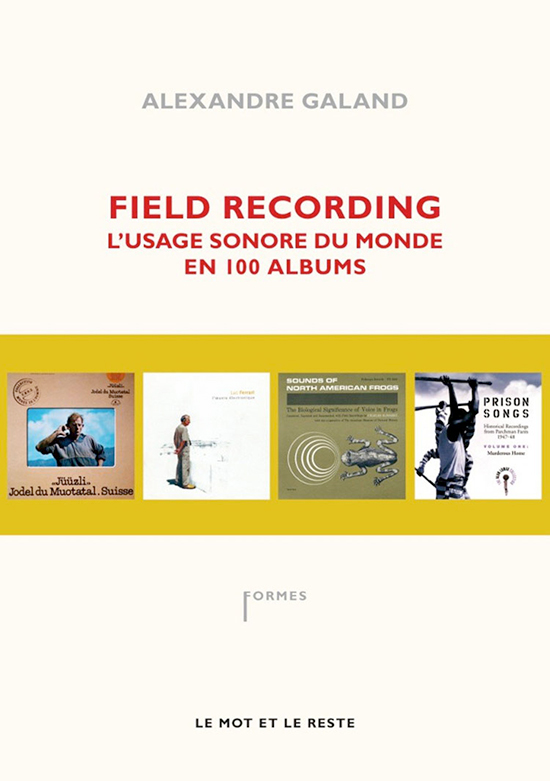
Initially, as a particular field in sound production, field recording was the result of a scientific and technological approach aimed at collecting the sounds of the world before becoming an aesthetic and artistic practice that started to use these very sounds as creative material. Over time, both approaches have reintroduced the noises of the world at the centre of creation. The publication of Field Recordings, l’usage sonore du monde (field recordings, the sonic use of the world) by Le Mot et le Reste editions was an opportunity to reflect upon what it has been customary to call (since the birth of Musique Concrete in the 50s, ambient music in the 70’s, hip hop and the appearance of the sampler in the 90s) the « Art of Field Recording ».

The Field Recording practice, as literally “recording in a field » appeared at the end of the 19th century thanks to the implementation of the first operational and portable sound recording devices. The major names in contemporary Field Recording – Chris Watson (former-Cabaret Voltaire), Geir Jenssen (aka Biosphere), the Touch label, Yann Paranthoën, Henri Pousseur, Lionel Marchetti or the late Luc Ferrari – are, and were, the heirs of emblematic pioneers such as Nicolas Bouvier, a Swiss writer, photographer, iconographer and traveller.

Equipped with his antiquated Nagra, one of the first tape recorders invented by Stefan Kudelski, throughout his life Bouvier explored the world’s roads, especially in Iran and Pakistan. He notably recorded Persians and Gypsies instruments and vocals in the Middle East. As such, he belongs to this category of travelling researchers, anthropologists, sociologists, audio-naturalists and ethnomusicologists, scientific and music lovers, who recorded sounds for heritage archiving purposed, forever curious, struggling against oblivion and ignorance.

Some researchers are passionate about the singing of the lyre bird in Australia others about the melodies of the Solomon Islanders, whilst others still are focusing on the noise of the city or the exalted complaints of prisoners from North American jails. From the outset, Field Recording was as extensive operating area which consisted in  rich and varied challenges and purposes. On this subject, the book by Alexander Galand, Field Recordings, l’usage sonore du monde en 100 albums (field recordings, the sonic use of the world through 100 albums), is a well of knowledge. The author – rightly – insists on the  scientific/artistic dichotomy, which turns out to be complementary over time. Comprising a long historiographical essay, three interviews (Jean C. Roché, Bernard Lortat Jacob and Peter Cusack) and a solid discography, this book is a first of his kind in French and an excellent introduction for the amateur wishing to dive into this ocean of sounds.

The technical origins of an art practice

Whether it be sound techniques or studies, collections used as archives or testimony of the anthropological heritage, initially field recording specifically used a scientific approach. In the beginning at least, the practice of field recording involved an important part of research: whether to investigate the nature of sounds, to collect sound curiosities or more specifically to test new techniques and recording equipment. From this point of view, these techniques and their evolution obviously had a lot to do with the birth of an art which was yet to rise at the time.

In 1876 Alexander Graham Bell invented the telephone, managing to transform the sound into an electrical signal. A year later, Thomas Edison was declared to be the « inventor of the phonograph » (although in reality he was just quicker at filing a patent of his in invention than his French competitor Charles Cros). This major invention marked the beginning of an era where reproduction of natural sounds (even as a series) had become possible. The phonograph was the first device to play sounds. Users then spoke into a metal horn, while operating a needle which engraved the pattern of the waves caused thereby onto a rotating cylinder covered with a sheet of tin that could then be payed back. This did not prove very malleable and was quickly replaced by a wax film.

Finally the acetate appeared and was used with the gramophone of Emile Berliner, inventor of the process. Nevertheless, Industrial production was laborious and only truly started in 1889. For his part, the Danish Valdemar Poulsen, following the discoveries of the German Heinrich Hertz on electromagnetic waves in 1887, invented a form of magnetic recording on a flexible wire in 1898. But the German chemical company BASF managed to store sounds on a « wire » recorder from 1930. This technique improved with the advent of the pre-magnetised tape provided by the same company (which incidentally was to be used a lot by the Nazi regime).

From Field Recordings to the soundscape

As we can see, since its inception, the art of Field Recording has relied on the constant technological evolution. The « audio-naturalists, » (name then given to the pioneers who practiced this type of research), could only use the available means, always seeking higher quality, portability and accessibility. This singled out several categories of practices and several approaches within Field Recording.

Some practitioners opted for rough, in situ, audio recordings in nature, choosing not to exclude « parasite sounds » and other natural sounds that surrounded the subject and observer. This is a well known problem faced by lovers of songs and animal sounds, as well as those who record and archive ethnographic sounds (the « natives » of various regions of the world, prisoners’ songs, sailors, bluesmen, folk songs and instruments) or naturalistic sounds.

Such a problem is inherent to the sound environment induces different approaches. Some prefer to isolate the recorded object, which requires access to a studio. This is where electroacoustics and sound processing come in. With the widespread production and reproduction tools (the gramophone, the phonograph and then the tape recorder) came the era of the acoustic, electroacoustic and acousmatic experience. The initial and basic field recording turned into « acoustic ecology », « landscape of sounds », « cinema for the ear » or « microphony », sometimes reproduced and « tweaked » in the studio. With the rise and accessibility of the home studio, these practices started spreading and gaining importance. Technically, everything is good to turn the world into an ocean sounds. The art of Field Recording is a quasi-infinite audio exploration of the world.

Soundind the world

The Field Recording practice really took a different turn in the 50s. In the footsteps of the great discoveries of contemporary music: from Arnold Schoenberg, Alban Berg and Anton Webern’s serialism to Musique Concrète, conceptualised by the French Pierre Schaeffer and electronic music as represented by the German Karlheinz Stockhausen, the approach evolved. In this regard, it is important to note the fundamental theoretical contribution of Pierre Schaeffer and Musique Concrète to the aesthetic and creative evolution and approach taken by Field Recording. If music history is inevitably linked to the history of technology, then Pierre Schaeffer was a true pioneer.

From 1948, the French man founded the Groupe de Recherches de Musique Concrete. It started as a simple radio recording studio but then actively took part in the development of a new form of music: a « concrete » music which he later renamed « electroacoustic » music. Schaeffer was one of the first to dare to master the art of manipulating sounds with the emerging technology of the early tape recorders. After much trial and error, he elaborated a theory that involved challenging the notions of « music », listening, timbre and sound. He wrote these ideas in his Traité des objets musicaux (treatise on musical objects), in 1966. Following the lessons taught in this clear and founding text, composers started to try new experiences.

In the domain of Field Recording another French composer, Luc Ferrari, stood out even more, using the electroacoustic manipulation of sound and recordings and calling it « anecdotal » because their mundane and daily life qualities. With Schaeffer, Ferrari and later other composers like Michel Chion or Lionel Marchetti, it is indeed truly the sounds of the world, of the whole world, urban sounds, domestic sounds, tiny or supposedly « uninteresting » sounds that entered the scope of musical creation.

Field Recording and sample art: an aesthetic (r)evolution

Today more than ever, the Field Recording practice is at the heart of sound creation. From the ambient music invented in the ’70s by Brian Eno to techno and via experimental projects by various artists and musicians from the above-mentioned scenes, the Field Recording practice responds to a multiplicity of genres, approaches and trends. Ambient music, for example, was conceptualised by chance by the British musician Brian Eno when lying in bed he played an LP at the wrong speed.This micro-event was to give him the idea of an « ambient » or “wallpaper” music, which initially did not meet any of the (admittedly very free) requirements of Field Recording. It was techno musicians such as the English of The Orb, or the more industrial Cabaret Voltaire, 23 Skidoo and other bands who blended together relatively slow rhythms with sound recordings, dialogues, sounds of wind and waves for some or urban cacophony and information flows for others.

The emergence of noise in pop music, which dates back to the Beatles and the Beach Boys, became widespread through techno. In the 90s, artists from this scene were inspired both by Schaeffer’s Musique Concrète and urban or natural soundscapes from the ambient music forefathers to create their own sonic universe. This is the case for Geir Jenssen (aka Biosphere) who with a handful of truly unforgettable albums set up the basis for a unique genre, almost single-handedly creating a music school. In addition, former artists from the industrial or techno scenes, such as former-Cabaret Voltaire’s Chris Watson fully embraced this art-form, quickly making a name for themselves in this marginal field. Meanwhile, numerous major artists have tried this genre, providing the listener with pure Field Recordings records as is the case with Moondog, Yann Paranthoën, Jana Winderen or Peter Cusack. They, too, followed the footsteps of great pioneers such as Luc Ferrari, Henri Pousseur, Steve Reich or Alvin Lucier.

From its worldview, its freedom, the multiplicity of its related practices, the ongoing active evolution of means of recording the world around us, exploring « micro” and “infra” sounds, the different goals pursued by artists specialised in it, Field Recording still has a bright future ahead. Like the productions it offers, it continues to be a window looking out onto the world and creation.

Maxence Grugier
published in MCD #70, “Echo / System : music and sound art”, march / may 2013

> Version Française

or how to draw sound lines

Whenever we describe music, outside of its technical aspects, we quickly revert to a physical, geographical, landscape vocabulary. Is strictly musical rhetoric insufficient, or does there exist an intimate relationship between sound and image that makes such comparisons inevitable? Here is a subjective and necessarily incomplete overview of synesthetic musical pieces.

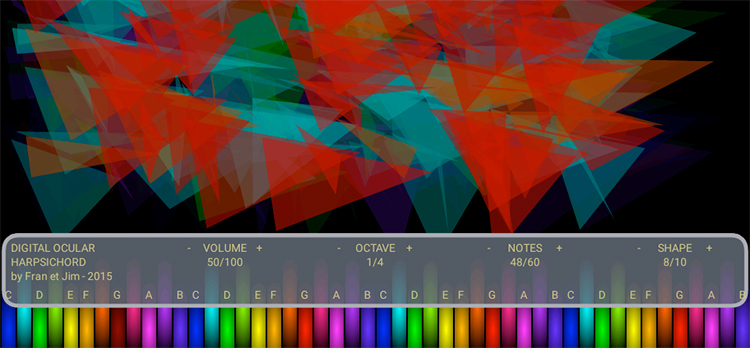
Jean-Michel Rolland, clavecin oculaire numérique conçu d’après les écrits du père Castel de 1735. Photo: D.R.

In February 1809, Ernst Florens Chladni was invited to the Tuileries palace by Napoleon Bonaparte. The German physician and musician came to present to him his extraordinary invention, or rather his discovery, which all the courts in Europe were talking about. Spurred by his curiosity and love for sound, in 1787 this father of modern acoustics had done an experiment in which he sprinkled some sand on a metal plate and rubbed it with a bow. Depending on the location, length and frequency of the resulting sounds, geometric shapes appeared, disappeared and transformed, offering the marvelous spectacle of music becoming lines.

It was no coincidence that this discovery rose to fame at the height of German romanticism, when appreciation for analogies between various resonances of the world was already setting the stage for another movement to appear a good century later: surrealism. At that time, romanticism aimed ideally to synthesize the arts. Meanwhile, shining a light on these intimate relationships between sound and image fit right into the Zeitgeist of the budding 18th century.

More than 150 years later, another scientist, Hans Jenny, expanded on Chladni’s experiments by placing oscillators on quartz sand, as well as on fluids. Jenny described the resulting cymatics—acoustic shapes—as following orderly patterns. Surprising images, reacting immediately to the sound, formed in the powders, but also in water, in alcohol. They could only be referred to, without hyperbole, as sound images.

Henceforth, the correlations between the harmony of sounds and the harmony of lines were scientifically, physically, confirmed. But it didn’t take these two ingenious installations for people to make images from every flutter of sound. Every description of music sooner or later uses a landscape vocabulary. How many skies, waves, sands, branches do we hear in the humming of strings, in the drops of a piano, in the vibrations of a synthesizer, in the friction of metal…

Still others feel this link intimately, and the complicity between image and sound stems from deep within, at the very root of their perceptions. This phenomenon, known as synesthesia, is rare, but some people “see” sounds in certain colors, while others “hear” certain sound frequencies when they see red, blue, green…

Poetry or neurology, the senses concur to entangle seeing and hearing, from Rimbaud (Voyelles) to Kandinsky, from Baudelaire (Correspondances) to Scriabin. This last artist, a Russian composer who dreamed of a great project associating colors and music, reappropriated the ideas of Father Castel, who in the 18th century had designed an “ocular harpsichord” for the deaf, whereby the succession of colors on the eye produced the same effect as musical notes on the ear.

Such audacious attempts, not always successful, were scorned by some, admired by others. Nonetheless, the 20th century witnessed the explosion of technology, just as it welcomed creative works where music merged with other movements well beyond the musician on his instrument.

It was the age of the theremin, named after its inventor. This pioneer instrument of electronic music owed its fame not only to its sounds, or even its technology, but above all to its futuristic mode of “remote” execution, anticipating the remote sensors that surround us today. The theremin player literally manipulates space: he keeps his hand within a few feet of the antenna, which picks up his movements and converts them into sound, controlling the pitch of the note with his right hand, the volume with his left.

The instrument has lived on through the century, and far from being classified as a curiosity of music history, it can still be heard today on albums by Squaremeter, The Damned, Radiohead, Cevin Key (Skinny Puppy)…

Some artists scratch space, while others (finally) make light or colors sing. Such is the case of the laser harp, invented in 1980 by Bernard Szajner. The interrupted light beam determines the pitch. Here again, other musicians, including some very successfully, have reappropriated this synesthetic invention that owes its existence to electronic technology.

From sensors to motion capture, astonishing artworks are expanding the field of musical possibilities. We have only to see the manipulating musicians of Biomuse, led by Atau Tanaka, as they move their arms like conductors of an invisible orchestra to knead a subjugated texture from this ghost ensemble. Biomuse, the fruit of much labor by researchers Hugh Lusted and Benjamin Knapp at BioControl Systems, is a “biomusical” interface that senses electric energy in the forearms and converts its movement and tension into sounds and music.

BioMuse Trio, in which Ben Knapp wears the biosensors, with violonist Gascia Ouzounian and Eric Lyon on laptop, gives an example of the installation’s fantastic dynamic, playing off violin samples captured digitally in almost real-time. Gestures trigger the imagination as if engraving on emptiness. Theremin, laser harp, Biomuse: the avatars of these spatial arm gestures all have the same objective, no matter their degree of sophistication: to transgress a law of physics, where one must touch in order to provoke…

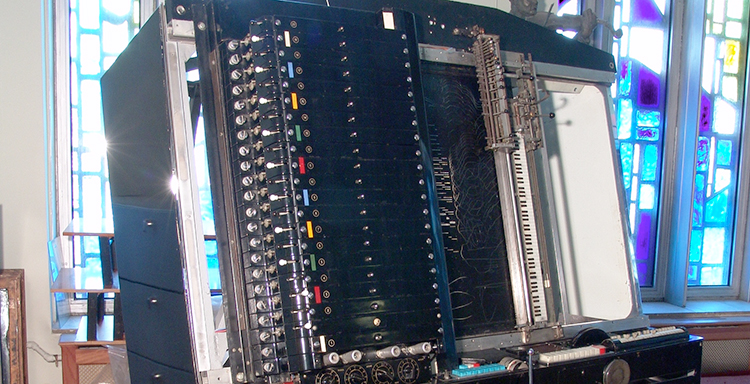
Much more adventurous was the path that extended from Father Castel’s ocular harpsichord, which Scriabin had also explored, which involved positively linking sound to image. From 1937 to 1957, the Russian engineer Evgeny Murzin developed such a device. Not only did he imagine it, he made it. The resulting ANS (in a tribute to Aleksandr Nikolaevich Scriabin) achieved the opposite of the discoveries of Chladni and Jenny—it converted images into sounds. Monumental, rustic and esoteric in appearance, this synthesizer (which Ivan Pavlov of CoH described as a “cross between a time machine from the future and a magic, antique, mysterious engine”) embodied a two-way concept: when played, the ANS could produce drawings and lines corresponding to sound data, like “musical landscapes” painted by the musician; but it could also react musically by synthesizing a sound from its graphical representation. The graphic was drawn on glass plates coated in black resin that were slid into the device, which reacted as programmed with purely synesthetic momentum.

There is only one ANS left today, conserved in Moscow at the Museum of Music, and has long been presented by Stanislas Kreichi, former assistant of Murzin. Little by little, the machine sweeps across the engraved glass plate, instantly converting lines into music, assimilating the stack of prepared drawings to a musical score.

Le synthétiseur ANS conçu par l’ingénieur russe Yevgeny Murzin. Photo: D.R.

In short, thanks to the ANS, shapes “take sound” in the same way that the discoveries of Chladni gave shape to sounds. Artemiev (for the soundtrack to Tarkovski’s Solaris), A. Schnikte, Coil and Cisfinitum have all used ANS sounds that seem to have emerged from the cosmos in the form of an austere chant full of light. The coldness of space, which we admittedly associate with Soviet epics, draws a halo around the delicate humming of the machine, its fragile whistling, and its medium waves.

Indeed, the music of the ANS is astonishing in its process; it is also unheard of (both literally and figuratively) in its texture. The Coil box set of 3 CDs and 1 DVD, which revisits the group’s 2002 experiments with the Russian synthesizer, gives a wide panorama of the machine’s potential.

The ANS made a dream come true: instantly converting drawing into musical vibration. It was a triumph of the romantic spirit, of surrealist audacity over realistic rigidity. Each step of this importance pushes back further the limits of the impossible. Just yesterday, a synesthetic device such as the ANS seemed crazy. Before that, space travel was only a fantasy. We know the giant step that mankind has made since… Space, and why not time? Maybe it’s the next phase. And we can only dream when we consider what Nobel prize-winning physician Georges Charpak very seriously suggested, that the ancient vibration of sounds emitted by a potter of antiquity could have engraved the pot as it spun, like grooves on a record made of wax or vinyl (1). If the future has yet to be written, the past is still overflowing with treasures to decode…

Denis Boyer
published in MCD #70, “Echo / System : music and sound art”, march / may 2013

Denis Boyer is Editor-in-chief of the review Fear Drop > www.feardrop.net

(1) These “paleo-acoustics” (or archeoacoustics) follow the research of Richard Woodbridge, who had done four such experiments in 1969. The first succeeded in transcribing a sound precisely produced by the spin of a potter’s wheel on a piece of pottery. This sound could be reproduced through headphones with the help of a wooden tip and a piezoelectric cell.

> Version Française

hypnotherapy method…

The presence and continuous development of technology in the music field will not have gone unnoticed, yet one could wonder about the lack of consideration as concerns the impact on contents, i.e. the normative trend induced by the generalisation of the computer tool as a means of production, distribution and listening.

Through the « modelling » phenomenon, this global and deep movement indeed conditions the entire music sector so as to de facto exclude some music. Eventually, with regard to the deployment of new media, the frantic emergence of new products, the fetishism about equipment, etc., one can also question the nature of listening and relating to music …
The vinyl or K7 revivals, as nice as they may occasionally be, are often expressed as a misunderstanding of digital formats (no, the CD is not bad; yes, digital amplifiers are on a par with transistor or tube equipment etc..) whilst they are still being conditioned by the latter, not to mention a form of nostalgia or a fad accompanied by a fantasy of subversion …
If the plurality of modes of production, distribution and listening seem conducive to a diversity of creation (including the auditor’s active involvement), unfortunately, in some respects, it also conceals standardisation phenomena. The audio hardware market is experiencing some effervescence … It may not be customary to pay for acquiring music itself, but it is usual to purchase €300 headphones so as to listen to MP3s…

The technique is the dominant factor in our society, it fundamentally shapes it (even before economics – that guides its applications, enhances some of its effects etc. –  and politics). We are referring to Jacques Ellul on this topic (instead it is usual to observe this kind of influences: economical, political, scientific, cultural). Any technique integrates negative and positive aspects, but in such a way that it makes it hard to separate them.
Faced with the usual arguments of the advent of new audio techniques (the accessibility of production, distribution and, lastly, the works), one should note how the technique does not only induce emancipatory effects. How can we be blind to the fact that technology is also a catalyst for the continuous flow of the global machine in an automatic mode, continuously fed by a succession of interchangeable contenders and their farmed music; obviously sustained by the market and the disguised monopolies of large groups?

Regarding production, unlike what the digital context may suggest, we do argue that setting up « labels » still has some relevance (even more so) today but let us remember that when the profile of such activity (or a publishing house) is akin to craftsmanship, it is not supposed to exist in relation to the established systems. This is an impossible economic model –  if we put a little awareness in the ins and outs – even though one can find tricks, play with constraints, integrate the « crisis » into the project. In this context, the technical facilities have not made the practice more viable (on a global scale), nor do they guarantee a quality of production.
A development which has repeatedly been commented upon involves a single individual, who without leaving home, can consolidate the entire music production chain from composition to the negotiating of rights via the promotional clip and up to public retailing. Faced with the idiocy of majors labels, this easy « all-in-one » solution is obviously attractive (though dominant circuits were quick to adapt and incorporate this aspect), but it can also overshadow the interest in collaborative modes inherent to former processes (sound engineer, producer, arranger, etc.)..

Here, we encounter the human propensity to opt for an easier practice, and the question of creative freedom. If it is possible to overcome the tutelage of a producer or a label, one nevertheless suffer the constraints of a technical (and commercial) system…
Production can be formatted both by the used tools as by the prospect oft the practical distribution. This standardisation – which, of course, may also result from a collective deed – of the project to the limits of a dominant system (excessive compression, etc..) is not necessarily conscious …
It is, of course, out of the question to validate the principle of division of labor whose horrors we know well. Functions should not be closed up – a history of provisions not of assignments. Besides, a single author might impose on himself a division of labor not dedicated to the artistic project… Projects must define the systems and not vice versa – which does not prevent anyone from toying with the established conventions. Cinema is full of examples of producers and writers who have demonstrated skills specific to each other’s field, etc.. As stated elsewhere, what makes art is constantly shifting and is not the sole fact of authors (questions of freedom). It is always enlightening to move between the different levels (author, label, distributor, store …), trying for example to examine the functions of each one in the light of the others (this also applies to other areas).

When it comes to audio media, unlike the dominant ideas, the CD is still the easiest way to listen to properly rendered music. Once again, we encounter the human propensity to search for convenience before the best option, if this was not the case, the MP3 would have been restricted to non-musical uses. If you however wish to use a « dematerialised » file (which always requires a great amount of equipment), a « correct » audio rendering still shows a significant difference with the simplicity and reliability of a CD set up (to near the CD quality, you will be faced with quite a few technical issues), knowing that we must also take into account the cost of HD tracks when cheap CD availability is infinite. This, of course, only applies if you are caring about things like fine orchestral works, etc.. Obviously when it comes to pop music calibrated for the MP3, differences are smaller …
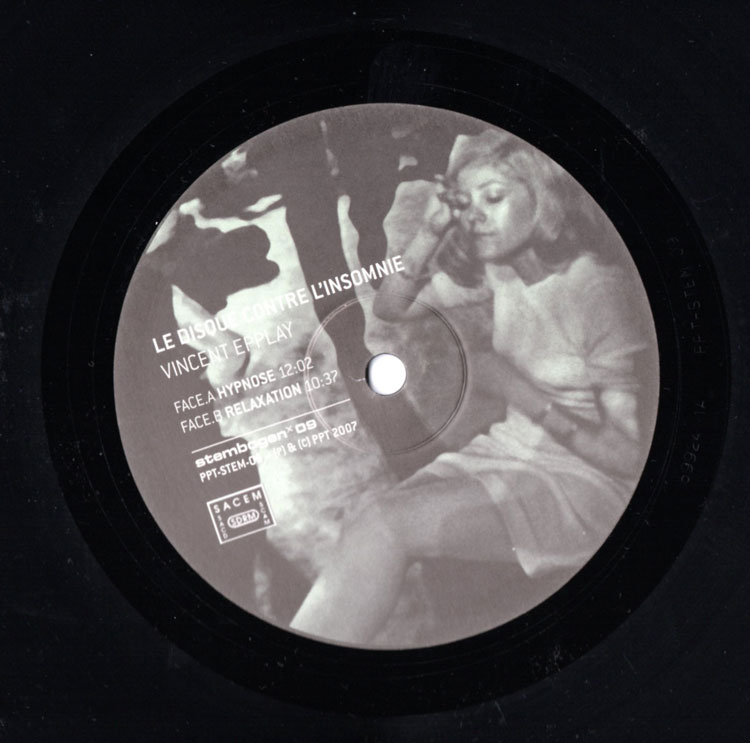
A vinyl / CD quarrel from another era is no longer relevant, and in fact I can not imagine some projects (such as Epplay on our label) or music (such as the skweee) other than on vinyl. However one should avoid comparing the sound of a cheap CD player to an upscale turntable… In many ways the CD has advantages we cannot all list here. For example, for some music, not to hear the surface friction is more important than what vinyl (sometimes deceivingly) provides. Finally, when observing the vinyl trend, one will notice countless new followers who share their disappointment on dedicated forums… Eventually, there is nothing intrinsically wrong with the vinyl and this is just about balancing the debate …

Dematerialisation might seem relevant with regard to arts and music … But something remains physical, a parasite aesthetic, etc.. Some projects rather opt for integrating the physical elements, to toy with them rather than suffer by convention. Therefore no objections should be maintained between the media; we should rather see a range of resources whose specificities it may be interesting to explore and mix to reach various objectives. The contribution of digital tools is undeniable in terms of field for experiments they opened for modes of composition, collaboration, sharing, listening… From a « consumer »‘s point of view, there is also a complementarity between the different proposals for different uses.
To return to the questions of sound reproduction, one can avoid falling into the trap of an elitist delirium – besides the hi-fi has become more accessible and we can enumerate many other unnecessary expenses, destructive ones even, that will end up costing more. On the other hand, numerous music are clearly being distorted by their means of diffusion to the point of losing their interest, their singularity. On occasion, on could also hear a clumsy performance or composition which in fact was caused by a weak rendering of the attacks or fades of the notes…

This is not about asserting how music should be listened to, or fantasise about a piece in its pristine origin, but about noting that this music is often altered without one having the choice or being aware of it: we can choose to read a book by fragments, but no one would accept a book that was distributed with modified vocabulary or missing sentences… However, many items of music only exist though their media. So if the quest for the identical sound from a studio to a listener is unrealistic (and what is more not necessarily desirable), we postulate that there is a decent, but relative, subjective, empirical minimum.
By improving the quality of reproduction we could certainly attract further audiences, the music is primarily a phenomenon of sound and not to properly render its carnal dimension will result in the indifference from the listener. Faced with these sound quality problems, there is also the lo-fi production option, usually a sign of an emergency, an indifference to « clean » sound or a rejection of digital tools, but this posture – bound to generate as much fetishism – does not solve the problem of rendering: are we to listen on a lo-fi or hi-fi system (which perfectly replicates the nature of the project)?

Our listening process is so tied to the technique that we sometimes listen more to the technique than to the music. For instance, in some concerts the amplification power compensates for the poverty of artistic proposal (and/or responds to a dominant/submissive game beyond any musical concerns, unless a reality of the concert, obvious in some cases, is being expressed there). One could see here an unexpected attraction to the noise experienced by transfer… just like a repressed sexual orientation experienced by transfer.
In this sense noise music is a significant link to our world, and though this direct confrontation with the technique, if properly conducted, it constitutes its aesthetic awareness, touching sensitive areas the dominant musical purr cannot fathom… This is the use of technology as a (re)activation of sensitive and mental areas versus the « prothesis » or « atrophy » techniques.

Denis Chevalier
Cofounder and Art Director of PPT et of the Stembogen label
> www.e-ppt.net

published in MCD #70, “Echo / System : music and sound art”, march / may 2013
> Version Française

A transversal label

What is the scope of action for a label in the current context where music, is dematerialised but still reified, constantly losing its commercial and aesthetic value in the “mesh of the web”? Pierre Beloüin, Optical Sound’s label-manager, answers to this question, and some others. The label is a structure that goes beyond the framework of music publishing to claim other artistic territories, as its subtitle indicates: records & fine arts.

My initial motivation for creating Optical Sound was to extend what I had already been doing, just like any other music lover, as a teenager, in the form of compilation cassettes: a way of giving a sonic point of view, but this time in a more professional manner, by producing groups, with a real distribution, visual identity and editorial line.
On the other hand, of course, I had in mind great labels that are still models for me, like Touch, 4AD, Mute, Mille Plateaux, Mego, L’invitation au Suicide, Sordide Sentimental, Giorno Poetry System, V.I.S.A, Bondage, Some Bizarre, Factory…  and I’ve left out some of the best!
Another essential motivation was also to link my work as an artist to my passion for music, starting with the first edition of Optical Sound which was created for individual listening (see: OS.000 Programme Radio), but also with one of my installations which was initially presented for my diploma at the Beaux-Arts de Paris and was called Optical Sound.

As far as I am concerned, music has always been intimately linked to visual arts, and I can continue to quote, in a very basic way, Mike Kelley and Sonic Youth, the Velvet Underground and Warhol; there are so many examples… Transversality wasn’t invented in the 1990’s.
These two areas, and many others, have always informed my research, in both directions. It forms a whole with all the cultural domains that drive me; it seems to me essential to have a certain coherence and a line of conduct.
Optical Sound is not a label for just electronic, experimental, alternative, cold wave, rock, dark dub, exotica, concrete or acousmatic music, but rather all of them at the same time, otherwise, what good would it be…
However, Optical Sound is above all a sprawling structure which, as well as physical releases in the form of sound objects, also organises exhibitions, concerts, books and journals, screen prints, DVD’s, iPad applications, performative listening devices, sound architecture, funerary audits, etc.

At the same time Optical Sound has a conservation function with archives (RGB~Transfer, etc.), trace archives (Légion Cérébrale, live act for 23 headphones)… For the RGB~Transfer or Echo Location, it was about paying tribute to my peers, (forefathers) not in a purely nostalgic form, but with a contemporary pendant of auto-reinterpretations for Echo Location: what happens in artists’ creative processes between their early works and their most recent ones? What view do they hold of their own work twenty years on?
For the more than three hours long DVD of RGB~Transfer archives, it was about showing exactly that, despite the lack of broadcasting and audiovisual facilities at that time (1979-1991) a burgeoning and creative French scene was very much present. Paradoxically, one can see that even with all the current available tools, there is a certain creative poverty now…
Concerning the relics and archives of  live shows ( such as the Légion Cérébrale concert for my own exhibition at the FRAC PACA, for example), they are part of the Optical Sound editorial line. I’m not just producing artists’ works, but I also collaborate with them regularly in the creation of tracks for my own work. These productions are autonomous extensions of my exhibition projects, which still exist in a physical form as catalogues, long after the dates of the exhibitions or residencies (see Special Kit produced following my residency in Canada and then at the Villa Arson).

It is often said that Optical Sound only produces visual things because it’s a reference to  cinema. Perhaps but not only: the choice of the name was above all a way of bringing to light all the mental images that are generated by listening to a sound piece.
I hate labelling and constraints: everything pushes people into clearly identifiable boxes, even in artistic fields, when all it takes is to study a content to understand how it works; but what is cruelly missing today is the time to listen, to look, and a return to desire…
The artists produced by Optical Sound are multifaceted – video artists but also musicians, etc. Yet, for a moving visual form, I would rather opt for a return to one-off screenings as part of concerts performed in unusual places, like I have already done so during the Ososphere festival, for example, or will soon do it again with the Fimé in the PACA region.

interviewed by Laurent Diouf
published in MCD #70, “Echo / System : music and sound art”, march / may 2013

Optical Sound > https://optical-sound.com/wp/

> Version Française

the dream life of digital letters

This will kill that. Such were the words used by a distraught priest in Victor Hugo’s Notre-Dame de Paris to express his anxiety over the fact that books would one day replace religious architecture. These days, there are fears that « this »—digital media—will lead to not only the disappearance of « that »—books—but above all the degeneration of certain forms of expression, and more specifically, of literature.

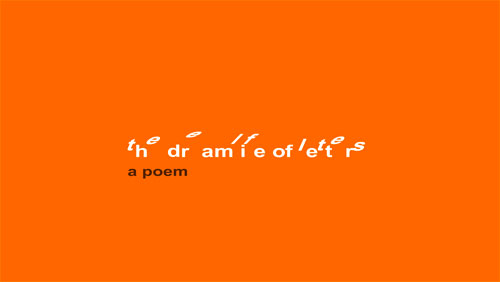
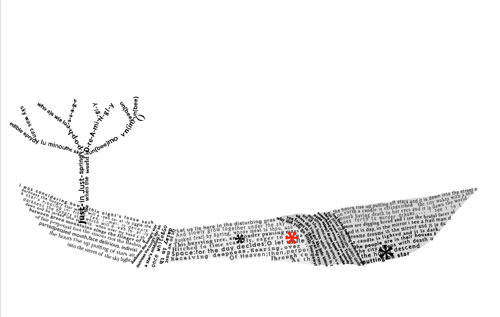
The Dreamlife of Letters, Brian Kim Stefans, 2000. Photo: D.R.

At a time when tablets are still transforming our reading habits, it seems particularly important to question the existing forms and potential of digital literature. I will not, however, establish any type of competitive relationship. Certain forms of literature continue to be writtern and read on paper; others have begun (ever since Theo Lutz’ Stochastische Texte in 1959) to experiment with the new dimensions brought to text by digital media. I will review of a few of these dimensions, with regard to their poetic potential. Literature written for digital media first took off in the 1980s and ’90s with the appearance of magazines (such as alire) and the creation of authors’ associations (such as the Electronic Literature Organization). The last few years have seen a growing number of festivals and anthologies.

Poetic machines before the letter

While digitally native, this literature belongs to the avant-garde tradition of trangressing the frame of the paper page with hypertexts and randomness « before the letter ». As early as the 1950s, the authors of OuLiPo (Ouvroir de Littérature Potentielle) had cut up poems into strips to show the importance of randomness in the creative process (see Raymond Queneau’s Hundred Thousand Billion Poems) and were among the first to consider computers as « automatic generators » of poetic texts. In terms of narration, the first digital experiments were often inspired by the tradition of the Nouveau Roman. Hypertext seemed like the dream machine to allow the text to expand in a complex web of interlaced temporalities and causalities. Today, the paradigms of the « poetic machine » and hypertext-fragmentation are still relevant; I would even say that we are only beginning to know how to « read » hypertext. Nonetheless, the arrival of hypermedia has also given rise to emerging literary forms that explore the borders between literature and visual arts.

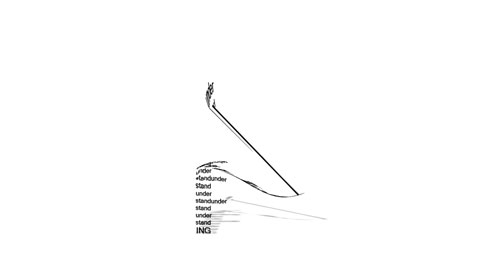
Stand under, Glia.ca, 2009. Photo: D.R.

Moving text

Certain works experiment with moving words and letters, which more or less act upon the meaning of the text. In Alison Clifford’s The Sweet Old Etcetera (1), the word « grasshoppers » hops onto the screen, and the double « o » of the word « look » appear and disappear like blinking eyes. I’ll call this quasi imitative relationship between text and movement « cine-gram » (in reference to the calligram). In other cases, the movement not only imitates the meaning of the text, it opens it up to new meanings, in a non-illustrative manner that recalls figures of speech such as metaphor. These I would call « cine-tropes ». For example, in David Jhave Johnston’s poem Stand Under (2), the words « under » and « stand » are unbearably stretched out and then compressed. Both inseparable and incompatible, the relationships between text and movement seem, at least in part, to escape interpretation. What remains then between text and movement is an impression of (de-)coherency: a free space in which I would situate the poetic potential of animated text.

Touch text

Other spaces of (de-)coherency have emerged from the relationship between texts and interactive gestures. In Philippe Bootz’ Le Rabot poète (3), the reader is invited to literally « plane » the surface of a poem using the cursor as a tool. This relationship between the gesture and « erased » effect visible on the screen could seem purely imitative, and thus constitute a « kine-gram » (again in reference to the calligram). However, certain words have a surprising relationship with the gesture—for example, the reader is invited to « plane » the words « you part these waters », even though water is not a planable material. Does this (de-)coherency between gesture and text escape all understanding? Perhaps not. Contrary to what online scratch games would have us believe, digital matter never gives in to our interactions. Thus, Le Rabot poète seems to warn the reader that his gesture is effectively futile. This impression of futility is further reinforced by the fact that the poem continues in the same way if the reader stops planing. This is how digital literature can sometimes be impertinent, resistant, even political—far from inviting the reader to play a frivolous word game, the interface challenges the reader’s reflexes and expectations, prompting him to question the « givens » of digital media. This questioning is all the more salutary when digital literature is occasionally accused of collaborating with the economic world, already using its machines and creative tools.

Bordering on disappearance

A third characteristic of digital literature is its multimedia nature. I won’t go into the complex relationships between text, image, sound and video in these « e-forms », but I will cite an emblematic example that shows both the potential and the possible risks for text. In Reiner Strasser’s In the white darkness (4), the reader activates images and fragments of text through a graphical interface. The word « remember » emerges, for instance. The letters are filled with images; « m » contains a child’s face. In a brief note, the author explains that he observed the development of Alzheimer’s disease over a period of several weeks. Based on that experience, he created this interactive visual poem, which sensitizes people to the fragmentation of memory, the slowness and despair of (de-)coherency, but also to the fading softness of the last memories. The result is a magma in which the text inexorably dissolves into graphical material, even if it remains present in the computer program of the work.

Programming text

This relationship between the visible text and the computer program is sometimes difficult to apprehend. Every work of digital literature depends on a program, even if the reader doesn’t see it in action on the screen. Because of machines’ ever-increasing processing power, the program is not necessarily executed in the same way on every computer, making digital literature fundamentally fragile, even ephemeral. Some 20-minute animations created in the 1980s are now almost unreadable as they speed across the screen in a matter of seconds. It’s a problem for conservation, but also a challenge for the authors. Some works are thus designed to slowly « decompose » on the screen. It’s this ephemeral nature that I’m experimenting with in my own pieces (Tramway (5)), by studying this increasing (de-)coherency between visible text and programming in the context of memory. This personal note ends my brief survey of experiments in digital literature. Instead of concluding, I invite the reader to take possession of these free spaces, between empty and meaningful, where digital literature’s poetic potential awakens a new « dream life of letters », always bordering on disappearance.

Alexandra Saemmer
published in MCD #76, “Writing Machines”, march/may 2012

(1) http://duck-egg.co.uk/sweetweb/sweetoldetc.html
(2) http://glia.ca/mp4/standUnder_MainConcept%20AVC-AAC_HI_qtp.mp4
(3) http://www.sitec.fr/users/akenatondocks/DOCKS-datas_f/collect_f/auteurs_f/B_f/BOOTZ_F/Animations_F/rabot.htm
(4) http://collection.eliterature.org/1/works/strasser_coverley__ii_in_the_white_darkness/index.html http://revuebleuorange.org/bleuorange/02/saemmer/
(5) http://collection.eliterature.org/1/works/stefans__the_dreamlife_of_letters.html