It really is a very odd business that all of us, to varying degrees, have music in our heads. When the Overlords of Arthur C. Clarke landed on our planet, they were surprised by the energy that our species applied to producing and listening to music; they would be even more surprised to learn that, even in the absence of external sources of stimulation, we hear for the most part continuous interior music. (Oliver Sacks, Musicophilia)

Whether we want to be or not, we are all science-fiction characters living in a science-fiction period. (Ray Bradbury)

Bach never modulated in the conventional sense, and leaves the extraordinary impression of an infinitely expanding Universe. (Glenn Gould)
 

Before we begin to imagine the natural and unnatural copulations between music and science-fiction, perhaps it’s best to define the latter, which is often for some what it is not for others, and not necessarily vice-versa.


In the 1950s, Jacques Sternberg titled one of his works: A Subsidiary of Fantasy called Science-Fiction. A bit simplistic, perhaps. Especially considering that fantasy is a non-rational novelistic conjecture, which squarely places it in a different conceptual niche from science-fiction, which is considered “more or less” rational. Pierre Versins, author of a now-mythical Encyclopedia published in the early 1970s, believes that science-fiction is a universe that is bigger than the known universe. A bit excessive, however. Versins must have realized as much, because he later specified: Science-fiction is not a “literary genre” but a state of mind (…) which is revealed through all genres, from poetry to film, and in all forms, from image to discourse.

This is where it gets much more interesting. Norman Spinrad, author of cult books Bug Jack Barron and The Iron Dream, hammers in the nail: We can only define science-fiction by the perception we have of it. Science-fiction is therefore what is perceived as such. So there is no doubt that Gravity’s Rainbow (Thomas Pynchon), House of Leaves (Mark Danielewski), Glamorama (Bret Easton Ellis) or Mantra (Rodrigo Fresan), while not publicized as such, can be perceived as science-fiction novels, just as Donnie Darko (Richard Kelly), Element of Crime (Lars Von Trier) or Mulholland Drive (David Lynch) can be perceived as films of the same genre.

What about music?

Since at least the 18th century, music has tapped into the world of science-fiction. One of the first musical works to be assimilated with SF is probably Joseph Haydn’s opera Il mondo della luna (1777), with a libretto by Goldoni, in which a truant tricks a gullible astronomer into believing that he lives on the moon. Later, Leos Janacek also takes an interest in our satellite with The Excursions of Mr. Broucek (1917), who first visits the moon and then time-travels to the 15th century. The science-fiction opera has tempted numerous neo-classical or post modern composers, such as Lorin Maazel (1984, based on George Orwell’s novel), Philip Glass (The Making of the Representative for Planet 8, based on a libretto by Doris Lessing) and Howard Shore (The Fly, based on George Langelaan’s short story and directed by David Cronenberg).

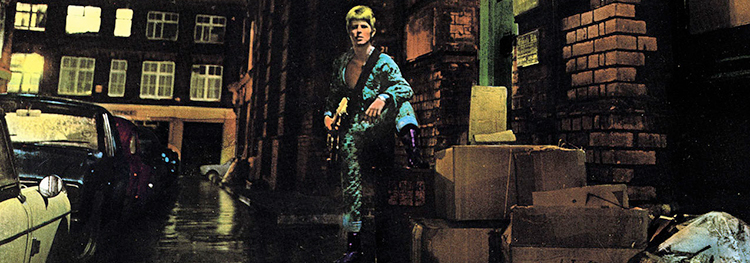
The worlds of jazz and especially rock, which are part of the same cultural, or rather counter-cultural community, as Boris Vian, Philip K. Dick, Robert Silverberg, Philip José Farmer, Michael Moorcock and J.G. Ballard, have more naturally built a number of bridges with SF. One of the most assiduous is David Bowie, with an imposing number of works, including Space Oddity (1969) inspired by 2001, a Space Odyssey by Arthur C. Clarke, or the concept album The Rise and Fall of Ziggy Stardust and the Spiders of Mars, which narrates the escapades of an extraterrestrial rock star, and Diamond Dogs, a dystopia in the spirit of 1984.

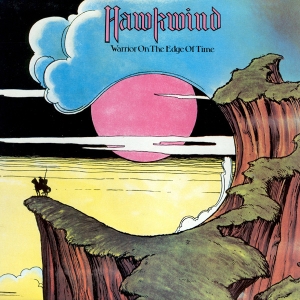
We could list dozens of groups, of course, but that deserves an article of its own (1). However, we will mention the British group Hawkwind, almost all of whose albums fall under the sign of SF, including Warrior of the Edge of Time based on the Cycle of the Eternal Hero by Michael Moorcock (who wrote the lyrics to three of the songs on the album), and the French group Magma, whose entire production revolves around the relationships/conflicts between Earthlings and the planet Kobaïa (with lyrics written in the ad hoc invented language of Kobaïan).
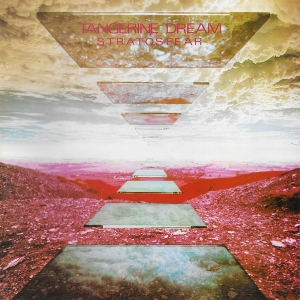
But psychedelic music is where SF has most potential in the Spinrad sense of perception. First off, there is the Pink Floyd spaceship piloted by Syd Barrett who delivers titles sparkling with stars and scented with acid and marijuana, such as Astronomy Domine, Interstellar Overdrive and Set the Control for the Heart of the Sun, as well as the whole “Krautrock” constellation (German rock of the 1960s and ’70s) with the representatives of the “cosmiche musik” trend: Tangerine Dream (Alpha Centauri, Phaedra, Rubycon, Stratosfear) or Klaus Schultze (Cyborg, Timewind, Moondawn, Dune), whose album titles evoke interstellar cargo-crossed immensities and more or less exotic planets that were already celebrated by Gustave Holst in his time. But whereas the British composer’s music only fully functioned as illustration once the theme was announced, all it took was a few notes for the cosmiche rockers to propel us into space.

How is this exploit possible without the use of words or images to funnel the listener’s imagination? With David Bowie or Hawkwind, the SF perspective is also suggested by the texts and imagery on the album covers. But without these textual or visual references, their music is incapable of assuring that the listener’s imagination is oriented toward science-fictional worlds. Hence the question:

Does science-fiction music exist?

Referring to Spinrad’s definition, I believe that we can answer in the affirmative: Phaedra, Rubycon, Moondawn, Dune, and almost all the German psychedelic albums that “sound” sci-fi, and which can therefore be considered as SF music. This leads to another question, which is much more difficult to answer:
Why—or rather how—does certain music sound sci-fi?

The archetypes of science-fiction, such as time machines, teleporting machines or space machines stuffed with electronics must have something to do with it. Indeed, sequencers, drum machines, samplers and, of course, computers decked music software are no longer instruments but also “machines” that generate sound. In the first half of the 20th century, they were only pure “anticipation”, excepting the first creation of mad engineers: the telharmonium (1900) or ætherophone (1919), better known as the Theremin, which already smelled like steampunk.

These first electronic instruments were often used before the arrival of synthesizers to add a certain “strangeness” to the soundtracks of fantasy and science-fiction films. The same can be said about Ondes Martenot (1928), the ingenious “steampunk” ancestor of the synthesizer, with its wooden keyboard and portable electronics. The German group Kraftwerk (who use the Ondéa, the modern version of Ondes Martenot) has played on these archetypes with the most clairvoyance and efficiency, especially on stage: electronic music + minimalist texts made up of keywords interwoven like strands of DNA + “hard science” stage design with robots standing in for the musicians + projection of films on key topics of science and technology… Thus, they are undeniably the precurseurs of cyberpunk (2). While their cosmiche colleagues ogled the space opera, albeit as sophisticated as Dune (inspired by Frank Herbert’s novel), Kraftwerk build a bridge between William Burroughs (Naked Lunch, Nova Express) and J.G. Ballard (Atrocity Exhibition, Crash) on one hand, and William Gibson (Johnny Mnemonic, Neuromancer) and Bruce Sterling (Mozart in Mirrorshades, Schismatrix), the popes of cyberpunk, on the other.

But synthetic sounds alone do not trigger a mental cinema in the image of space opera or even cyberpunk. The “composition”, the creative talent of the musician (fortunately) remains an essential element. As evidence, let’s go back in time for a moment (time travel is still a beautiful invention):

In his Last conversation before the stars, (1982) Philip K. Dick talks about his plans for a new novel titled The Owl in Daylight in which one of the main components is music, saying Pythagorus concluded that the foundation of the universe was the combination of mathematics and music, because they are two aspects of the same thing. Such was his teaching—hence the expression “music of spheres”. Then he said that moving bodies emit music but that we don’t hear it because we’re immersed in it since the time we were born, so we’re no longer aware of it. However, we perceive uninterrupted music.
This music that we do not perceive, but that exists somewhere in the mathematical universe of the world, do we not hear it somehow in the soundtrack of Eraserhead as “interpreted” by David Lynch and Alan Splet? It seems that this reinvented music of matter, of time and of space is, according to Spinrad’s definition, unquestionably science-fiction music, just like the images that go with it.

We can also get an idea of this explicitly SF intention through a creative shock: in the overture of Zaïs, where Jean-Philippe Rameau manages to musically translate the establishment of a progressive order of matter, in a true harmonic interpretation, two centuries ahead of his time, of the evolution (or nucleosynthesis) of interstellar matter (3); or in Les Éléments (1721) by Jean-Féry Rebel, who selects chords and arranges them to express chaos by themselves, without relying on voices or décor. The surprisingly modern result could have been signed by Art Zoyd. Whatever the perspective, on one side of time or the other, from listeners of the era to those of today, the creative shock triggers a break from reality and propels the work into SF.

This “break” is now “common”. We live in a bubble of the expanded, inflated present, lashing out its tentacles in all the senses of time. Accelerated duplication, cloning, drones. Technology is icreasingly overtaking basic research. Electronic music, now digital, lives its own life. It regenerates, metamorphoses, samples and duplicates, lives, dies and rises from its samples. Compression-expansion. The entire history of music in a nanosecond loop. Numbers are numbers.

The first time that Philip K. Dick took LSD, he was listening to a quartet by Beethoven, and he saw it in the form of a cactus. With each progression, from measure to measure, the cactus gained complexity; it was a process of accretion, and no longer a succession. It grew bigger and bigger, more and more complex. Through synesthesia, Dick saw Beethoven’s quartet in the form of fractal scaling, a Fibonacci series. He “naturally” converted the sound into image, just as a software program would have done digitally. Probably without knowing it, he was anticipating the digital revolution capable of “dematerializing” sounds and “rematerializing” them as images.

Number are numbers, and today all music is science-fiction.

Jacques Barbéri
published in MCD #70, “Echo / System : music and sound art”, march / may 2013

> Version Française

(1) See, among others, the feature Culture rock & science-fiction (Bifrost 69 magazine, January 2013)
(2) In the same vein (without the electro-pop touch), we can mention the French group Heldon and the solo albums of its leader, Richard Pinhas (to whom we owe an excellent book on Deleuze and music: Les larmes de Nietzsche), precursor in the 1970s of cyber-electro music that openly referenced Philip K. Dick, Norman Spinrad and Michel Jeury.
(3) In Astronomie et musique au siècle des lumières, Dominique Proust.

A writer and musician, Jacques Barbéri has published the trilogy Narcose La Mémoire du Crime, Le tueur venu du Centaure (La Volte), short story collections, Kosmokrim (Présences du Futur), L’homme qui parlait aux araignées and more recently Le Landau du Rat (La Volte). > www.lewub.com/barberi/

Barbéri is also a member of the group Limite, formed in the mid-1980s with other writers such as Emmanuel Jouanne, Francis Berthelot, Jean-Pierre Vernay and Antoine Volodine, sharing the will to experiment and transgress writing and narrative codes in science-fiction (see the anthology Malgré le monde, Présences du Futur). > www.rumbatraciens.com/limite/mecanique/m002.html

In parallel, Barbéri performs (saxophone, electronics, text) in the group Palo Alto led by Denis Frajerman. The discography of this experimental and atypical group includes Terminal Sidéral (CD+DVD on Optical Sound), Cinq Faux Nids Six Faux Nez with DDAA (Déficit Des Années Antérieures) on the label Le Cluricaun and, of course, Slowing Apocalypse: a tribute to J.G. Ballard published by È®e, featuring Laurent Pernice, with whom Barbéri also recorded Drosophiles & Doryphores, an electronica and melodic album on the multimedia Slovenian label rx:tx.
there is no predicate « this is literature »

Several times in your texts, you emphasize the strength of the ecosystem of reading. As a publisher, how do you feel our digital environment has changed our relationship with reading?
I’ve been working with texts in digital format almost since I’ve had a computer, in 1988. But it was a work relationship. The first e-readers (for me, the Sony, in 2008) allowed us to read continuous prose as comfortably as a paper book. But the ergonomics weren’t really perfected yet. Now, both because we know how to make epubs that are comfortable and stable (more or less the same on any reading device) and because the devices themselves have evolved, we can forget about them. You have it in your pocket, you don’t think about going to buy a newspaper or a paper book anymore. The iPad became the first companion for personal reading, but since the recent arrival of the Odyssey, the Kobo, I’ve gone back to reading on dedicated e-readers. These devices are good, because now we forget them—it’s paper books that we find annoying, when we have to shlep one around, or when we have the reflex to click on a word with our finger to call up the dictionary or the search engine.

Again, as a publisher, you strongly oppose DRM. Aren’t you afraid that the same thing will happen to e-books as with music, that is, widespread sharing with free access via P2P (what we commonly call « piracy »)?

Let’s stop using the word « afraid ». I’m afraid to walk down the stairs, so I stay upstairs. It’s not about being afraid of piracy, it’s about continuing to make contemporary literature desirable and demanding. The notion of ecosystem is used in the context of the Internet, where we offer access to our creative studio, and thus to a large free portion of our works. But with e-books—for example, but not only—we can offer a « service », a commodity of access, which can also include shared annotations, updates, expanding works that make peer-to-peer dissuasive or useless.

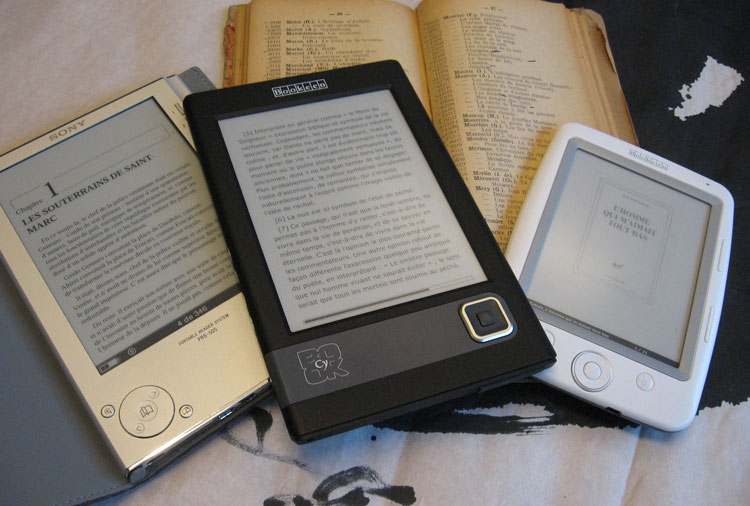
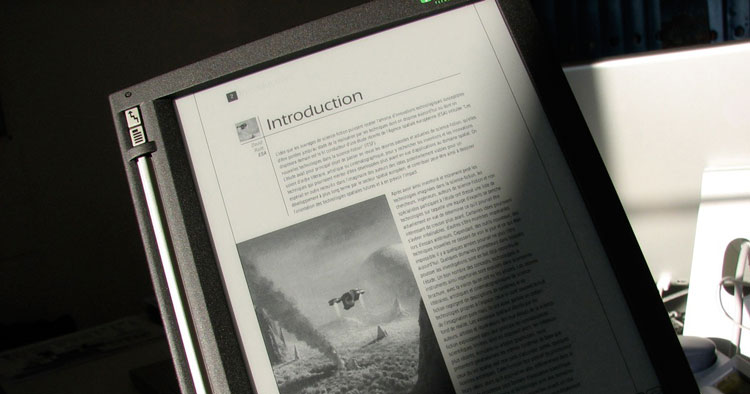
Liseuses électroniques. Photo: D.R.

Liseuses électroniques. Photo: D.R.

Considering the philosophy of access rather than possession, aren’t you afraid that access to books—and therefore to knowledge, culture, art—is concentrated in the hands of companies, which are themselves quite concrete and can disappear from one day to the other, thus depriving readers of access to the texts?

There it is again, the word « afraid »: I’m afraid of Nestlé, so I don’t buy milk for my kids. Yes, we face a centralized distribution system, whose reason for being is far from humanistic. It’s the same for car sellers. But we can tell ourselves, on the contrary, that we invest in them, that we use their tools not only to authorize access to our work, but also to promote it. That’s what we do, and often in dialogue with them. The question  is confusing; perennial access has nothing to do with it. The role of libraries, having our own servers complement or mirror those of digital libraries, even if my computer gets run over by a truck, or if Apple stops distributing e-books tomorrow, makes no difference.

Aren’t libraries the guarantee? Meaning that libraries will also have to go through their digital revolution?

Why use the future tense? Fortunately, they didn’t wait for the shockwaves to rethink their profession in digital terms. It still involves the tasks of mediation, orientation, the notion of public service in access (when large university campuses such as Nice, Montpellier or Strasbourg give each connected student integral access to Publie.net). If the librarian’s job were only to index, bind and lend books, what’s the point?

As a writer, in a 2006 interview for Le Magazine Littéraire, you wrote: It’s surprising how much the literary world distrusts the Internet. Do you believe that it’s still true?

It seems evident to me, at least if I compare it with artistic professions such as musicians, or scientific professions (excluding academic literary departments, which are even more behind). Most print writers tend to have the polar bear syndrome, with their claws firmly gripping the melting, drifting glacier. But of course, the environment has changed in the past five years. The authors who have emerged, and who have begun publishing since then, came with their digital habits, their blogs, and they know very well that if you want to know what’s going on, best go online.

In a way, couldn’t we say that the Internet « transpires » through today’s writers? I’m thinking of the recent cases of plagiarism: « Hegemann » in Germany and « Houellebecq » in France?

Those plagiarism cases are nothing but headline fodder for failing newspapers. We always write with what has already been written.

Liseuses électroniques.

Liseuses électroniques. Photo: D.R.

One of your articles, reprised in your latest work, after the book, is titled (writing) that comments are not writing at the bottom. It’s a beautiful formula. Do you think that comments enrich the text as an integral part of it? In other words, that writing a blog entry is more of a process than a definitive act? Do you think we’re returning to a form of orality in writing?

Literary history, and not just Jewish tradition (like the Zohar), has always included its own commentary, what Maurice Blanchot called « the infinite conversation ». The difference is that reading/writing in one word can now fit on the same device, be perfectly symmetrical in those positions, and intervene before publication, where it’s the construction site itself that is published. We don’t change the collective body of literature, which is also compatible with the « essential solitude » of the author—I’m thinking of the conversations noted by Kafka, the 3,000 letters left by Beckett—but this collective body can go beyond the private sphere, not have to wait for publication as hierarchy.

A question for both the publisher and the writer in you, one that you’ve been asked many times, but I can’t resist: Do you think that the notion of author has evolved under the influence of not only digital publishing but also digital writing?

The notion of author, no. The notion of writer, yes. This term was invented in the 17th century, in the context of a specialized function and what it generated. Over the course of the 19th century, with the commercial development of literature, it gradually gained a more fetichistic or symbolic value. Of course, with the Internet, we start over again at zero.

Now I’m thinking about the art of mixing, appropriation, sharing… Do you think that the notion of authorship has changed with the flow and Web 2.0? In other words, don’t you think that with the Internet, collective writing has become reality?

Collective writing didn’t wait for the Internet to become reality. Examples abound, beginning with the surrealist adventure. What is fascinating—and I say this more as a viewer—is to see Web experiments that allow very new forms of collective realization, and that it’s quite compatible with the deep, solitary commitment of those who participate in it.

Do you think that hypermedia literature is literature? Don’t you think that this type of literature suffers from a lack of publishing? Why hasn’t Publie.net done anything about it? Is it an economic problem?

There is no predicate « this is literature ». That’s why we need to constantly verify our assumptions. Neither Madame de Sévigné, nor the bishop Jacques-Bénigne Bossuet, nor Saint-Simon wrote for literature. It’s a constantly retrospective construction. On the other hand, I seriously invite you to come visit Publie.net, as the iPad is a great invention for « hypermedia » experiments—except that, precisely, we don’t need to call them anything so barbaric. We simply call them « books », period.

Writers have always integrated their medium (without always questioning it). In France, writers such as Mallarmé and Apollinaire questioned the letter and the page. In American literature, B.S. Johnson cut holes into his Albert Angelo, Douglas Coupland played with fonts and pagination, Mark Danielewski turned the book upside down, etc. In what way is e-publishing a new medium for writers to explore?

You’re a child in front of a candy store. A very serious man asks you the question: In what way is a candy store a new medium for children to explore?

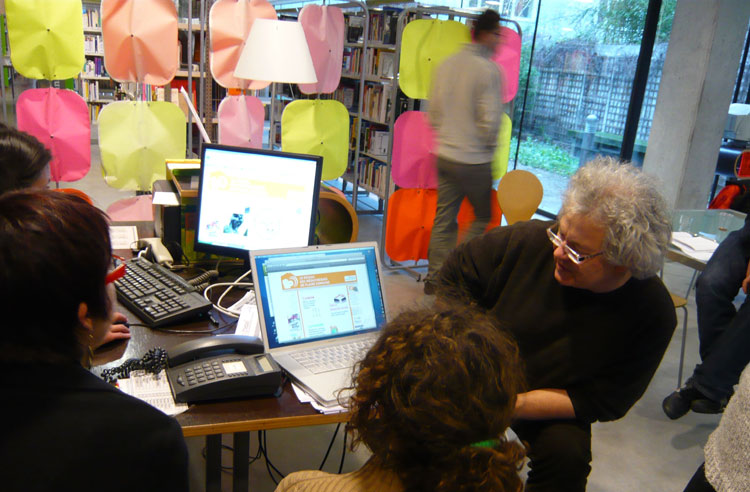
François Bon à la médiathèque de Bagnolet, 2009.

François Bon à la médiathèque de Bagnolet, 2009. Photo: D.R.

Literary and media Friedrich Kittler wrote in 1985: literature, which formerly ruled under the name of poetry above all other media, is now defined by other media. What do you think?

Couldn’t care less. Patter for a professor paid in career points after publication. If that’s the exact sentence, taken out of context, then this guy must not have read a whole lot.

In general, do you think that writing and reading machines (printing, typewriters, PCs and now tablets…) determine the way we write?

No, it’s our head that determines it. And urgency. And the notion of beauty. And the notion of our own experience among others. And our passion in language. And what we make from it.

Bonus question: You are one among that rare breed of writer-publishers. How do the writer and the publisher live together?

It’s the Old World that determines these partitions. They’re very recent. There are dilemmas that are never easy to resolve, for anyone, anywhere, regarding the relationship between work and personal time, including the tunnels, in relation to more collective involvement. Similarly, we don’t read the same way if we’re in the middle of writing something, or in a certain phase of writing. I launched with some friends a digital publishing cooperative, because we vitally needed to experiment, to have our own space for textual invention—including (but not only) because of the inaction or frigid hostility of our own publishers (it’s different now, they smell the cake). But it wasn’t in order to play out an entrepreneurial model, or the paternalism of publishing houses that we had known, or even the « economic models » and other bullshit. Writing is intransitive, said Maurice Blanchot. Let’s assume this intransitivity where we « already » have our territory for reading, writing and experiencing the world: online.

Interview by Emmanuel Guez
published in MCD #76, “Writing Machines”, march/may 2012/p>

François Bon: www.tierslivre.net

Thomas Paine’s adoptive town

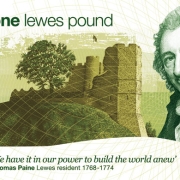
Thomas Paine, who is credited with helping to spark the French and American revolutions, is burning a hole in my pocket. Instead of the Queen’s face on British banknotes, I have Thomas Paine on my Lewes Pounds. His face is all over Lewes–this is where he was living at the start of his radical political career in the eighteenth century.

Livre lewes (recto). Conception graphique : Hudoq Digital Media, en partenariat avec Giant Arc Design. © Lewes Pound

Lewes has always been a revolutionary place. The first limits were put on the powers of an English king after the Battle of Lewes in 1264, when the barons forced Henry III to accept a parliament of nobles. When Bloody Queen Mary martyred 17 Protestants here in 1557 they became a potent anti-establishment symbol that still resonates today. Every year, on the 5th of November, Lewes’ Bonfire Boys and Girls commemorate the 1557 martyrs (and celebrate the foiling of a 1605 Catholic plot to blow up the English Parliament) by burning effigies of the Pope and the government of the day. Lewes’ Bonfire celebrations are so fiery that they can be seen from NASA’s satellites!

Thomas Paine wrote his first political work in Lewes – a treatise about the condition of his co-workers in the excise service–and went on to write Common Sense, the pamphlet which fanned the flames of revolution in America, and Rights of Man, which, in 1792, earned him a seat in the French revolutionary Parliament.

There was a Lewes Pound in Paine’s time. In fact our town had had its own currency between 1789 and 1895 as it pushed back against the outside world. The current Lewes Pound is part of a modern-day revolution, trying to relocalise economics and take back control of our lives from global capitalism.

Local currency for local businesses

I use the Lewes Pound for most of my day to day purchases – at the two food markets, in the three alternative food shops, in the cheese shop and the two bakeries, in about half the cafes and pubs, at my hair dresser and the pet food shop, in the hotel my parents stay in, at two shops where I buy clothes, at the CD shop, in my favourite restaurant. You can’t buy a daily newspaper with it for some reason but, if you’re motivated, you can do pretty much everything else.

I pay for my Lewes Pounds in sterling by direct debit from my bank account and then pick up them up once a month at a food shop near my home. If I need more Lewes Pounds, there about five shops in Lewes that dispense them, the equivalent of “cash machines”.

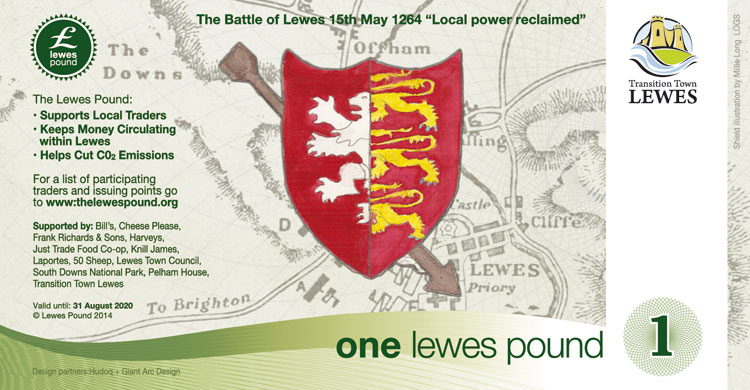
Livre lewes (verso). Conception graphique : Hudoq Digital Media, en partenariat avec Giant Arc Design. © Lewes Pound

The aim of a local currency is twofold: to celebrate the local community and to enhance local economies. Supermarkets, who provide fewer and worse paid jobs than local shops, extract 95% of the money spent in them. It goes into their tills and straight out of our town. The Lewes Pound can’t be spent anywhere else so it has to circulate locally, thereby facilitating and enhancing exchange between local businesses.

Part of the folklore

The Lewes pound has become part of the folklore of Lewes–like Thomas Paine and the annual Bonfire celebrations. In my opinion this focus on the folkloric has obscured the economic arguments, that local currencies can create extra local economic activity. The businesses who refuse to accept Lewes Pounds, and there are still quite a few of them, either do not understand the economic arguments or say they cannot buy anything with them in Lewes. This is a problem–most shops are not supplied by local businesses in our globalised economic system.

I also have to be clear that I am one of a very small group of people who religiously use the Lewes Pound–most people are happy to see it exists but prefer to stick with their pounds sterling, which work in London and Brighton. In some shops I am the only customer who uses Lewes Pounds! But these are experimental days. The main thing is to show how a local currency can work. If, or maybe when, the financial system collapses under the weight of its own contradictions, Lewes will be ready. As I said before, we are a revolutionary lot in Lewes!

Alexis Rowell
published in MCD #76, “Changer l’argent”, déc. 2014 / févr. 2015

Alexis Rowell is a Transitioner and eco activist. He is currently a member of Transition Town Lewes in East Sussex and act as managing Editor of Transition Free Press.
http://thelewespound.org/

In Europe, Italy was the first country to be an epicenter of the novel coronavirus. As a result, mobilized Italian makers showed the way for makers around the world. Enrico Bassi of Opendot fablab in Milan, specialized in open healthcare, tells the story.

Italy was one of the nations hardest hit by the Covid-19 epidemic. For weeks on end, the number of deaths and cases continued to increase, especially in the northern regions of Lombardy and Veneto. Their respective health systems, considered to be the most efficient on the Peninsula, were brought to their knees. As hospital supplies ran out, personal protective equipment (PPE) became a rare find, as were essential parts for ventilators, CPAP machines, etc.

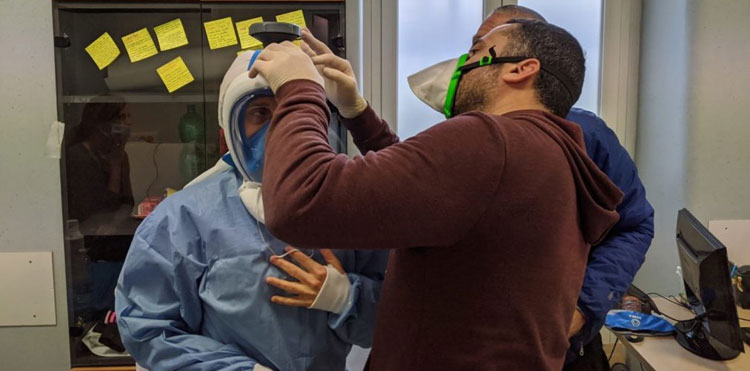
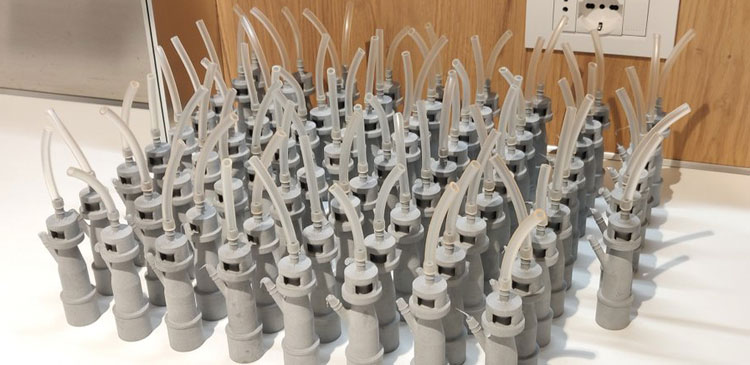
At Chiari hospital, the situation was dire: all the Venturi valves required for mixing oxygen and air were currently in use, and the company that produced them could not supply new ones fast enough. So Cristian Fracassi and his team from the company Isinnova brought a small 3D printer to the hospital, redefined the shape of the piece, printed and tested it in record time. But these fused filament fabrication (FFF) printers could not reliably produce precise or sterilized pieces, so after a few tests, hospital staff decided to use pieces produced by sintering.

This first mobilization unified the heart’s generosity, the brain’s tech-savvy and a good dose of courage—this kind of experiment had never before been tested in such conditions. News spread around the world! However, considering the delicate nature of the project, the files were never made public, and Fracassi himself advised against producing similar solutions with non-professional technologies. He emphasized that this experiment could only be done as a last resort in an emergency situation and that industrial products should always be the preferred solution… when available.

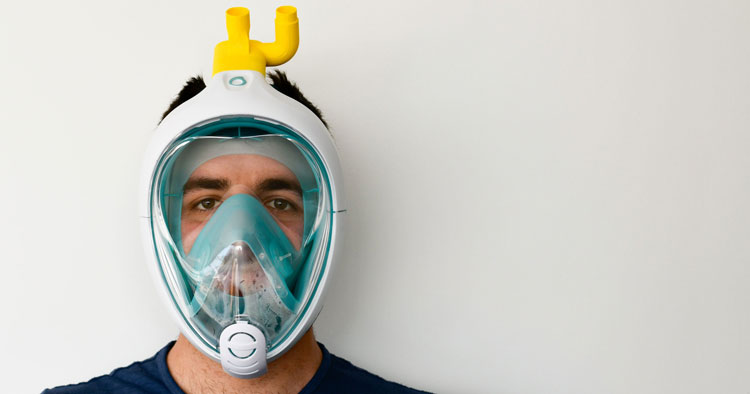
Isinnova produced a scuba-diving mask adapter as early as mid-March. Photo: DR.

Nonetheless, it wasn’t long before Fracassi’s team was contacted by Renato Favero, a doctor and former director of Gardone Valtrompia hospital. He wanted to share an idea that could potentially help overcome the temporary shortage of CPAP masks for non-invasive ventilation. Could they modify scuba-diving masks using 3D-printed valve adapters, based on the open source models published on Isinnova’s website?

Given the simplicity and efficiency of this new project, the idea caught on fast. Some makers began contacting nearby hospitals, where they already knew a staff member, to offer their services. In other cases, it was the hospitals that asked for help. As these requests grew in scale, people began to coordinate a timely response to the crisis.

The first order came from Brescia: 500 adapters. Isinnova, associated with a fablab in Brescia, posted a call for contributors on Facebook on March 22, which received hundreds of comments and was shared thousands of times. Within 24 hours, the distributed maker community had produced and even surpassed the required number of adapters! But there were still some problems: how could they verify the quality of the pieces, avoid overproduction and manage delivery while under lockdown?

Despite a few difficulties, this first experience in distributed production exceeded expectations. International projects aiming to find similar solutions to improve the supply of PPE for healthcare staff and other essential workers also began to emerge.

Scuba-diving mask adapter designed by Studio 5T. Photo: DR.

Coordinated actions

Local coordination groups formed or mobilized to produce and distribute parts for such projects. These groups were almost all volunteer-based, almost always within existing communities of people or fablab networks who were already used to working together. The first Covid-19 maker networks in Italy were regional, and they succeeded in responding to local needs as they evolved.

Makers Sicilia united Sicilian makers, fablabs, innovation startups and incubators to respond to the crisis in Sicily. Since it was founded in late March 2020, the group regularly meets online to share updates on local projects, examine ongoing experiments in local hospitals, exchange information on certifications and necessary legal procedures. Members have also contributed to purchasing materials. Officine Mediterranee is another network that is active in the south of Italy. It unites makers, fablabs, associations and small businesses involved in digital production across the regions of Basilicata, Puglia and Campania.

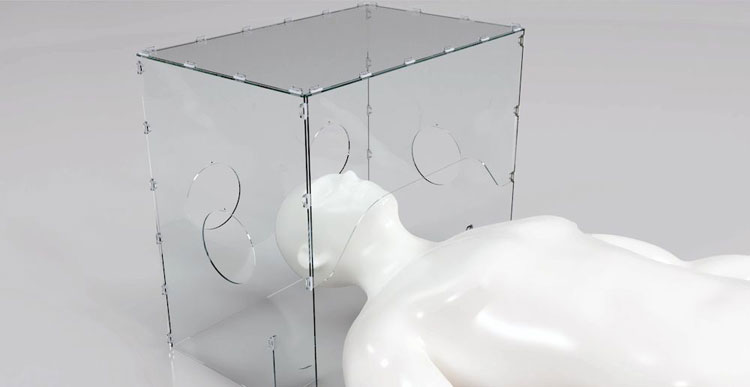
According to Alessandro Bolettieri of Officine Mediterranee, “The group formed in response to a request for 500 face shields from Basilicata’s emergency coordination number (118). In about 40 days, we managed to produce and distribute more than 2000 face shields, as well as over 50 Charlotte valves, mask ear-savers and 20 intubation boxes, in collaboration with Open Design School in Matera. Officine Mediterranee has around 50 members: makers and other professionals assisting with coordination and communication. Their group work is recounted by its members through a series of “Daily Diaries” shared online.

Makers at school

In retrospect, the projects led by Indire (National Institute for Documentation, Innovation and Research in Education) are particularly interesting. This historical institute has been active in the education sector for more than 90 years. A few years ago, it began exploring the relationship between schools and making through the Maker@Scuola project.

After co-developing with doctors a face shield model that was adapted to their needs, the project branched off in two non-emergency directions: on one side, Indire collaborated with a big company to produce the shields on an industrial scale; on the other side, the face shield production model was integrated into company simulation training for students in technology and technical high schools.

In Veneto, following a regional competition in 2015, funding was provided to 18 fablabs to seed a Venetian network. FIve years later, some labs have closed, while others have joined the network. The region of Veneto posted on the Innovation Lab website the main activities and potential contributions of these fablabs, in addition to the contributions of makers, volunteers and businesses eager to help.

Intubation station designed by Fablab Napoli and Fatebenefratelli Hospital. Photo: DR.

Nationwide coordination

This teamwork at local and regional levels paved the way for nationwide coordination across Italy. In the period of just a few days, three different initiatives emerged with similar and complementary objectives. Tech For Care is the result of a collaboration between Maker Faire Rome – The European Edition and I-RIM (Institute for Robotics and Intelligent Machines). This platform is not only a place to share projects, it also lists needs from frontline workers and proposed solutions from the maker community, startups and research institutes linked to the two project founders.

Opendot, the fablab that I coordinate, operates in the healthcare sector. For this reason, we were involved in implementing the project from the beginning. Tech for Care was also presented during Virtually Maker Faire on May 23, 2020. Some of the published projects come directly from the partners. For example, I-RIM developed a telepresence robot that can be easily assembled from pieces bought online or 3D printed. The project is entirely open source and published online.

Another nationwide coordination project, Air Factories is a distributed factory for manufacturing components and prototypes to fight Covid-19. The project was started in Messina, Sicily, by engineers at Innesta, SmartME.io and Neural, but it welcomes requests for solutions and volunteers from anywhere in Sicily.

An additional response “from the base” came from Make in Italy, an association founded in 2014 to promote research and coordination initiatives around digital fabrication and maker culture. After a few years of low activity, the group mobilized to coordinate supply and demand. Within a few days, they collected 500 contacts from makers, small laboratories, startups and fablabs. Their website currently lists over 25,000 items produced and donated.

Tech For Care and Make in Italy have pooled together a selection of open source projects published on Careables.org, a platform developed within the European H2020 “Made 4 You” project, with which our Opendot fablab is also associated. The goal is to find, collect and share open source solutions that are easily reproducible in the healthcare sector. Sharing projects on a common database makes it easier to collaborate between the two platforms.

Corporate makers

Italy’s response to the health crisis wasn’t limited to the grassroots maker movement of hundreds of volunteers and fablabs. Many Italian companies worked closely with active makers, and in some cases, even helped the movement to take off.

The most obvious example of that is Arduino. Not only were they behind Italy’s first fablab (I started out in 2011 as coordinator of this lab in Turin), but ever since then, they have clearly been at the technological core of innumerable DIY projects. This was further demonstrated in many solutions that emerged during the pandemic. Alessandro Ranellucci (Head of Open Source & Community) and David Cuartielles (Arduino co-founder) organized an online conference for presenting and debating projects to fight the pandemic.

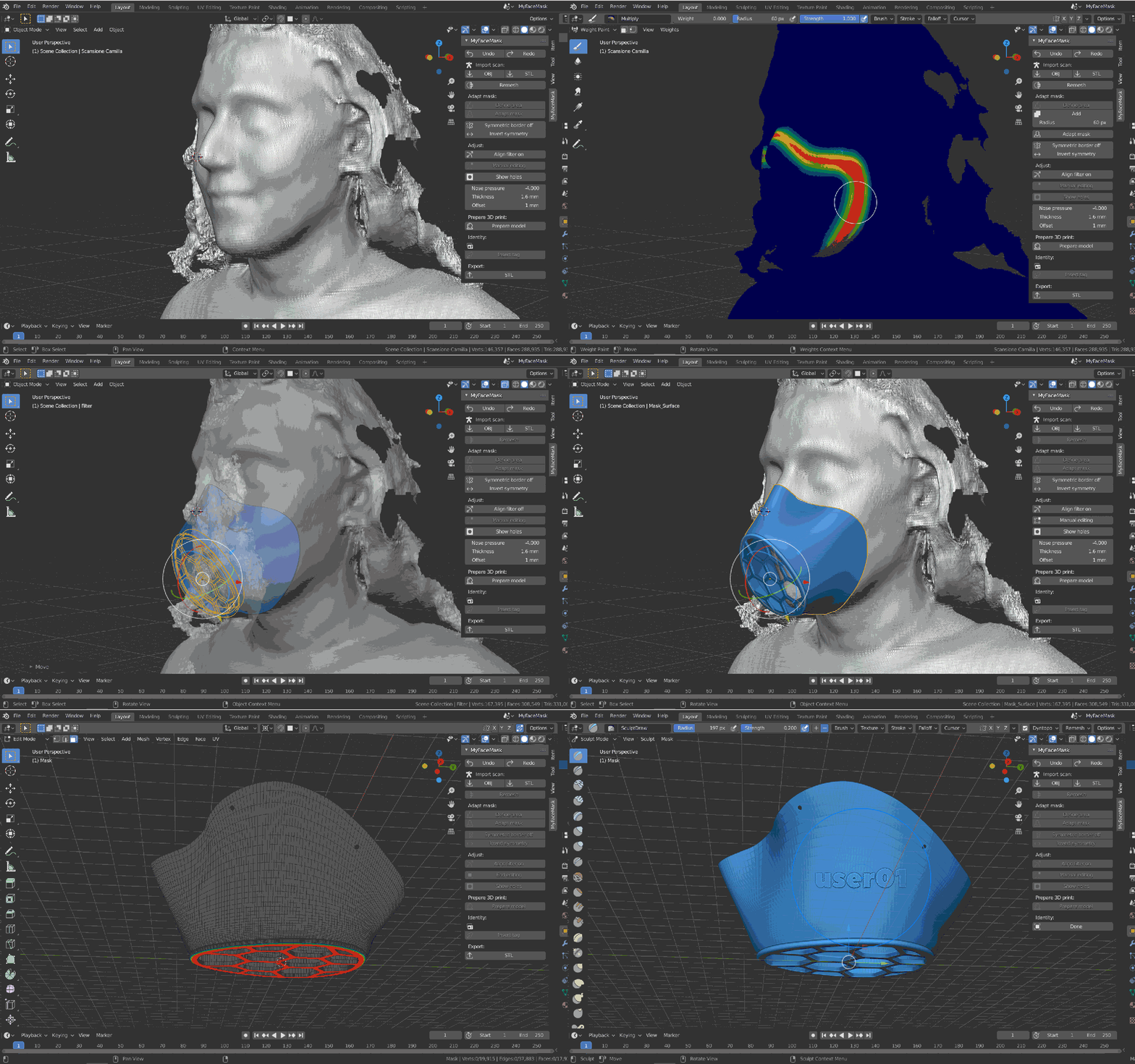
Filoalfa, one of the main producers of 3D printer filament in Italy, launched the “Suspended spool” initiative to collect and donate spools of filament to support the three nationwide projects mentioned earlier. WASP, one of Italy’s biggest manufacturers of 3D printers using filament, teamed up with Alessandro Zomparelli, renowned expert in parametric modeling, to develop an add-on for Blender allowing users to model and print a customized mask with interchangeable filters.

FiloAlfa. Photo: DR.

What are the takeaways?

These past months have been filled with excitement and fear, willingness to contribute and frustration by the limits of what was possible, enthusiasm for the generous response from so many, and sadness for the ongoing situation. We talked about makers as Plan C, a temporary solution until the industry got organized, and it seems that a good portion of European funding for research is going to support the industrial sector. But I would still like to think that what happened during the past months was a keystone, a beta-test of what could be the role of innovative communities equipped with technology.

Many people say that this crisis has accelerated our digital transformation much more than all the policies implemented in the past years. I believe that it also demonstrated the value of those who create and practice innovation for those who need it. Five years ago, when we were talking about how digital fabrication could serve healthcare, it seemed to be a marginal preoccupation. Three years ago, when we started working with doctors and hospitals, it seemed infeasible.

These last examples are the ones that could continue once—hopefully soon—this surreal situation that we are in is behind us. Because of the emergency, various hospitals contacted specialized studios, fablabs, small businesses and startups in order to develop new solutions together. Fablab Napoli started collaborating with Buon Consiglio Fatebenefratelli hospital to produce clear boxes to protect doctors during intubation.

As is often the case, available models didn’t quite meet the needs of the hospital, so some doctors, including the department director of Fontanella General Medicine, began to design necessary variations. In light of the potential, the project was scaled up to involve other entities, including ENEA Research Center in Portici. Interestingly, the hospitals that adopted it continue to use it today as a common accessory for use during intubation procedures.

In Rome, Studio 5T had started working with hospitals early on in the crisis, especially Spallanzani hospital, Pertini hospital and Policlinico Umberto I. After an initial meeting, the studio offered to produce face shields, but the existing model didn’t meet the doctors’ needs. However, as in Naples, the doctors understood the potential of digital fabrication’s speed and flexible process.

Through this collaboration, their role evolved from users to designers of solutions. Months of collaborating led to other projects, including some that are still in development. Here in Milan, we continue to collaborate with local hospitals (4 so far) and with the doctors and therapists who work there. We have started projects together, with visible results—once people understand the potential, they become more proactive, constructive and independent.

One of these doctor-inventors, who works in intensive care, printed more than 200 ear-savers for his colleagues, safety tested Venturi valves, and printed various mask models in order to evalute their efficiency and comfort. He started a few years ago, followed basic training, and we successfully developed a model together. We would like this type of cooperation to be the rule rather than the exception, that hospitals understand and remember the potential they saw during this period. Then perhaps we will be more capable of reacting, more quickly and more efficiently, during the next crisis.

Enrico Bassi
published in partnership with Makery.info

More information on Opendot in Milan

This series of reports is supported by Daniel and Nina Carasso Foundation’s emergency fund for Covid-19.

> version française / french version

opening health solutions on a global scale

Three regional networks spanning Brittany, France and West Africa have partnered with local health, research and corporate organizations to provide African fablabs with machines and consumables—with the goal of producing on-site equipment for testing, prevention of and protection against Covid-19.

Already lacking in sanitary infrastructure and equipment, West African countries now have an urgent need for protective face shields and masks, ventilators and medical staff trained in intensive care. In response, African makers have mobilized to bring simple, low-cost and efficient solutions to detect, treat and prevent Covid-19. Makers Nord Sud contre le coronavirus (Makers North South against Covid-19) is a project to pool the capacities of three regional networks—Bretagne Solidaire (Brittany), Réseau Français des Fablabs (France) and Réseau Francophones des Fablabs d’Afrique de l’Ouest (West Africa)—to support health systems through local and sustainable manufacturing of sanitary equipment, while supporting the global actions of African fablabs.

ReFFAO inauguration in 2018. © ReFFAO.org. Photo: D.R.

Fablab dynamics in French-speaking West Africa

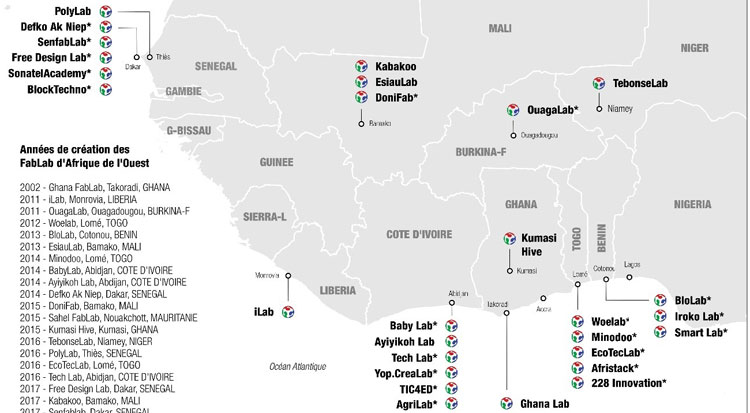
Their names are Ahmadou, Diarra, Gildas, Modou, Ghislain, Marie, Medard. They live in Senegal, Mauritania, Ivory Coast, Burkina Faso, Mali, Benin, throughout the Economic Community of West African States (ECOWAS). These men and women belong to one of the largest African networks of fablabs in the southern hemisphere: Réseau Francophone des Fablabs d’Afrique de l’Ouest (ReFFAO), founded in 2018, which organizes Make Africa every year in Cotonou, Benin. Currently, 27 fablabs are working together in 10 countries, locally reinterpreting ways of doing and sharing solutions in the field—adapted to local constraints, enriched with cultural diversity, as well as guided by a strong sense of meaning.

Hub Cité, an initiative of anthropologist and architect Sénamé Koffi Agbodjinou, founder of L’Africaine d’architecture and Woelab in Togo, stands in stark contrast to the European Smart Cities approach, instead integrating low-tech solutions and citizen participation. In this way, the project is more in line with the concepts of local productive autonomy advocated by the Fab City network. For example, sanitary handwashing stations (such as Senfablab’s Dane Corona) are mechanical and designed for outdoor public spaces, far from electronic distributors or prototypes for individual bathrooms.

Further considerations are equal access (gender, disability, etc.), education/training and climate change, as seen in initiatives to rebuild computers (Jerry DIT), foster creativity in digital fabrication through art-therapy for victims of war and violence (Yop Crealab, Ivory Coast), or educate children who were exploited for gold panning (Wakatlab, Burkina Faso).

Mobilized on the ground since March

Today, more than 6,000 face shields have been printed, assembled and delivered to hospitals and clinics, while more than 200 automatic handwashing stations have been made from recycled materials. Six ventilators have been developed, more than 9,000 masks have been sewn and distributed, disinfectant gel distributors have been designed and installed in public spaces. More examples are listed on ReFFAO’s website. But official recognition, material stock (there is no local production of 3D printer filament in ECOWAS) and on-site equipment are still sorely lacking.

Virtuous alliance at the core of a crisis

For the past three years, a trilateral partnership between ReFFAO, Réseau Français des Fablabs (RFFLabs) and Tiers-lieux Edu has produced a number of consorted actions. After Fair’Langue, an initiative that crossed fablabs and education with the Tiers-Lieux Edu network, and another project that was canceled due to the pandemic, Makers Nord Sud contre le coronavirus brings together new actors that are diverse and complementary, sharing a strong desire for solutions that integrate commons, the health sector and distributed manufacturing.

Particularly active within this project is a veteran organization that is relatively unfamiliar with the maker world, but which federates more than 40 solidary associations with intimate knowledge of the realities, cities and countrysides of Africa and Asia: Réseau Bretagne Solidaire. It includes dozens of cooperative projects, knowledge of diplomatic circles, calls for projects and pragmatism in the field. The connector between these worlds is Martin Lozivit, a geographer who worked in Cotonou for two years, also with Low-tech Lab, and administrator of Réseau Bretagne Solidaire. Along with Hugues Aubin (RFFlabs) and Woelab (Togo), he spoke about fablabs and sustainable cities at Make Africa 2019.

Ventilator made by ENCI, Ecoteclab, M.Akakpo; TIDD – Togo. Photo: © ReFFAO.org

Other powerful players have since contributed their own resources: Just One Giant Lab (JOGL) and its 5,000 members are helping organize open research and development communities; Assistance Publique des Hôpitaux de Paris (AP-HP) with Roman Khonsari and Philippe Cochin, who architectured part of the Covid3d project to link prototypes to the medical field for scientific validation. They are the working gears of the first professional 3D printing farm set up in Cochin-Port-Royal during the lockdown in France (20,000 objects were printed, including medical devices used in the field).

Ahmadou Diallo from African Airbus Community, an informal and powerful network of goodwill for humanitarian projects across the continent, brings in the support of thousands of ingenious engineers. It’s less about money than coordinating different skills and manufacturing rare or expensive parts. Now supported by the Presidential Council for Africa, this community shares contacts, opens its doors and leads the SN3DCOVID19 project in Dakar, a citizen collective of 10 Senegalese organizations (startups, associations, schools, universities) collaborating to fight Covid-19.

Labsud fablab in Montpellier has offered its digital work stations and its many contacts in the medical field in France’s Occitanie region. Indiens Dans la Ville, founder of Atelier commun in Rennes, bring their expertise in upcycling plastics. Also in Rennes, members of My Human Kit, an international pioneer of crossover between makers and health applications with Nicolas Huchet, have also joined the fight. All together, the project includes French-speaking fablab networks (a total of 240 labs in 11 countries), health professionals, collaborative open source development platforms, international solidary organizations, artist-makers and industry.

African Airbus Community. Photo: © Ahmadou Diallo

Printing medical equipment and upcycling plastic for local manufacturing

Currently, Makers Nord Sud contre le coronavirus is engaged in two primary actions. The first aims to provide equipment for 10 fablabs in 8 ECOWAS countries, in order to support the development of prototypes in progress. A detailed list of equipment (machines, components, electronics) was established, following a call for West African fablabs. A map created with Thomas Sanz, researcher at Vulca and volunteer at RFFLabs, visualizes the locations of health centers in relation to fablabs and makerspaces. It shows the proximity between needs and ultra-local response, as many fablabs are located next to hospitals and already supply them with equipment.

The second action consists of working with Indiens Dans la Ville to install a Precious Plastic machine in Cotonou. This machine would transform plastic waste into raw material for 3D printing or molding. During the health crisis, Indiens Dans la Ville, mobilized alongside Couturier-es masqué-es, finalized a pivotal technique to control and specify the diameter of 3D printer filament upcycled from plastic waste. This open source tool can be adapted to local restrictions and used to test manufacturing of consumables and personal protective equipment, without the need to import rolls of filament, in close proximity to health care centers and the public.

175,000€ for 8 West African countries

The goal of all the partners is to convince big legitimate structures such as Organisation Internationale de la Francophonie (already supporting many solidary projects to fight Covid-19), Agence Française de Développement and any goodwill initiatives to financially support this project—then, if necessary, initiate complementary actions such as crowdfunding to further synergize the enthusiasm of African makers with the needs of health centers and local communities.

Since May, Makers Nord Sud contre le coronavirus has contacted numerous benevolent and concerned organizations: Research Institute for Development and its research-action program to support the African response to Covid-19 (ARIACOV), embassies, Organisation Internationale de la Francophonie, Fondation de France, French regions and cities (Occitanie, Bretagne, Rennes…).

The project is aiming for deployment by late 2020, as well as for an extension in time and space, to reconstruct health care according to a model that recalls the ideal of the Fab City Foundation: globally sharing and finding solutions for the common good of humanity, through legal manufacturing and distribution by local actors.

Health care as an open horizon

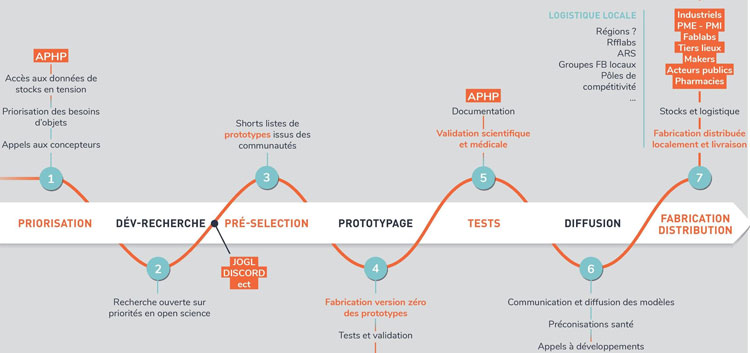
These improbable collaborations were formed during the pandemic in order to explore new leads in health care solutions. Among them is the “Open Santé” project, a complete open innovation loop for open source medical devices, by JOGL, Entraide Covid-19, AP-HP, RFFLabs, Fab and Co, the Facebook group Makers contre covid, and Visière solidaire (solidary face shield), a group formed by Youtuber Héliox, Covid3d.fr, Covid-initiatives, Makery Medialab, etc.

The concept is to create a continuous loop that integrates inventors of solutions and plans that respond to needs in health care, while incorporating selected manufactured models, rapid prototyping, medical validation, publication and dissemination online adapted to four types of manufacturing (individuals, fablabs, companies, industrials), manufacturing and legal use. This concept was presented on June 11 at the end of a special program by Make Magazine.

Makers Nord Sud contre le coronavirus seeks to develop this model with fablabs, health care organizations and authorities of West African countries in order to demonstrate a process that legalizes the on-site manufacturing of open source tools for diagnoses, prevention and treatment. This open process would have a significant impact on reducing the cost of research, development and certification of medical equipment, as well as eliminating problems in repairing imported devices (for example, up to 80% for prosthetics).

Intercontinental projects to solve a global issue


Determined to open health care solutions on a global scale, the brand-new platform Open Source Medical Supplies (OSMS)—which emerged from an alliance of makers during the Covid-19 crisis in the United States, now supported by the Food and Drug Administration (FDA)—is currently deploying a similar project worldwide, notably in English-speaking Africa. We met them while planning our francophone counterpart, as they collaborate with Translation Commons to offer 600 translators and a guide to open source medical assistance in the U.S. Together, Makers Nord Sud and OSMS, two projects that emerged from the invention of new circuits within exceptional legal frameworks during the crisis, potentially cover some 50 countries.

Will open health care take off?

As we hear about formulas for open source Covid-19 vaccines (for example from Open Source Pharma Foundation in India and in France), open health care offers hope for a global redistribution of resources through participative and especially distributed health care. The health crisis has given us an opportunity to invent not only objects, but also an entirely new systemic environment to reconstruct health care by placing part of its economic value in impacted countries. Beyond developing a cure for the novel coronavirus, this hope for a new deal concerns hundreds of millions of people worldwide.

Hugues Aubin
published in partnership with Makery.info

Makers Nord Sud contre le coronavirus website

This series of surveys is supported by the Covid-19 emergency fund of the Daniel and Nina Carasso Foundation.

> version française / french version

Co-founder of Makerspace Madrid, Cesar Garcia Saez also hosts La Hora Maker, a media & YouTube channel followed by more than 5000 makers in Spain. For Makery, he comes back on the mobilization of the makers in support of health care workers and exposed personnel during the Covid-19 pandemic.

Medical Personnel at Terrasa Hospitals wearing 3D printed faceshields produced at Tinkerers Fablab Casteldefels. Photo: D.R.

Spain was one of first European countries to be hit by the SARS-CoV-2 virus, right after Italy. By March 14, the Spanish government declared a State of Alarm and mandated a nationwide lockdown. During the three months that followed, both ad hoc and existing teams of Spanish makers have been communicating, organizing and working remotely to respond to the crisis.

Before the lockdown

During the weeks leading up to the State of Emergency in Spain, news from Italy and China highlighted the urgent need for lung ventilators to treat patients in Intensive Care Units. Without any corrective measures, the exponential nature of contagion threatened to provoke a peak demand for these devices, and many more potential deaths.

Realizing the critical nature of this problem, several groups around the world started working on open source solutions. In response to Colin Keogh’s call to develop an Open Source Ventilator on Twitter on March 11, a dedicated group was created on Telegram, parallel to the existing Facebook group, specifically to unite Spanish makers who preferred to collaborate through the popular messaging app.

At the same time, Jorge Barrero, director of COTEC Foundation for Innovation, called on several members of its network (including the author of this article) to evaluate the feasibility of a low-cost 3D-printed ventilator. After receiving positive feedback from several sources, in addition to news about a “small” group of makers tackling the problem, another initiative was born: A.I.RE (Ayuda Innovadora a la Respiración / Innovative Help for Breathing), a WhatsApp group to connect anyone able and willing to help, including doctors, enterprises, makers, innovators, etc.

As for the “small” maker group—Coronavirus Makers—it spread like wildfire among the Spanish maker community. In the weekend before lockdown, the Telegram group grew to 1,000 members in less than 48 hours. Just two weeks later, it expanded to 16,500 members! But how does a community with thousands of members organize?

Volunteers assembling 3D printed face shields at Fab Lab Sant Cugat. Photo: D.R.

Emerging patterns in uncertain times

Once the group started to grow, the number of daily messages exploded. This made it increasingly hard to communicate efficiently, as some topics would be covered repeatedly, for an endless number of times. It was really difficult to know exactly what was needed at any given moment. But soon, several focused workgroups spun off to create their own channels, inviting those interested in their specific topic to hop on board.

Many doctors and enthusiasts were also invited to join the conversation on Telegram, but the groups could be quite noisy and confusing for people who were new to the platform. David Cuartielles, co-founder of Arduino, created a specific forum (Foro A.I.RE) for a slower-paced conversation, distilling the most relevant facts about the topic. Foro A.I.RE attracted some 4,000 individuals within the first month, sharing papers, news and even reference designs for ventilators.

On Telegram, the number of topics was expanding organically, although ventilators still topped the list. Reesistencia Team announced they would start working on an open source ventilator based on a Jackson Rees type of valve (hence the name “Rees-istencia”). On March 16, they shared the initial design of Reespirator 23, which included a large 3D-printed piece to press the valve. They launched an open call for makers to start the lengthy process of printing these pieces.

This call sparked new regional channels on Coronavirus Makers, working to produce the pieces locally. As most components of the original design were open source and based on widely available Arduino boards, the initial idea was to produce the ventilators in a distributed way, near the hospitals in need.

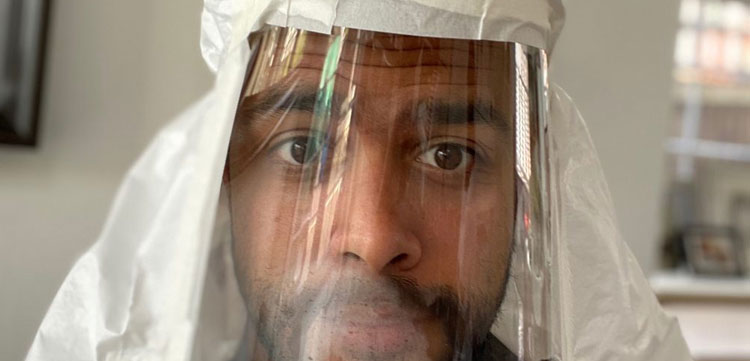
Another priority topic on the channels was Personal Protective Equipment, as the urgent need for PPE soon emerged as one of Spain’s biggest challenges. As the spread of Covid-19 reached new peaks, news reported that Spain was the country with the most infections among healthcare workers. Makers immediately started working on all kinds of protective gear—goggles, masks and the ever-popular face shield designs.

On March 16, a publication in the forum provided scientific evidence on the usage of face shields to extend the lifetime of masks and prevent large virus-infected droplets from reaching cloth protections and the eyes of medical personnel. In Oviedo, Reesistencia Team had finished the prototype and was waiting for a lung simulator to start testing. Makers were eager to help 3D-print pieces, whether for the ventilator or any other project.

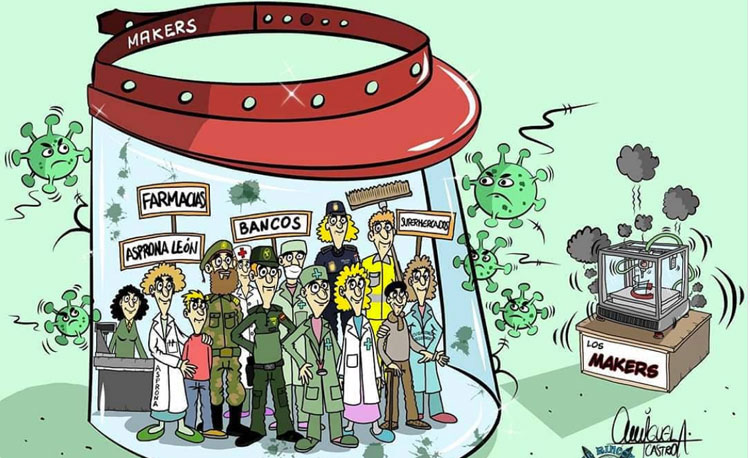
Illustration in El Rincon de Miguel highlighting makers’ role in printing face shields to protect essential workers. Photo: D.R.

Several makers started creating and sharing face shield designs in the Telegram groups. These shields were printed by makers all around Spain and given to neighbours who worked in hospitals. This act of kindness allowed for extremely rapid feedback loops. Nurses and doctors would use them during the day and then offer insights about how to improve them and make them more comfortable.

By the end of the week, every region in Spain had large numbers of makers producing face shields and delivering them to hospitals. Given the high volume of this makeshift equipment being used in hospitals, some people started asking questions about the quality of materials used, standards, safety, etc. Now under new scrutiny, local groups sought validation from their respective authorities.

Some regions, like Canarias, authorized the face shields, following standard work safety procedures, until other certified pieces were available. Madrid initially authorized the use of 3D-printed face shields on March 24, but then inexplicably reversed its decision on March 28. This movement sparked a huge controversy, as no alternative pieces were available for medical personnel. How could local authorities possibly prefer that doctors and nurses continue working unprotected rather than authorize 3D-printed parts, if only temporarily?

Fortunately, in other regions such as Navarra, the local government contacted the maker group directly and even offered to help with supply and distribution. Valencia followed suit, authorizing a specific 3D-printed model. All this time, the Coronavirus Makers group responded organically, adapting to evolving conditions to continue supporting medical personnel and other collectives in need.

For example, on March 30, the Spanish government halted all activity by non-essential workers, to prevent additional movement during the Easter holiday. This put additional stress on providers of raw materials and alternative transportation. One week, face shields would be delivered by volunteers, the next week, it could be by taxi drivers, and during the most extreme lockdown, even police and military members participated in the distribution network!

By the end of the first wave, on June 10, about one million face shields had been produced and distributed in Spain by volunteer makers across the country. A final design has been approved on a national level, both for 3D-printing and injection molding, so that everyone can produce an open source 3D-printed face shield that is certified in all regions.

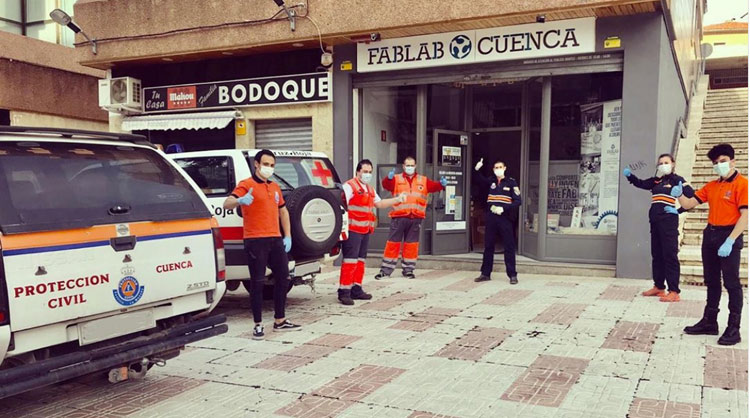
Local Civil Protection and Red Cross teams supporting distribution of face shields from Fablab Cuenca. Photo: D.R.

Fablabs, makerspaces and other pre-existing collectives

But what is the relation between the ad-hoc Coronavirus Makers network and other maker groups and spaces that existed before the pandemic? Although the response is quite diverse, with different responses in each region, most fablabs, makerspaces and other institutions have been extremely active in fighting the pandemic and contributing supplies for local needs.

Fablab Cuenca and Fablab Mallorca participated as local coordinators for the Coronavirus Makers groups in their regions, supporting other makers and helping with logistics and equipment. Fablab Bilbao and Fablab Leon produced new designs for face shields using laser cutters, complementing the production of local maker groups with thousands more units. Fablab Xtrene (Almendralejo), Tinkerers Fablab (Castelldefels) and Fablab Sevilla responded to needs through their pre-existing networks.

Maker collectives such as Sevilla Maker Society produced PPE as well, involving unusual partners such as the Betis Football Club to help with distribution. Makespace Madrid has been working on an open source ventilator, while providing PPE to its neighbours. In some particular cases, fablabs within larger institutions such as universities have not been able to use the spaces, because of local regulations and mandatory stay-at-home orders. Their members have generally contributed their time and personal networks to support the local coronavirus groups.

Communication among all these spaces was possible from the start thanks to pre-existing communication channels. Through the shared WhatsApp group for CREFAB, the Spanish Network of Digital Creation and Fabrication (Spaces) shared news, organized local needs, best practices, etc. Other digital fabrication organizations such as Ayudame 3D and FabDeFab stopped their regular activities to help produce PPE, working with their partners and volunteers, supporting the larger cause, while retaining their own identity/brand.

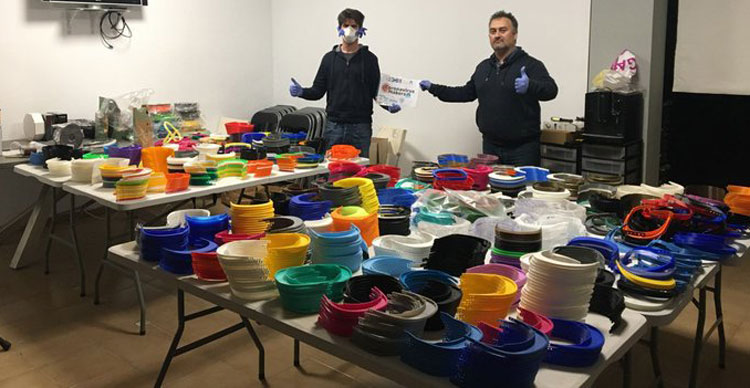
Fablab Mallorca, acting as regional distribution center, inundated with 3D-printed face shields produced by volunteer makers. Photo: D.R.

After three months of lockdown

Evolving to adapt to current needs during the past three months, Coronavirus Makers has gone on to produce many other types of PPE. One of the most popular is the “salvaorejas” (ear-savers), a flat piece that secures the straps behind the head instead of around the ears when a mask is worn for an extended period of time. Coronavirus Makers also now has a large group dedicated to textiles, working ethically with workshops and small shops to produce PPE and creating open source designs for DIY masks called +K rilla and +K Origami. A distributed group is producing ICU grade masks using injection molded silicone.

Other groups have created software such as mobile applications to manage the logistics of deliveries or to encourage healthy habits, such as Higiene Covid-19, promoted by the Ecuadorian government. Spain is expected to end its State of Emergency on June 21. Since the end of May, demand for PPE has dropped, and most people are either going back to their regular work and/or helping other people in their neighborhoods or in other countries. More than 15 coronavirus maker groups in other countries, mostly Spanish-speaking ones, are currently trying to replicate some of these processes to fight Covid-19 in Latin America.

So what happened to the open source ventilators?

While Spain saw a groundbreaking number of projects to build open source, low-cost alternatives to help critically ill people breathe, the main challenge with so many ventilators was that the approval steps, requirements, etc., were not clearly defined. Some countries, like the UK, published a document with clear requirements, while the U.S. published special guidelines with less stringent FDA requirements for approval. In Spain, however, there were no such special provisions, so each team working on a ventilator was pretty much on their own.

By the end of March, A.I.RE, through COTEC Foundation, managed to organize an open call with the people in charge of the certification process at the Spanish Agency of Medicine and Health Products (AEMPS). During that call, 115 people representing more than 35 projects could ask questions about the certification process. All this information was then published to officially guide the development process. A complete video conference on ventilator certification was organised with with AEMPS and multiple R&D teams.

To get a prototype approved for clinical trial, it was required to pass tests with a lung simulator, animal trials experiencing severe respiratory distress and electromagnetic compliance. Once reviewed, it would need a final seal of approval from the ethical committee at the hospital. Then it could be used, if and only if, there was no other certified ventilator available for the patient (see this article on the Arduino Blog for more details).

Under these rules, seven prototypes managed to pass all the tests within the following two weeks. Several of these teams included members from large companies and/or research centers, with expertise in certifying clinical equipment. Others however, coming from maker/designer backgrounds, managed to have their product approved and even manufactured by large companies, offering maker friendly versions such as OxyGEN.

While creating a ventilator from scratch is a herculean task, a critical mass of individuals joined this race against the clock. In less than one month, Spain went from zero available ventilators to several ready-to-use devices. By the time this process was over, the impact of lockdown had reduced the number of patients under intensive care. The only two companies producing certified ventilators increased their production tenfold in the past month, with support from the Ministry of Industry, so there was much less need for DIY/maker respirators. Reesistencia Team passed trials of their device with animals, but so far no AEMPS-approved version has been publicly released.

In the tradition of open source, some of the projects have forked or merged. For example, on April 24 Reespirator 2020 was announced as a fork of Reesistencia Team’s Reespirator 23. In this repository, they explained that, even though none of these ventilators would be mass manufactured in Spain, they plan to keep developing them to benefit other countries in need.

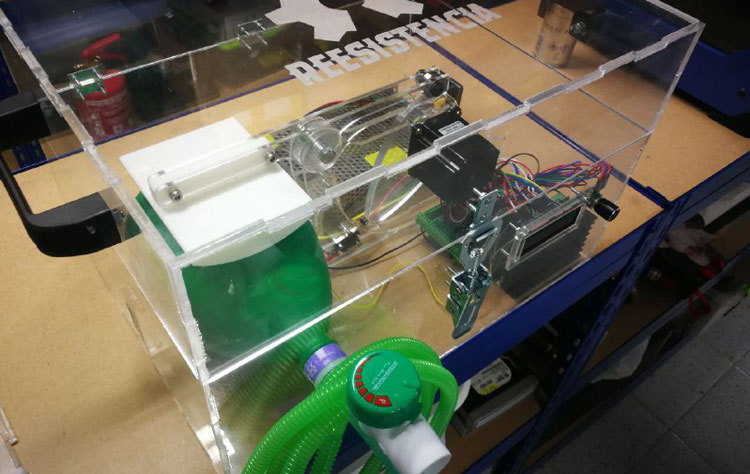
Initial prototype for ReesistenciaTeam Ventilator. Photo: D.R

Other Spanish initiatives

During these last three months, makers in Spain have connected with countless companies, institutions and individuals sharing the same goals. Ayuda Digital COVID (formerly known as TIC para Bien), contributed their IT expertise to help create elements of the digital infrastructure. Frena La Curva (Slow down the curve), focused on social aspects, connecting offers and demands from underserved communities. European Cluster Alliance connected Spanish initiatives to a larger pan-European network, promoting cross pollination of ideas among European peers. COVIDWarriors facilitated networking with common goals and provided several hospitals with open source robots for clinical trials. Sharing a common goal enabled collaboration on multiple scales, at speeds that were unthinkable a few months ago!

Final gratitude

All the work done by the Spanish maker initiatives would have not been possible without the support of hundreds of companies and individuals that have supplied raw materials, transportation and other elements to channel this maker solidarity.  Special gratitude to all our medical personnel: doctors, nurses and everyone involved in mitigating the severe impact of the Covid-19 pandemic!

Cesar Garcia Saez
published in partnership with Makery.info

Follow on Cesar Garcia Saez on La Hora Maker.
More on Makerspace Madrid.
Original call for makers on Twitter

This series of surveys is supported by the Covid-19 emergency fund of the Daniel and Nina Carasso Foundation.

> french version / version française

a breathing aid prototyped at F1 speed

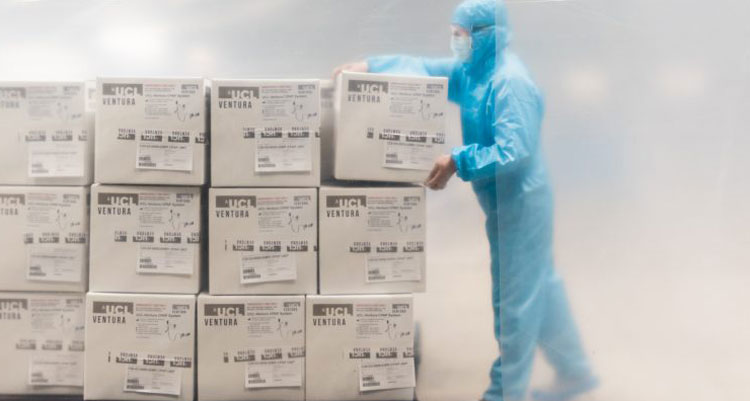
100 hours: the time it took the team at University College London and Mercedes’s Formula 1 department to develop the first prototype of a CPAP device. In less than a month, more than 10,000 certified devices were produced, documented and distributed to 60 hospitals throughout the UK.

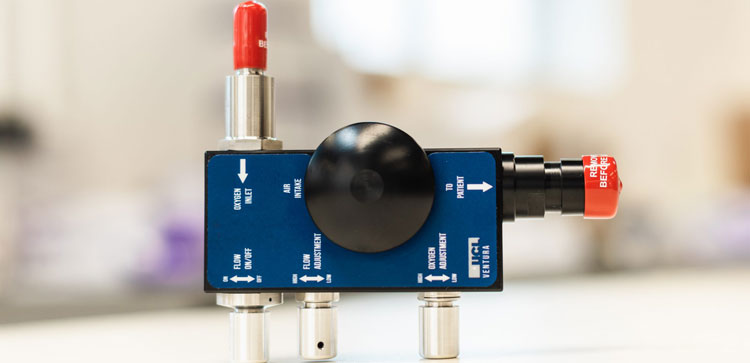
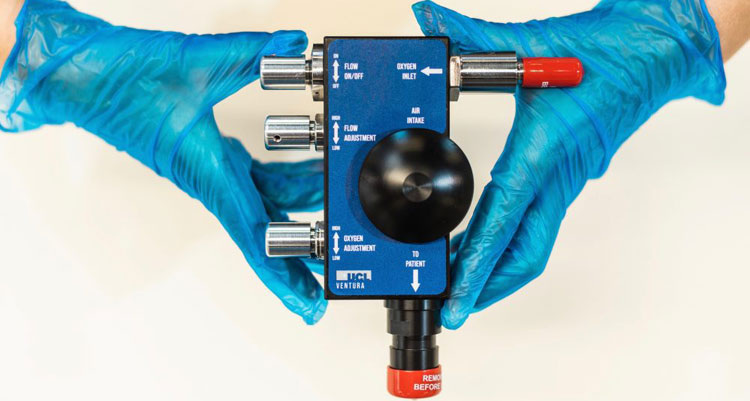
UCL-Ventura, a CPAP device co-developed by University College London and Mercedes. Photo: © James Tye/UCL

In early March, the government launched the Ventilator Challenge inviting corporations and universities to design mechanical ventilators. “What China and Italy were reporting was that once Covid-19 patients are hospitalized, they need respiratory support because they don’t have enough oxygen,” recalls Rebecca Shipley, professor in the department of healthcare engineering at University College London (UCL).

“In order to give the patient more oxygen, the patient needs to be mechanically ventilated by having a tube inserted into their lungs and letting the ventilator breathe for them.” It’s a very invasive process, she explains, which also requires that the patient be completely sedated.

At UCL, the mechanical engineers sprung into action. Innovation Action was established to support and develop projects for low and mid-cost manufacturing, locally across the UK. While benefiting from the support of a well-developed international network, UCL’s mechanical engineering department also works closely with the intensive care services of University College Hospital.

In a feat of logistics, 10,000 devices were delivered to 60 hospitals throughout the UK. Photo: © James Tye / UCL

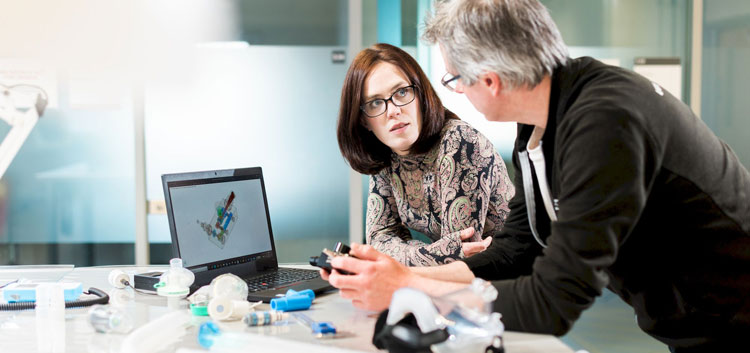
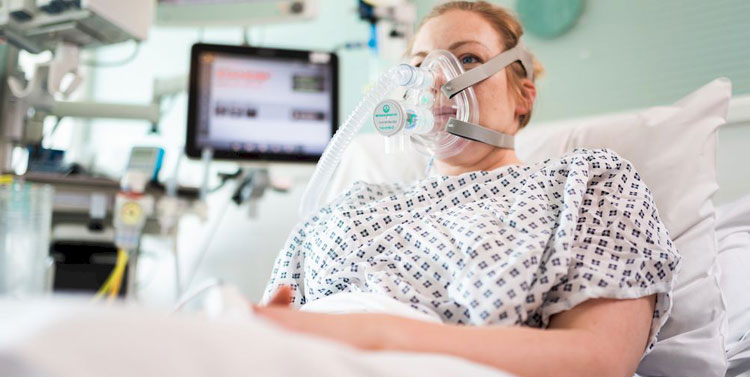
As feedback from the frontlines indicated that more non-invasive techniques were required, the team turned to Continuous Positive Airway Pressure (CPAP), a breathing aid that connects to the hospital’s oxygen supply network and mixes the oxygen with air in order to provide the patient with a constant pressurized flow of highly oxygenated air. Often used in cases of sleep apnea, CPAP devices are easier to administer by medical staff than mechanical ventilators. The patient can continue to communicate, and the device can be used for up to five weeks. Most importantly, according to Shipley, “CPAP protects 60% of patients from an increase in symptoms and the need for a mechanical ventilator.”

So the team focused on the historical Respironics device developed by Philips. “There’s a lot of data on its clinical use, and it’s a pretty simple device,” says Shipley. Then her UCL colleague Tim Baker, a mechanical engineer and member of Mercedes’s AMG High Performance Powertrains team specialized in building Formula 1 engines, joined the team.

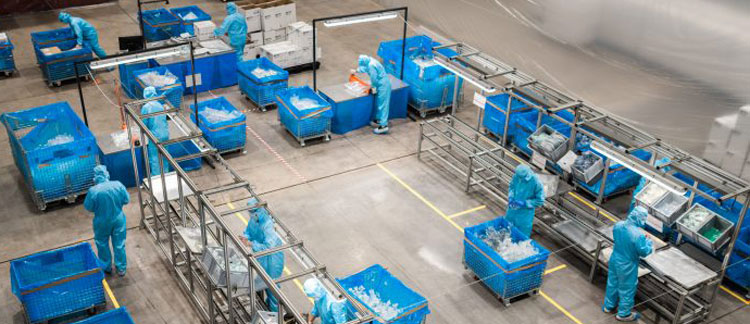
Almost a hundred people worked on preparing and delivering the devices. Photo: © James Tye / UCL

More than 300 people on board

Assisted by Mercedes’s chief engineer, the team began reverse-engineering the CPAP device. It took them just 100 hours to develop the first prototype, with a slight modification: the design is optimized to use the least possible amount of oxygen, a precious resource in times of Covid-19. “We were the right people, with the right expertises, and we all already knew each other,” Shipley comments, explaining their lightning speed. Ten days later, the model was approved by the national Medicines and Healthcare products Regulatory Agency (MHRA) and ready for mass production, with a capacity of 1,000 units per day, at a cost of around £1,000 (1,123€) per unit.

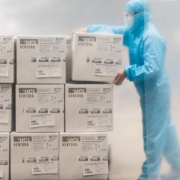
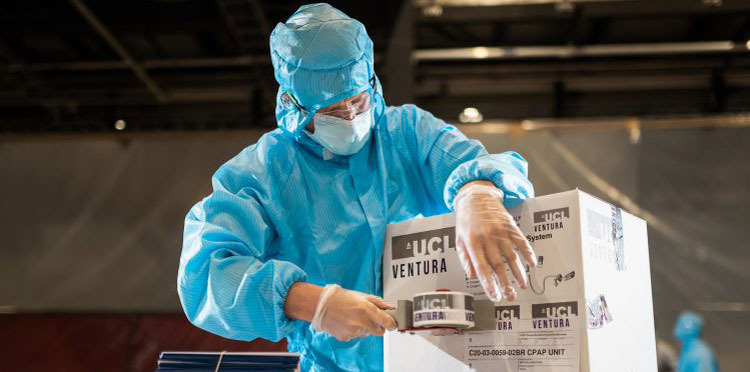
In total, several hundred people were mobilized for this project: 15 at UCL, some 200 in Mercedes factories and around 100 for logistics. Once the certified devices were mass manufactured, approximately 10,000 units were boxed and delivered. “We had no problem with our devices in the hospitals, because the model was already being widely used,” says Shipley. The team developed its own training material, complete with videos.

A logistics staff wears a suit to ensure that he does not contaminate the cargo. Photo: © James Tye / UCL

Since the model and documentation were made available in open source, they have been downloaded by more than 1,800 teams from 105 countries. “The idea is to facilitate local manufacturing,” says Shipley, echoing the mission of UCL’s Innovation Action. 50 teams are building their own prototypes in Brazil, Bulgaria, India and Iran. UCL continues to provide technical and logistical support through e-mail, a series of interactive webinars, and a Facebook group to connect teams around the world. “For now the main challenge is to find a supply chain, but we’re working with local organizations,” she says.

Elsa Ferreira
published in partnership with Makery.info

More information about UCL-Ventura

Quantifying communities to analyze a pandemic

> français

If JOGL’s OpenCovid19 Initiative came out of a crisis, the multidisciplinary collaborations that are forming among its members around a growing number of projects prove that this open online platform is much more than a flash mob. What does the data say?

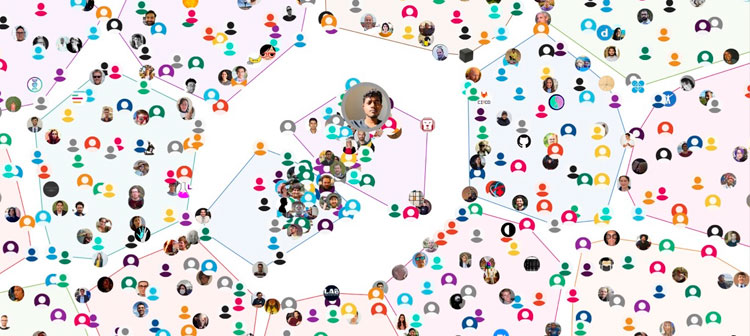
OpenCovid19 Initiative Slack users clustered by channel membership on TeamChatViz. Photo: © JOGL

Marc Santolini, one of the co-founders of Just One Giant Lab (JOGL) with bio-community leader Thomas Landrain and computational biologist Léo Blondel, has spent the past two years at the Center for Research and Interdisciplinarity (CRI) in Paris investigating collaborative learning and solving using network science and data-driven approaches, with the goal of developing tools to foster collective intelligence.

In the case of OpenCovid19 Initiative, he has been leading a Metastudy team to examine how this open community has been self-organizing during the past two months since its launch. At the same time, the team is developing an algorithmic recommendation system to optimize matches between project needs and contributor skills and resources.

“The idea is that behind JOGL there is a network of actors,” Marc explains. “These actors are connected to projects they follow, to people they interact with, to skills, needs and lots of other objects that are on the platform. This network of actors is called a heterogeneous information network. The algorithm predicts potential connections on this heterogeneous network. In other words, we can predict a connection between two people that doesn’t yet exist, but based on the structure of the network, we can say that it should very probably exist. We can also make recommendations based on certain meta-paths within the network that we want to push, for example, matchmaking skills with needs, or between similar projects.”

Prototyping on the go, the team has already applied this methodology to gain insight from the OpenCovid19 Slack workspace, where the TeamChatViz tool showed that new members were often bottlenecked shortly after onboarding. Now, new members are automatically joined to channels where they are most likely to make connections—with people they might not have met otherwise.

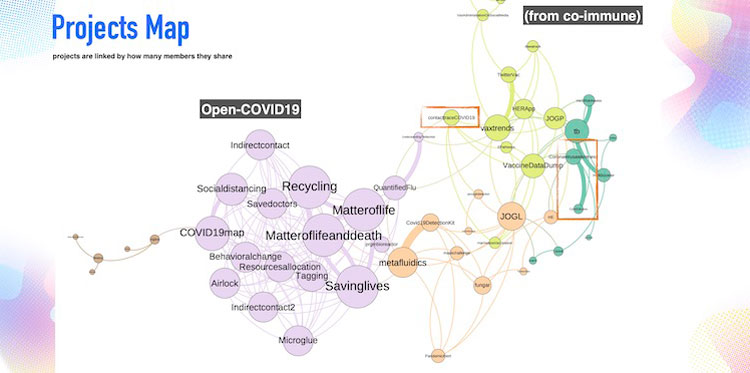
Visualization of linked JOGL projects in April 2020. Photo: © JOGL

Powered by peer review

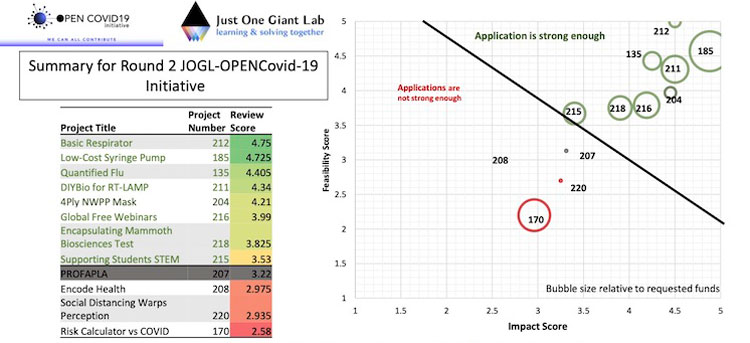
Consistent with this lateral approach, JOGL’s micro-grants for OpenCovid19 projects are awarded based on peer reviews by fellow members of the OpenCovid19 community. This participatory process was co-designed by Chris Graham and Elliot Lawton, based on the original architecture of JOGL’s Co-Immune program. The latter was also used for OpenCovid19’s sibling community, Helpful Engineering.

“In academia, grant funding is slow, peer review is slow, and honestly, all science is slow unless you focus on a very small area—and this is all sped up by collaboration and by increasing the number of people to remove the burden on individuals,” says Chris Graham. “At JOGL, the open grant system, and an analysis of the collective thoughts on projects that this brings, has let us assign funding ethically to a list of fantastic projects that both science and community agree with, and it’s already helping us thrive.”

“I believe in open science and the sharing of ideas collectively,” he continues. “We all have a dream that in the future, scientists will be using the Web for collaboration and to achieve their goals more efficiently, breaking down many hierarchical barriers that exist traditionally and getting straight to the source—whether it be funding, sharing ideas or peer review.”

While JOGL is currently collaborating with Kap Code to create an open database on Covid-19, Kaggle has already made available the COVID-19 Open Research Dataset (CORD-19), which includes more than 63,000 scholarly articles about Covid-19, Sars-CoV-2 and related coronaviruses—followed by “a call to action to the world’s artificial intelligence experts to develop text and data mining tools that can help the medical community develop answers to high priority scientific questions”.

At CRI, Marc Santolini (along with his lab postdoctoral associate whose research topic is on “the rise and fall of research fields” from disruption to decay) plans to fully investigate #CoronaResearchDynamics within CORD-19, for example in terms of peer citations and projects realized, in order to compare and contrast with collaborative relationships within JOGL.

“Were they more collaborative or more competitive?” Marc probes. “Can we visualize a comparison between the community of thousands that we managed to weave, who succeeded in collaborating and realizing projects, versus more traditional collaborations and accomplishments in the academic world? In short, we want to analyze the differences between institutional and non-institutional approaches during this sprint in Covid research. What are the particular strengths of open communities?”

Peer-reviewed results of JOGL micro-grants Round 2. © JOGL

Predicting from crowdsourced patterns

Beyond these data-driven metascience approaches on the JOGL community itself, many projects have emerged on the platform that focus on researching and developing data collection methods, analyses, models and simulations to describe and forecast the Covid-19 pandemic.

One of the most ambitious data analysis projects on JOGL (also on the data-oriented CoronaWhy platform) is data scientist John Urbanik’s Computational Epidemiology Modeling Toolkit (#epimodelingtoolkit): an open source toolkit and data exchange for epidemiologists to develop simulation models for the evolution of Covid-19 in specific situations. It’s similar to parallel efforts by contributors to Kaggle’s Covid-19 forecasting challenge, or the academic team behind EpidemicForecasting.org.

Two other OpenCovid19 Initiative projects, both awarded JOGL micro-grants, tackle pandemic problems using de-identified crowdsourced data on a community scale. Their open source approach contrasts with more top-down institutional applications.

Quantified Flu is an ongoing project led by Bastian Greshake Tzovaras and Mad Price Ball of Open Humans, to aggregate, visualize and analyze raw sensor data from wearable health devices (Fitbit, Oura Ring, Google Fit, Apple Watch), which symptom self-tracking members can also access and choose to share. On the institutional side, the government-endorsed COVID Symptom Study iOS/Android app, launched by a genetic epidemiologist at King’s College London and his company Zoe, currently invites millions of citizens in the UK and the U.S. to track their symptoms in real-time, allowing the gatekeeping academics to potentially predict the probability of Covid-19 infection.

CoughCheck is an AI project to develop a smartphone app that analyzes the sound of your cough to inform its algorithmic prediction. Following a highly successful launch on JOGL in March, the project now counts 47 members and 27 followers, while team leader Hernán Morales Durand is collaborating with Open Humans to collect and store audio samples and other community health data from participating self-researchers. In institutional parallel, the COVID-19 Sounds App developed by the University of Cambridge solicits people worldwide to volunteer the sounds of their cough, breathing and voice, either through a mobile app or directly on their website, to contribute to its own academic research.

Simulating the invisible curve

One of JOGL’s inherent strengths as a global, open and collaborative platform is its ability to extend its tentacles beyond biohacking, beyond academia, beyond digital social media and into the dirty, messy offline chaos of real-world communities. These exceptionally dense, marginalized communities of urban slums, migrant worker dormitories and overpopulated refugee camps remind us that social distancing is a luxury that not everyone can afford. While these populations are among the most vulnerable to a Covid outbreak, they are often unaccounted for or overlooked by official predictions.

A couple months ago, data scientist Billy Zhao, co-founder of the AI for Good London community, assembled an international, multidisciplinary team including collaborators from Italy to Ethiopia to focus specifically on studying and modeling the potential spread of Covid-19 in the Moria refugee camp in Greece. In April, the team entered (and won) the international Hack from Home hackathon with a proof of concept for their AI for Good Simulator. The project has since joined JOGL’s OpenCovid19 Initiative, as the team reaches out to an expanded global community.

With thousands of tents pitched in an area of less than one square kilometer that is grossly overcrowded with some 19,000 refugees from Syria and Afghanistan, Moria is the largest refugee camp in Europe. “Some people have been there for years, living in tense situations,” says Billy. “They have a deep distrust in authority, because they should have gotten off the island of Lesbos to go to the mainland ages ago, but the government failed them as a promise.

In some cases, there isn’t much community engagement where the camp residents don’t have mobile phones. So it’s hard to get in contact with them, as we really want to find out people’s attitudes towards different possible interventions, to estimate how many people are going to actually follow the rules, what things will be feasible. Right now they’re not even sure if there’s enough land or capacity for quarantine facilities.”

Fortunately, the AI for Good Simulator project’s core team includes Alice Piterova, who has a strong connection with humanitarian actors after working with Techfugees, and Joel Hernandez, an NGO worker who has been working on the ground in Moria for the past several years. So far, Billy has recruited about 20 volunteers through Help with COVID and Data Science for Social Good, with hopefully more soon to come through JOGL. The volunteers are divided into three sub-teams: user research, mathematical epidemiology modeling, and data visualization for the final dashboard. The team is also in regular contact with epidemiologists at the London School of Hygiene and Tropical Medicine.

Together, they are working to design and develop a site-specific epidemiological model to support NGOs in mobilizing actions and inform sound policies by local authorities in a timely manner. “Because once the first death shows up within the camp, the virus is probably everywhere, it might be already too late,” warns Billy.

For the AI for Good Simulator, he also believes that it’s worth taking the time and doing the research to get things right. The team is currently comparing three different models, including a compartment model and an agent-based model based on the academic study of a 2014 cholera outbreak in the Daadab refugee camp in Kenya.

“These three different models are all an extraction of the same reality, but because they have different assumptions, they each have a different makeup that tells you a different story,” says Billy. “So when the models agree from all these angles, you see that this is probably the best intervention we should go for. But when the models disagree, you can actually pick them apart and say, this assumption leads to this, this assumption leads to that, and maybe we need to think about it a little bit more.

“Right now we are still in this first phase of exploring, getting in touch with these different NGOs and trying to figure out their needs, what’s currently being done. There are also academic organizations that are thinking about using high-resolution satellite imagery to see where the congestion spots are within the camp… So there are more AI applications to be done down the road.”

As these projects gain followers on JOGL, the collaborative platform continues to refine its recommendations, matchmaking members and fostering synergies for a sustainable future beyond Covid-19.

“With the heat of the crisis now behind comes the challenge of stabilizing and sustaining such open collaborative projects in the longer term,” says Marc Santolini. “New members of communities that scaled up quickly can easily get lost, and smart onboarding strategies are key to sustaining such efforts. Creating an architecture of attention with recommender systems is key, but their design needs to take into account the specific needs associated with various phases of a project cycle: team building and ideation, implementation, documentation. The JOGL team is now collaborating with social scientists, computer scientists, project managers and user experience specialists to help design this architecture. Ironically, collective intelligence is at the core of its own design.”

Cherise Fong
published in partnership with Makery.info

Join JOGL’s OpenCovid19 Initiative

ramp up their response

> français

In the UK, the Covid-19 crisis has mobilised citizens eager to join the common fight against the pandemic. DIY problem-solving makers and open-source engineers, in collaboration with clinical teams, are contributing their technical expertise to the collective response.

Professors Rebecca Shipley and Tim Baker of UCL Mechanical Engineering worked on an open source ventilator for Innovation Action. Photo: © UCL

Since March, and the beginning of the lockdown, the UK has seen myriad maker responses to the pandemic, more or less organised in networks. Among the dozens of initiatives, a few projects stand out: Innovation Action, a platform usually focused on assistive technologies for disabled people, donated its resources to serve the fight against Covid-19; Helpful Engineering UK, a delegation of the international network Helpful Engineering, mobilised some 3,500 people sharing models and contributing skills; SHIELD, a cooperative of associations, consolidated efforts by linking projects to complementary strengths through a national database of institutions, many lacking materials (around 250,000 pieces, or £1M (1.12M€) of equipment have been distributed through this platform).

Makerspaces are also taking action locally. In Cambridge, Makespace members develop open source projects, which they produce, document, share online and deliver throughout the city. In southwestern Cornwall, the art-science-nature lab Foam produces cloth masks that they deliver to care homes or community care groups—as an example of the “cottage industry”, where individuals produce and sew from their homes with provided materials, reminiscent of the domestic industry of the proto-industrial era. In total, 4000 masks have been sewn for Cornwall’s care homes.

“The interesting thing is that without any top-down governmental support, an alternative distribution network has appeared, seemingly very quickly,” explains Foam co-founder Dave Griffiths. “We e-mail our contact when we have a batch ready to go, they tell us the address of a care home or community care group who need them. It was alarming when the local hospital started asking for them.”

In the cottage industry, masks are sewn on centenary machines (such as this 1911 Singer):


Top priority: PPE

The UK is no exception when it comes to the dire shortage of personal protective equipment (PPE). Face shields are first in line, and often the first response of most local initiatives. “They were clearly in shortage and relatively easy to manufacture,” sums up Nigel Daly, head of Helpful Engineering’s UK delegation (HEUK).

Some 8,000 volunteers from 3DCrowd, a community of “3D printing warriors”, printed and delivered more than 65,000 single-use face shields to National Health Service (NHS) workers—“a kind of face-shield Amazon (but free)”—thanks to over £138,000 (154,000€) in donations. In Cambridge, Makespace produced more than 5,500 shields. Once the equipment was distributed to local healthcare workers, the community launched a call to deliver the 3,500 remaining units: “We were overwhelmed with responses from care homes, schools, hospices, funeral homes, people looking after their parents.”

At SHIELD, an umbrella organisation that includes Women in 3D printing, HEUK and Med Supply Drive UK, volunteers produce 1,200 to 1,500 goggles, face-shields and masks per day, and aim to produce 10,000 units daily. The organisation relies on their “3d printing farm” of some 70 3D printers at Makerversity, a makerspace/accelerator in Somerset House. “We iterated on the 3D printers,” explains Dominic Pimenta, cardiologist, co-founder of SHIELD and president of the nonprofit organisation Heroes, through which he raised more than £650,000 (724,000€), where £305,000 (340,000€) went toward PPE production. “It takes a lot of quality-control time and a lot of manual work. Next stage, we are going to try injection moulding.” It’s also a more efficient technique that “removes the need to clean the headband before going out”.

HEUK volunteers collaborated with the makerspace Building Bloqs, which gave them free access to laser cutters and mobilised its community. “We are proud to see how quickly we have been able, in two weeks, to mobilise our community, source materials, produce 5,000 face shields and publish the documentation,” comments Makespace member Julia Citron.

Introduction to SHIELD, late April 2020


Expert communities

During this health crisis, makerspaces have fully assumed their role as innovative rapid prototypers, who are also agile in finding funding and mobilising their volunteer communities, with highly sharpened skills and expertise.

Between SHIELD and HEUK, skills are complementary. “We are providing technical and manufacturing advice,” explains HEUK’s Nigel Daly, himself a manager of engineering projects. “SHIELD are helping us in terms of distribution, clinical feedback and funding.” In addition to having a close relationship with healthcare workers, SHIELD’s Dominic Pimenta has been able to test the prototypes directly through his work as a cardiologist.

In Cambridge, this high level of expertise has been key to an efficient response. Makespace created a database where each member was invited to list their skills, so that the team could then match specific makers to specific projects and needs. “One of our community members works for the mechanical engineering department of the local hospital,” says Julia Citron. “We made a spreadsheet with all the designs that people have seen online, a list of ventilators, masks, goggles, gloves. We shared it with the clinic through this person and asked which ones they needed in priority.” She says that another member, who is a software developer, “created a software to track the batches, so if someone came and later had symptoms of Covid-19, we knew which batches they touched and could put these boxes in quarantine.”

From DIY to mass production

Beyond their proven methods of action, volunteers also created links with local industries. Confronted with the shortage of plastic for face shields, Makespace was able to source materials through another one of their members, who is employed in the food-packaging industry. “Our role is not in mass manufacturing,” Citron emphasises. “Once the design is approved, the documentation is published and shared with local industries, which have production capacities of up to 10,000 units a day.”

SHIELD works closely with industries such as Rolls-Royce, which helped them cut face shields, as well as manufacturers of plastic and 3D printers. The organisation is currently trying to maintain a steady and sustainable production line, while securing government funding in order to scale up production.

Cardiologist and SHIELD founder, Dominic Pimenta, ready for his shift. Photo: © Dominic Pimenta

The certification conundrum

Acting on behalf of the greater good without self-interested profit isn’t easy, especially when it comes to equipment certification. HEUK’s Nigel Daly regrets that regulation standards, as defined by BSI, are extremely exacting: “The barriers in terms of cost and time for small-scale manufacturers are high. Our testing for the face shields takes 3 to 4 weeks and costs 1,000 pounds [almost 1200€].”

If some tests are common sense, such as making sure the visor covers enough of the face to be protective, some are “less sensible”, says Daly. “For example, you have to put your visor in an oven at 55 degrees for 60 minutes and test to see if it deforms. This scenario is not going to happen. Any visor would melt in these conditions.” This might be understandable for sterilising the equipment, but it is done chemically using 70% alcohol, Daly retorts.

“To get certification is incredibly difficult,” confirms Dominic Pimenta. “And rightly so.” SHIELD members developed a ventilator with a filter from a scuba mask. The model is currently being tested by BSI, at a cost of £18,000 (20,000€) to be footed by the organisation. “Once it is an approved product, we can donate it all over the world!” Pimenta rejoices.

One of the main hurdles is the CE marking, a lengthy and costly certification that is compulsory for local action, Daly explains. If an organisation wishes to give the equipment produced to central NHS procurement, the latter will be in charge of the certifications. “Most local charities want to meet local needs,” says Daly, especially since the central procurement service has been impacted by confusion and dysfunction. Notably, the government assured that there was no shortage but instead “distribution issues”, before admitting some problems with supply.

A number of alternative spaces used designs that had been approved by NGOs or had already been used by hospitals, but on May 7 the British government published some rules to follow in making PPE. Is it now clear that charities are responsible for the safety of the material they provide. “A lot of charities either stopped producing while they thought about what to do or are going to withdraw altogether,” Daly says.

The “UCL-Ventura” device offers non-invasive ventilation. Photo: © James Tye / UCL

Academic and government alliance

Innovation Action is attempting to smoothe out the certification process. The multidisciplinary team represents several organs of the University College of London (UCL): the in-house makerspace Institute of MakingGlobal Disability Innovation (GDI) HubInstitute of Healthcare Engineering and clinical partners from the University College Hospital. Born out of the legacy of the London 2012 Paralympic Games, GDI Hub was launched in 2016 to tackle assistive technologies and received a generous government funding of £20 million (22.4 million €). The team received an additional funding of around £2,000 (2,240€) to adapt its platform to respond to the Covid-19 crisis, and now works in close relationship with the government initiative Covid Action.

One of the flagship projects of this initiative is the development of Continuous positive airway pressure (CPAP), a non-invasive ventilation device that requires an unforgiving certification process. Once they were authorised by the Medicines and Healthcare products Regulatory Agency (MHRA), Innovation Action published the open source documentation, “but only for those who are capable of manufacturing the device,” says Catherine Holloway, academic director of GDI, in order to ensure that the device is conscientiously reproduced.

The “UCL-Ventura” device is currently deployed in nearly 50 NHS hospitals across the UK, while the details have been downloaded by more than 1,800 teams from 105 countries. “20 teams have manufactured prototypes for testing,” says Holloway.

CPAP device, developed by Innovation Action’s multidisciplinary team. Photo: © James Tye / UCL.

Single-use equipment and problem-solving

Beyond their immediate response to the health crisis in producing hundreds of thousands of face shields and masks, the UK maker community has also been rediscovered as a precious resource for problem-solving.

“The local hospital came to us with a huge shipment of surgical masks with elastic loops,” recalls Julia Citron. “They had a few problems: They weren’t tight enough, so not very safe. They were also very uncomfortable to wear all day.” Makespace shared the problem with its community and received 15 proposals in 48 hours. “We produced two prototypes and put them in testing at the hospital. Doctors and nurses voted for their favourite design, and we published the model so they could be made to scale.”

Another major problem is the use of disposable materials. Beyond the obvious environmental challenge – a surgical mask takes 450 years to disintegrate – single-use equipment is an urgent problem for healthcare workers and the capacity to build stock. Some makerspaces mark their face shields with a single-use warning, while making sure they can also be sterilised and reused. “Even if you reuse your mask just once, you double your stock,” points out Dominic Pimenta.

One of the main difficulties in designing the masks was how to make them fit on each individual’s face. “The problem we have with the mask we are using right now is not the quality of materials, it is recognised as being very effective,” Pimenta explains, referring to the scuba mask-turned-respirator. “The problem is the fit: 70% of NHS workers or healthcare workers would fail that fit test. This is why the legal requirement is that everybody is fit-tested, but it is variable if masks are disposable. If you get fit-tested for a mask, and you come to work and can’t find that mask, then what do you do?”

He made this challenge his main focus and, in collaboration with Doctor Jasmine Ho, founder of Med Supply Drive UK, he currently lobbies for the testing of a decontamination technique by vaporised hydrogen peroxide, which would allow the masks to be re-used up to 20 times. The system was developed by Battelle, an Ohio-based research and development nonprofit, and was approved by the U.S. Food and Drug Administration (FDA).

Meanwhile, HEUK has already launched itself into the next challenge: making a “pandemic airway guard”: a sort of polycarbonate box that serves as an extra layer of protection when intubating a patient—an activity that places the medical staff at high risk of exposure to aerosols. “There are hundreds of people who want to make a difference,” says Nigel Daly. “It is an inspiring story, it helps us to focus and not feel powerless.”

Elsa Ferreira
published in partnership with Makery.info

https://twitter.com/3dcrowduk/status/1259890705067134983

 
https://twitter.com/cammakespace/status/1244285130925051907

sew protective gowns for the frontline

> français

In early April, Makerscovid.paris received an outsize order from Groupe Hospitalier Universitaire (GHU)—for 8,400 protective gowns. Two labs and a library rose to the challenge. Photographer Quentin Chevrier followed their response.

Making protective gowns at HomeMakers in Paris. Photo: Quentin Chevrier

At SimplonLab

Antonin Fournier explains how SimplonLab immediately took charge of the textiles order. “Baptiste Degrémont, textile designer in residence at SimplonLab, began working on prototypes of gowns to send to the hospital and have them validated for use. He and graphic designer Anouk Chambon made an assembly guide for the gowns to share with the network and meet the hospital’s needs.

SimplonLab’s textile team. Photo: © Quentin Chevrier

Then we worked with Virginie de Labarre (fabmanager of Villette Makerz), who sent out a call for volunteers and arranged to move machines from Villettes Makerz to SimplonLab, in order to transform the space into a small textile factory. Fashion schools Duperré, ESMOD and Condé relayed the call for volunteers to their students, who came to lend us a hand. Along with HomeMakers and Médiathèque Marguerite Duras, we began producing gowns, as well as preparing kits for people to sew them at home.” (Antonin Fournier)

At Médiathèque Marguerite Duras, 10 sewing librarians work in shifts on 6 sewing machines imported on site from Médiathèque Robert Sabatier (18th arrondissement) and Assia Djebar library (20th arrondissement). Photo: © Quentin Chevrier

At Médiathèque Marguerite Duras

Under the impulse of Cyrille Jaouan—librarian by day, maker by night—Médiathèque Marguerite Duras mobilized within the first weeks of lockdown to 3D print Prusa face shields. He explains how the media library has since transformed into a micro-factory.

“Médiathèque Marguerite Duras passed a new milestone once we installed the temporary ‘Corolab’. Given the magnitude of the demand for protective gear, we needed to adapt. With a team of volunteers from Bibliothèques de Paris, we succeeded (poke Pascal Ferry) in collecting sewing machines and 3D printers from the network of Paris libraries (yes, there are sewing machines and 3D printers in the libraries). Our local municipality in the 20th arrondissement supported this action by providing equipment through a participatory budget. The team is already hard at work on the orders for gowns and visors.

The Médiathèque is closed to the public, but the magazines will be forwarded—under protective plastic wrap—to Paris hospitals (Pompidou, Necker, Cochin, etc.) for their health care workers and patient. Photo: © Quentin Chevrier

“So Paris libraries were able to join the momentum of Paris makers driven by Fab City Grand Paris. Simplon Lab, our neighbor in the 20th arrondissement, provided documentation and fabrics, which enabled us librarians to work together to produce 40-50 medical gowns and 3D parts (face shields, visors, adapted door and elevator knobs).” (Cyrille Jaouan)

“Mask” section at HomeMakers. Photo: © Quentin Chevrier

At HomeMakers

Julia Lim and Gilles Bessard du Parc, who manage the textile fablab HomeMakers in the 15th arrondissement, talk about how they got involved to produce face shields, masks and gowns.

“HomeMakers first mobilized to 3D-print face shields to help meet initial hospital needs, before turning to laser-cut shields and masks based on AFNOR’s model. Most recently, we contributed our expertise in textiles to respond to the urgent need for masks and gowns. The first production rounds of masks were distributed through a circuit of donations and pick ups. Since then, we’re in the process of being certified.”

Making gowns and masks at HomeMakers. Photo: © Quentin Chevrier

“At HomeMakers, we began producing protective shirts and pants for health care workers 10 days ago. Given the increased sollicitations from hospitals, Covid-19 centers, nursing homes, and because textiles are in our DNA, we dedicated part of our production chain exclusively to protective medical garments.

Joining SimplonLab to meet GHU’s order, several more experienced volunteers [with guidance from fabmanager Gilles Bessard du Parc] are working on these pieces. At each phase, we optimize the sewing and assembly. Everything happens on site, with both industrial and home machines that allow us to centralize production and follow every detail of the assembly line.” (Julia Lim and Gilles Bessard du Parc)

Ewen Chardronnet
published in partnership with Makery.info

SimplonLab
Cyrille Jaouan’s blog post on bibliomakers
HomeMakers textile fablab

Stand for cutting gowns in the middle of Médiathèque Marguerite Duras. In normal times, these work tables are used by students and researchers to consult documents. Here, documentation on sewing techniques, standards and recommendations is collected and applied. The 2/F reading room serves as a sewing workshop. Photo: © Quentin Chevrier