Y a-t-il quelqu’un dans la machine ?

Mort en octobre dernier, Friedrich Kittler est un théoricien encore méconnu du grand public français. Son originalité est d’avoir mis en dialogue les pensées de Foucault et de Lacan avec la théorie des médias, et notamment McLuhan. Une pensée qui relève notamment que l’écriture est aujourd’hui liée au code informatique, un code néanmoins de plus en plus inaccessible à l’utilisateur.
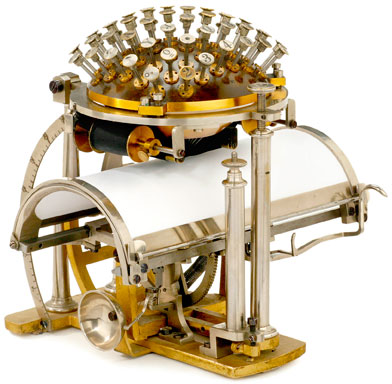
The Hansen Writing Ball,1865

The Hansen Writing Ball,1865. Photo: D.R.

Dans une interview, le germaniste et théoricien des médias Friedrich Kittler affirmait : je ne peux pas comprendre que les gens n’apprennent à lire et à écrire que les 26 lettres de l’alphabet. Ils devraient au moins y ajouter les 10 chiffres, les intégrales et les sinus (…). Ils devraient de plus maîtriser deux langages de programmation, afin de disposer de ce qui, en ce moment, constitue la culture. Ailleurs, il fustigeait la volonté de l’industrie informatique de déposséder l’utilisateur d’ordinateur de la main mise sur sa machine.

La question a hanté le débat entre les technophiles et les technophobes : est-ce l’homme qui utilise la machine pour produire du sens ou sont-ce les machines qui produisent l’homme et ses productions ? En un mot, qui sont les maîtres et les esclaves de notre siècle numérique où l’informatique est devenu le gestionnaire omniprésent de nos activités pratiques et théoriques. Cette question a toute sa place dans la théorie des médias, mais c’est une question vaine en réalité si nous partons du constat que l’homme n’a jamais maîtrisé ses productions signifiantes, au sens où il en aurait été l’auteur pleinement conscient et autonome. Tel est le point de départ de Friedrich Kittler.

Quelle est sa thèse directrice ? Que le système d’écriture d’une époque, c’est-à-dire les techniques dont dispose une culture pour enregistrer, transmettre et traiter les informations, détermine ce que l’homme est, ce qu’il pense et la perception qu’il a de lui-même. Si l’on peut parler d’un déterminisme technique du penseur allemand, c’est néanmoins plus sous les auspices de Foucault que de Marx que Kittler a placé sa pensée. Comme son prédécesseur français, qui écrivait dans L’ordre du discours : s’il y a des choses dites, il ne faut pas en demander la raison immédiate aux choses qui s’y trouvent dites ou aux hommes qui les ont dites, mais au système de la discursivité, aux possibilités et aux impossibilités énonciatives qu’il ménage, Kittler s’attache en effet à mettre au jour les conditions de possibilité d’émergence des différents types de discours qui permettent selon les époques à des productions successives (du vol des oiseaux chez les romains aux symptômes de la névrose) de devenir signifiants pour leurs contemporains. Tout, à une époque donnée, et cela indépendamment des intentions signifiantes de ceux qui parlent, ne peut pas être dit, ni entendu. Mais là où Foucault s’intéresse exclusivement aux ordres du discours déterminant les productions langagières, Kittler élargit son champ d’investigation à l’environnement technique dans son ensemble.

L’écriture fut le premier système technique au moyen duquel les informations furent enregistrées, transmises et traitées. Elle fut pendant un temps le seul canal du souvenir et de la constitution du monde. Son monopole fut remis en cause au début du XXème siècle par le phonographe, la photographie et le cinéma. Au-delà de la pluralité nouvelle des représentations de la réalité qu’ils offrent, ces nouveaux médias instituent une rupture en ce que, contrairement à l’écriture qui reproduit symboliquement la réalité, leur mode de représentation passe par l’enregistrement des effets physiques de la réalité et conservent ainsi la trace du corps ou de l’événement. Kittler analyse ainsi dans Grammophon, Film, Typewriter le récit de Salomo Friedlaender, Goethe parle dans le phonographe (1916) qui imagine la possibilité d’entendre de nouveau la voix de Goethe en enregistrant les vibrations de l’air que ses paroles n’ont pu manquer de produire, et qui pour certaines, renvoyées d’objets en objets, persistent encore aujourd’hui, quoique affaiblies. Le son enregistré, comme la photographie, constituerait ainsi des preuves mécaniques de l’existence de l’objet. L’écriture produit du sens par le symbole, le phonographe et la photographie par l’enregistrement.

Un système de production du sens modifié à partir de 1900.
C’est sur le système de l’enseignement qui avait institué le système d’écriture de 1800 que les nouveaux médias agissent, mettant un terme à ce que l’on peut appeler le règne de la signification. Jusqu’en 1800 en effet, c’est la voix maternelle qui en susurrant à l’oreille des enfants de tendres paroles fait parler. Entre ces syllabes et les premiers mots prononcés par les enfants, s’établit une continuité portée par une instance productrice du sens. De la même manière que la syllabe « ma » naît de l’amour mère-enfant, pour peu à peu se transformer en mot constitué « maman », la parole s’établit ainsi naturellement des syllabes établissant un lien affectif entre l’enfant et la mère aux premiers mots doués de sens.
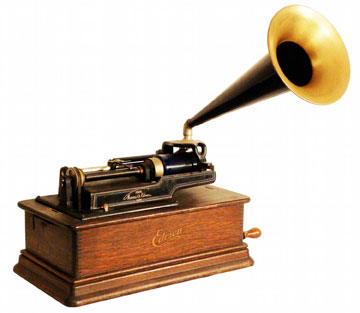
Thomas A. Edison, Home phonograph, 1906.

Thomas A. Edison, Home phonograph, 1906. Photo: D.R.

Mais le règne des nouveaux médias bouleverse les modalités de la transmission de la parole. Désormais, de la même façon que le phonographe enregistre ce que les cordes vocales émettent comme sons avant toute mise en ordre des signes et toute signification (les vibrations sont des fréquences qui se situent en deçà des seuils de perception de mouvements et qui ne peuvent être transcrites ni écrites), l’apprentissage du langage devient le traitement de données en elles-mêmes non signifiantes. Apprendre à parler et à écrire revient désormais à apprendre des syllabes dénuées de sens, que l’on combinera pour donner des mots et des phrases. La syllabe « ma » n’a plus une valeur affective particulière, mais n’est que le résultat d’une production systématique des sons à partir des lettres de l’alphabet (ma-me-mi-mo-mu…). La mémorisation ne se fait pas en un processus naturel et continu de la parole de la mère à celle de l’enfant, mais l’enfant apprend désormais de manière sérielle des syllabes dénuées de sens. Le système d’écriture de 1900 est un jeu de dés avec des unités discrètes ordonnées de façon sérielle. Voilà ce qui constituent les médias au sens moderne du terme : des matériaux de base dénués de sens, conçus par des générateurs au hasard, dont la sélection construit des ensembles.

Les discours produits ne sont plus les mêmes. Il faut selon Kittler radicaliser l’idée de Walter Benjamin selon laquelle le cinéma produit de la dispersion qui s’oppose à la concentration bourgeoise. Cela est bien plus général et plus systématique. Le film n’a pas de primauté parmi les médias qui révolutionnent l’art et la littérature. Tous produisent une fuite des idées dans le sens psychiatrique du terme. Le théoricien relate ainsi dans Das Aufschreibesystem les expérimentations du psychiatre viennois Stransky (1905). Ses sujets d’expérimentations, parmi lesquels des collègues et des patients, doivent parler une minute dans le tube du phonographe (si possible vite et beaucoup). Les mêmes comportements sont observés chez tous : sont prononcées des phrases ne se souciant plus de signifier. Le phonographe produit des réponses provocatrices, qu’aucun serviteur de l’État ou pédagogue ayant une certaine considération de soi aurait pu écrire. Des individus qui doivent parler ou lire plus vite qu’ils ne pensent déclarent nécessairement une petite guerre à la discipline.

Il s’agit d’un changement de paradigme qui affecte encore aujourd’hui la production du sens. Il n’y a à partir de 1900 plus d’instance productrice de discours qui transformerait les débuts inarticulés en significations, mais un processus aléatoire d’enregistrement et de combinaison.

Quelle place occupe la révolution numérique dans ce système ?
L’apparition de l’ordinateur n’a fait qu’accomplir le caractère non signifiant des éléments discrets dont la combinaison produit des énoncés signifiants. Avec le codage binaire, les flux de données acoustiques, optiques et écrites, autrefois différenciés et autonomes, sont aujourd’hui codés par les mêmes éléments de base et transmis par les mêmes fibres optiques. Au monopole de l’écriture a succédé le monopole des chiffres, alors même que le lien avec la réalité que le phonographe et la photographie avaient institué par rapport à l’écriture a été rompu, puisque la reproduction ne se fait plus par enregistrement mais par codage. Sons et images, voix et textes ne sont plus que des interfaces produites par une série de chiffres. La différence entre les médias n’est plus qu’un effet de surface et non l’expression d’une différence réelle.

Corollairement, le niveau technique de production du sens (le code) n’est pas celui sémantique d’existence de la signification. Kittler insiste sur l’écart entre le code, de plus en plus inaccessible à l’utilisateur, et les interfaces, et souligne les efforts de l’industrie informatique pour restreindre les possibilités d’intervention sur la machine, transformant la machine en outil prêt à l’emploi qu’elle n’est pas. Pour ce faire, les possibilités d’intervention sur la machine et de modification de ses paramètres techniques sont restreints, en même temps que les velléités de l’utilisateur de le faire sont canalisés par le fait que les interfaces soient d’usage facile et immédiat, ce qui dispense de toute intervention.

Ainsi, si l’homme n’a jamais maîtrisé ses productions signifiantes, comme nous le disions en préambule, si celles-ci sont aujourd’hui déterminées par le système binaire d’écriture qui est le nôtre, l’ère numérique nous conduit en sus à nous demander s’il y a un auteur dans la machine, c’est-à-dire si et comment l’utilisateur peut, au sein de ces déterminations, se réapproprier une intention signifiante.


Frédérique Vargoz
agrégée de philosophie
publié dans MCD #66, « Machines d’écritures », mars / mai 2012
une littérature illisible ?

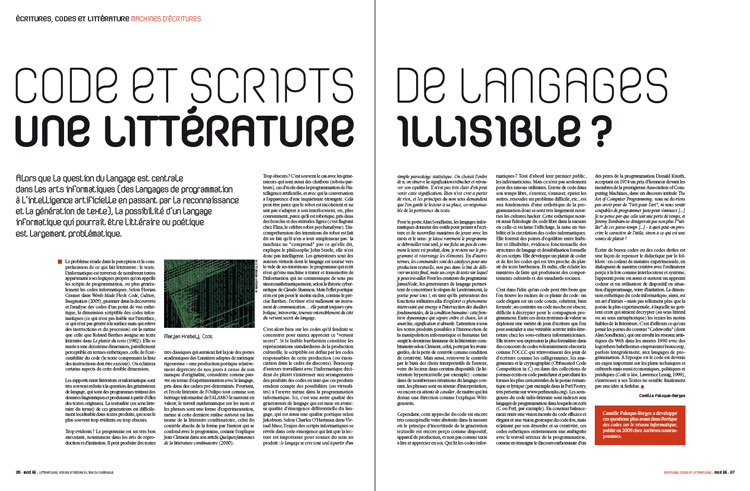
Alors que la question du langage est centrale dans les arts informatiques (des langages de programmation à l’intelligence artificielle en passant par la reconnaissance et la génération de texte), la possibilité d’un langage informatique qui pourrait être littéraire ou poétique est largement problématique.

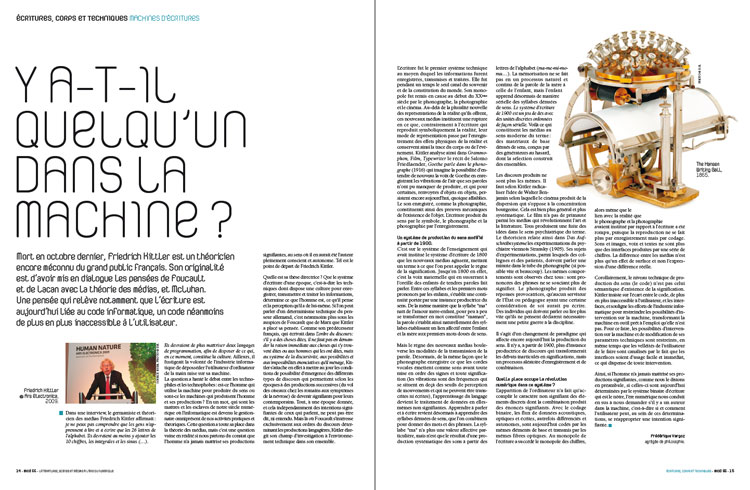
Bumby, LifePl, 2005.

Bumby, LifePl, 2005. Photo: © Bumby

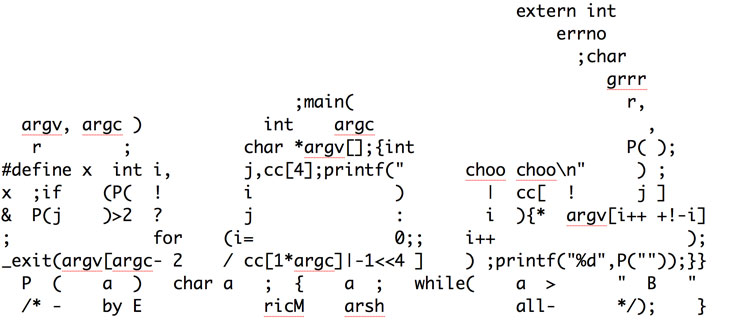
Le problème réside dans la perception et la compréhension de ce qui fait littérature : le texte. L’informatique est traversée de nombreux textes appartenant à ses logiques propres qu’on appelle les scripts de programmation, ou plus généralement les codes informatiques. Selon Florian Cramer dans Words Made Flesh: Code, Culture, Imagination (2005), pionnier dans la découverte et l’analyse des codes d’un point de vue esthétique, la dimension scriptible des codes informatiques (ce qui n’est pas lisible sur l’interface, ce qui n’est pas généré à la surface, mais qui relève des instructions et du processus) est la même que celle que Roland Barthes assigne au texte littéraire dans Le plaisir du texte (1982). Elle se marie à une deuxième dimension, pareillement perceptible en termes esthétiques, celle de l’exécutabilité du code (le texte comprenant la liste des instructions doit être exécuté). On éclairera certains aspects de cette double dimension.

Les rapports entre littérature et informatique sont très souvent réduits à la question des générateurs de langage, qui sont des programmes traitant des données linguistiques et produisant à partir d’elles des textes originaux. La textualité (au sens littéraire du terme) de ces générateurs est difficilement localisable dans textes produits, qui sont le plus souvent trop évidents ou trop obscurs.

Trop évidents ? Le programme est un très bon exécutant, notamment dans les arts de reproduction et d’imitation. Il peut produire des textes très classiques qui auraient fait la joie des poètes académiques des Lumières adeptes de métrique rigoureuse – une production poétique relativement dépréciée de nos jours à cause de son manque d’originalité, considérée comme pauvre en terme d’expérimentation avec le langage, pris dans des cadres pré-déterminés. Pourtant, et l’école littéraire de l’Oulipo tout comme son héritage informatisé de l’ALAMO le mettent en valeur, le travail mathématique sur les mots et les phrases sont une forme d’expérimentation, même si cette dernière réalise surtout un fantasme de la littéraire combinatoire, celui du contrôle absolu de la forme par l’auteur qui se confond avec le programme, comme l’explique Jean Clément dans son article Quelques fantasmes de la littérature combinatoire (2000).

Trop obscurs ? C’est souvent le cas avec les générateurs qui sont aussi des chatbots (robots-parleurs), cas d’école dans la programmation de l’intelligence artificielle, et avec qui la conversation a l’apparence d’une inquiétante étrangeté. Cela peut être parce que le robot est incohérent et ne sait pas s’adapter à son interlocuteur, ou, plus couramment, parce qu’il est robotique, pris dans des boucles et des attitudes figées (c’est flagrant chez Eliza, le célèbre robot psychanalyste). L’incompréhension des intentions du robot est fait dû au fait qu’il n’en a tout simplement pas : la machine ne « comprend » pas ce qu’elle dit, explique le philosophe John Searle, elle n’est donc pas intelligente. Les générateurs sont des auteurs virtuels dont le langage est tourné vers le vide de ses intentions : le programme qui écrit n’est qu’une machine à traiter et transmettre de l’information qui ne communique de sens pas sinon mathématiquement, selon la théorie cybernétique de Claude Shannon. Mais l’effet poétique n’en est pas pour le moins exclu, comme le précise Barthes : l’écriture n’est nullement un instrument de communication… elle paraît toujours symbolique, introvertie, tournée ostensiblement du côté du versant secret du langage.

C’est alors bien sur les codes qu’il faudrait se concentrer pour mieux apprécier ce « versant secret ». Si le lisible barthésien constitue les représentations standardisées de la production culturelle, le scriptible est défini par les codes responsables de cette production (ou énonciation dans le cadre du discours). Beaucoup d’auteurs travaillant avec l’informatique décident de plutôt s’intéresser aux arrangements des produits des codes en tant que ces produits rendent compte des possibilités (ou virtualités) à l’œuvre même dans la programmation informatique. Ici, c’est une autre qualité des générateurs de langage qui est mise en avant : sa qualité d’émergence différentielle du langage, qui est aussi une qualité poétique selon Jacobson. Selon Charles O’Hartman dans Virtual Muse, l’enjeu des scripts informatiques se révèle dans cette émergence qui fait que la lecture est importante pour sonner du sens au produit : le langage se crée tout seul à partir d’un simple parasitage statistique. On choisit l’ordre de n, on observe la signification trébucher et retrouver son équilibre. Il n’est pas très clair d’où peut venir cette signification. Rien n’est créé à partir de rien, et les principes du non-sens demandent que l’on garde le lecteur à sa place, co-responsable de la pertinence du texte.

Photo: © Marshall

Pour le poète Alan Sondheim, les langages informatiques donnent des outils pour penser à l’écriture et de nouvelles manières de jouer avec les mots et le sens : je laisse rarement le programme se débrouiller tout seul, je me fiche un peu de comment le texte est produit, donc je reviens sur le programme et réarrange les éléments. En d’autres termes, les commandes sont des catalyses pour une production textuelle, non pas dans le but de délivrer un texte final, mais un corps de texte sur lequel je peux travailler. Pour les créateurs du programme JanusNode, les générateurs de langage permettent de concrétiser le slogan de Lautréamont, la poésie pour tous !, en tant qu’ils présentent des fonctions utilitaires afin d’explorer ce phénomène intéressant qui émerge à l’intersection des dualités fondamentales, de la condition humaine : cette frontière dynamique qui sépare ordre et chaos, loi et anarchie, signification et absurde. L’attention à tous les textes produits possibles à l’intersection de la manipulation informatique et humaine fait surgit le deuxième fantasme de la littérature combinatoire selon Clément, celui, porté par les avant-gardes, de la perte de contrôle comme condition de créativité. Mais aussi, retrouver le contrôle par le biais des choix interprétatifs de l’auteur, voire du lecteur dans certains dispositifs (la littérature hypertextuelle par exemple) : comme dans de nombreuses situations du langage courant, les phrases sont en attente d’interprétation, ou encore en attente de cavalier, de maître qui lui donne une direction comme l’explique Wittgenstein.

Cependant, cette approche du code est encore très conceptuelle, voire abstraite dans la mesure où le principe d’incertitude de la génération textuelle est encore perçu comme dispositif, appareil de production, et non pas comme texte à lire et apprécier en soi. Qui lit les codes informatiques ? Tout d’abord leur premier public, les informaticiens. Mais ce n’est pas seulement pour des raisons utilitaires. L’envie de code dans son temps libre, s’exercer, s’amuser, épater les autres, résoudre un problème difficile, etc., est aux fondements d’une esthétique de la programmation dont se sont très largement nourries les cultures hacker. Cette esthétique nourrit aussi l’idéologie du code libre dans la mesure où celle-ci réclame l’affichage, la mise en visibilité et la circulation des codes informatiques. Elle fournit des points d’équilibre entre lisibilité et illisibilité, évidence fonctionnelle des structures de langage et déstabilisation formelle de ces scripts. Elle développe un plaisir de coder et de lire les codes qui est très proche du plaisir du texte barthésien. Et enfin, elle éclaire les manières de faire qui produisent des comportements culturels et des standards sociaux.

C’est dans l’idée qu’un code peut être beau que l’on trouve les racines de ce plaisir du code : un code élégant est un code concis, cohérent, bien formulé ; au contraire un code moche est obscur, difficile à décrypter pour le compagnon programmeur. Entre ces deux systèmes de valeur se déploie une variété de jeux d’écriture que l’on peut assimiler à une véritable activité infra-littérature chez les sous-cultures informaticiennes. Elle trouve son expression la plus formalisée dans des concours de codes volontairement obscurcis comme l’OCCC qui réinvestissent des jeux d’écriture comme les calligrammes, les anagrammes et la cryptographie (Obfuscated Code Competition in C) ou dans des collections de poèmes écrits en code pastichant et parodiant les formes les plus caricaturales de la poésie romantique et lyrique (par exemple dans la Perl Poetry, très présente sur www.perlmonks.org). Les sous-genres du code infra-littéraire sont indexés aux langages de programmation dans lesquels on écrit (C ou Perl, par exemple). En constant balancement entre une vision morale du code efficace et élégant et une vision grotesque du code fou, mais éclairant par son désordre et sa créativité, ces codes esthétiques entretiennent une ambiguïté avec le travail sérieux de la programmation, comme en témoigne le discours enthousiaste d’un des pères de la programmation Donald Knuth, acceptant en 1974 un prix d’honneur devant les membres de la prestigieuse Association of Computing Machines, dans un discours intitulé The Art of Computer Programming : nous ne devrions pas avoir peur de « l’art pour l’art », ni nous sentir coupables de programmer juste pour s’amuser. […] Je ne pense par que cela soit une perte de temps, et Jeremy Bentham ne dénigrerait pas non plus l’ »utilité » de ces passe-temps […] – à quoi peut-on prescrire le caractère de l’utile, sinon à ce qui est une source de plaisir ?

Écrire de beaux codes ou des codes drôles est une façon de repenser la didactique par le folklore : en codant de manière expérimentale, en dialoguant de manière créative avec l’ordinateur perçu à la fois comme interlocuteur et système, l’apprenti poète est aussi et surtout un apprenti codeur et un utilisateur de dispositif en situation d’apprentissage, voire d’initiation. La dimension esthétique du code informatique, ainsi, est un art d’initiés – mais pas tellement plus que la poésie la plus expérimentale, à laquelle ne goûtent ceux qui aiment décrypter (au sens littéral ou au sens métaphorique) les textes les moins lisibles de la littérature. C’est d’ailleurs ce qu’ont pensé les poètes du courant « Codeworks » (dont Alan Sondheim), qui ont envahi les réseaux artistiques du Web dans les années 1990 avec des logorrhées babéliennes empruntant beaucoup, parfois intégralement, aux langages de programmation. À l’époque où le code est devenu un enjeu important sur les plans techniques et culturels, mais aussi économiques, politiques et juridiques (Code is law, Lawrence Lessig, 1999), s’intéresser à ses Textes ne semble finalement pas une idée si farfelue.

Camille Paloque-Berges
publié dans MCD #66, « Machines d’écritures », mars / mai 2012
Camille Paloque-Berges a développé ces questions plus avant dans Poétique des codes informatiques, publié en 2009 chez Archives contemporaines.

Bernard Stiegler, dans Réenchanter le monde, par son approche critique de l’intentionnalité occidentale, montre parfaitement, que derrière le tournant de la démocratisation de la technologie, s’est produit aussi un tournant de la sensibilité humaine. Tournant se constituant comme perte de l’attention, transformation des processus d’identification.

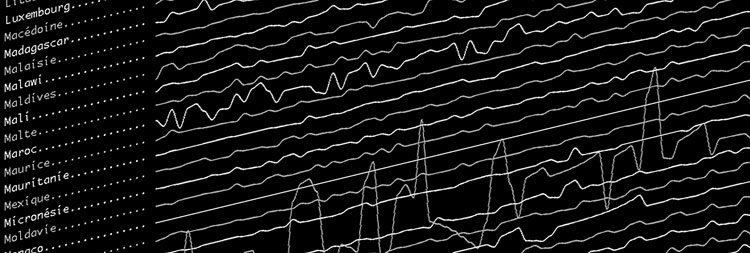
Internet_Encephalography, Art of failure.

Internet_Encephalography, Art of failure. Photo: D.R.

Mise en situation de la technologie
Toutefois, loin de se laisser aller à un constat seulement négatif, il montre en quel sens ce qui peut être un poison, peut devenir aussi de par la réversibilité de tout pharmakon, remède. Si la technologie, notamment à travers l’industrie de masse que représente le spectacle, anéantit l’attention, au point de ne plus permettre de réel investissement sur des pratiques, cependant, en tant que moyen, potentialité d’existence, elle peut ouvrir l’horizon à partir duquel une forme de retournement s’effectue. De la passivité impliquée par la technologie, qui fait que l’homme est un ouvrier soumis aux logiques cybernétiques qui le cadenassent, peut se développer des armes qui remettent en cause l’idéologie dominante déterminant l’usage des technologies.

Pour bien saisir les enjeux de cette intégration du numérique au niveau des espaces scéniques, il faut tout d’abord comprendre quelle en est la nécessité. Depuis trente ans, l’accélération du développement du contrôle technologique des individus, du corps et des désirs, de la mémoire individuelle et collective, s’est constitué au niveau d’agencements qui dépassent le seul cadre de l’ordinateur, comme l’a très bien fait remarquer le Critical Art Ensemble, dans son essai La Résistance électronique. De la vidéosurveillance, à l’ensemble des moyens d’existence, la possibilité du contrôle numérique est devenue générale, le lieu même de notre être. Heidegger sur ce point avait raison : nous sommes passés dans l’ère de la vérité de l’être réduite à l’essence de la technique.

C’est pourquoi le rapport à la technologie de métaphorique a pu peu à peu devenir le medium même des recherches. Aussi bien dans la performance comme avec Stelarc (1) (Third Hand), que dans la poésie, l’homme pouvant se transformer en technologie, comme cela est apparu dans les Événements 99 de Anne-James Chaton (2). Le poète est la membrane mécanique articulant tous les codes amassés durant la journée, liant cette liste au flux événementiel de l’actualité. Loin de toute dichotomie entre le propre et l’impropre, Anne-James Chaton est tout à la fois celui qui est articulé par la société du code commercial et celui qui en crée les micro-agencements, les micro-déplacements, les perturbations.

Accident d’écriture
Face à cette ère technique, la performance s’est elle-même transformée, et suivant plus ou moins ce qui était déjà annoncé dans La Révolution électronique de Burroughs, a questionné les médiums afin de produire des formes d’accidentalité. Si d’un côté il est possible de représenter la question du médium et de son rapport au contrôle, comme le fait par exemple Magalie Debazeilles (3) avec C2M1 mettant en avant le développement et le déraillement du rapport de l’écriture aux technologies, ce qui serait plutôt du côté du théâtre, d’un autre côté la performance interroge la résistance des médiums eux-mêmes et ceci afin de se tenir dans la présentation médiumnique et non plus dans sa représentation. Ce qu’il y a de commun dans toutes les technologies actuelles tient à l’écriture du code, et à la logique algorithmique. Le code en tant que procédure de traitement est lui-même pensé comme un support immatériel qui permet la reproductibilité infinie, la mémoire inaltérable. Or, un certain nombre d’œuvres interroge la matérialité de cette illusion matérielle. Interroge aussi le caractère idéologique implicite d’une telle conception de la maîtrise du monde, des êtres et des choses selon la possibilité du numérique et de sa pseudo-dématérialisation.

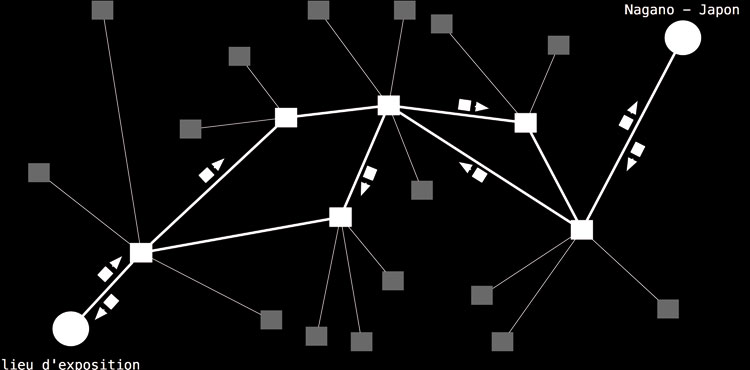
Internet_Topography, Art of failure.

Internet_Topography, Art of failure. Photo: D.R.

Le code devient alors le lieu de la perturbation de l’écriture du pouvoir, le code devient la matière et la scène même de nouvelles écritures. Démolécularisation — Jean-François et Jérôme Blanquet (4) — donne à voir une altération du langage spectaculaire. Démolécularisation teste et produit cette perturbation des technologies du spectacle. Les deux performers sont sur scène, l’un proche de l’autre, perdus dans des interfaces électro-analogiques de traitements sonores et visuels. En partant de textes pornographiques, qui sont passés à la moulinette de la reconnaissance vocale, peu à peu en introduisant les spécificités des technologies qu’ils utilisent, ils dérèglent l’hyperaffect spectaculaire de la pornographie, créant une forme de destruction radicale de l’attention et de l’attendu captif de la pornographie, dans le brouillage. L’image projetée comme le son, se démolécularise, se dilate, efface ce qu’il porte pour que le médium n’apparaisse plus que comme médium.

Avec Art of failure (Nicolas Montgermont et Nicolas Maigret (5)), ce travail de bug se radicalise. La performance 8 silences, qui semble de prime abord sonore, porte en fait sur l’écriture. S’envoyant un silence, une suite de 1, peu à peu, ce code renvoyé de serveur en serveur, se perturbe, se détruit, au point de devenir une masse sonore hypernoise. Le message informatique n’est pas immatériel, n’est pas virtuel, il a des trajectoires et se détruit, il obéit à des interfaces et est altéré par celles-ci. Ces performances montrent que la prétention à la transparence et à l’immatérialité de l’information est une illusion due à l’aveuglement sur la technologie. À l’instar de Adorno, face à cette attention sur le médium qui conduit à la mise en œuvre des bugs, on pourrait penser que les dissonances qui effraient (les auditeurs) leur parlent de leur propre condition; c’est uniquement pour cela qu’elles leur sont insupportables (in Philosophie de la nouvelle musique).

Flesh
Mais ce qui est au cœur même de la critique de la domination technique tient au rapport au corps, à la possibilité de l’aliéner, de l’identifier, de le contrôler. Jaime Del Val (6), performer espagnol, pointe cela. Dans Anticuerpos, il interroge et met en critique la détermination du corps comme identifié à un genre. Homosexuel militant, il se met en scène nu, dans la rue, bardé de caméras, de pico-projecteurs, et il neutralise la définition du corps, par des détails projetés de celui-ci, qui ne permettent plus de l’identifier. À l’instar de la première page de Économie libidinale de Jean-François Lyotard, le corps désirant et désiré quant à son dispositif pulsionnel, n’est plus ni homme ni femme, il n’est plus refermé sur son enveloppe, mais il se déplie dans l’espace, ses limites et frontières quasi insaisissables. Il décaractérise la perception du corps et la repolarise en fragments dans sa déambulation. Avec Jaime Del Val est mis en critique une des prétentions de la société de contrôle et de surveillance : le contrôle du corps et de là sa possibilité de catégorisation des identités.

Feedback d’hypomnèse
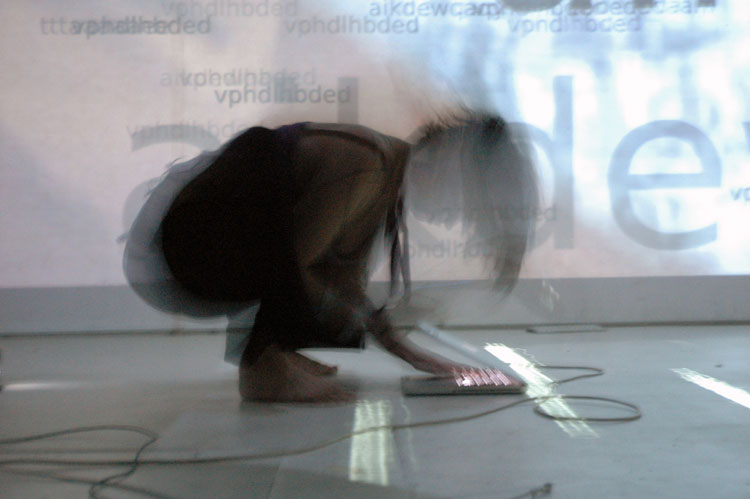
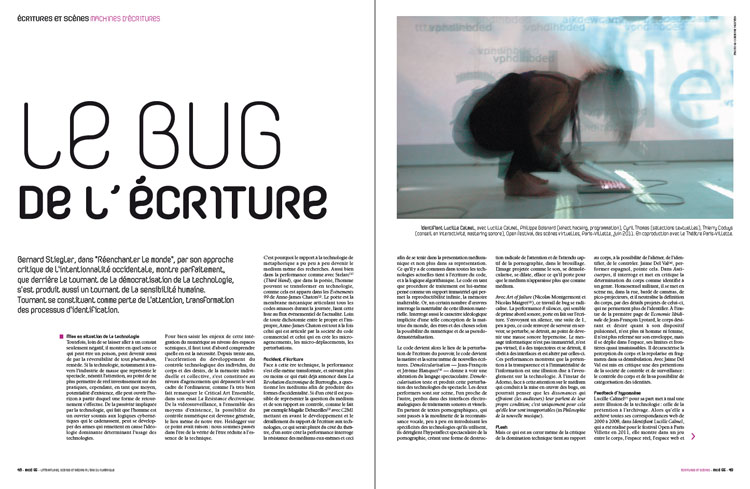
Lucille Calmel (7) pour sa part met à mal une autre illusion de la technologie : celle de la prétention à l’archivage. Alors qu’elle a archivé toutes ses correspondances web de 2000 à 2008, dans Identifiant Lucille Calmel, qui a été réalisé pour le festival Open à Paris Villette en 2011, elle montre dans un jeu entre le corps, l’espace réel, l’espace web et un ensemble de capteurs telle la kinect, de quelle manière cette hyper-mémoire du réseau tout à la fois est parcellaire, déformée, et ne peut être reprise que selon la pratique d’une nouvelle écriture, elle-même produisant un nouvel archivage. Au plus près de la différance au sens de Derrida, elle met en présence à travers des bugs, des saturations d’écriture, l’indissociabilité de l’organique et du numérique et de là, dans des jeux de feed-back, de flash-back, de quelle manière se contracte et s’altère matériellement l’archivage numérique.

Identifiant : Lucille Calmel, avec Philippe Boisnard (kinect hacking, programmation), Cyril Thomas (sélections textuelles), Thierry Coduys (conseil en interactivité, mastering sonore), Open festival des scènes virtuelles, Paris-Villette, juin 2011.

Identifiant : Lucille Calmel, avec Philippe Boisnard (kinect hacking, programmation), Cyril Thomas (sélections textuelles), Thierry Coduys (conseil en interactivité, mastering sonore), Open festival des scènes virtuelles, Paris-Villette, juin 2011. En coproduction avec le Théâtre Paris-Villette. Photos © Corinne Nguyen

Dans la même lignée, ce que nous faisons avec Hortense Gauthier sous le nom de hp process (8) pose la critique de la relation prétendue par les réseaux de communication et la lisibilité des traces de celles-ci. Contact est ainsi une performance, où un homme et une femme s’écrivent, mais la présentation de cette écriture se fait selon une logique esthétique d’empilement, d’entrelacs sur scène, mais aussi sur le net en direct, de redéploiement spatial de cette correspondance. Derrière la prétendue maîtrise et transparence de l’écriture, ces deux performances indiquent de quelle manière l’écriture du vivant, l’écriture vivante, s’échappe des déterminations de contrôle, cela en jouant sur les médiums eux-mêmes.

De la transformation de l’idéologie des moyens
Il ne s’agit plus seulement de représenter spectaculairement le pouvoir politique. Celui-ci, ayant abdiqué depuis le XXème siècle face à l’économie, oblige à réfléchir les moyens mêmes de la production. Ce qui domine le capitalisme est la propriété, la relation au monde est celle d’une appropriation, donc d’une soustraction du possible aux autres hommes, selon la revendication du réel. Actuellement, ce qui anime les grandes entreprises informatiques tient aux brevets. Cette idéologie du copyright ne touche pas seulement la dimension économique, mais elle est devenue le socle idéologique de notre rapport à l’être. De sa mise en stock. Tout du point de vue de l’être peut être breveté, déplacé de l’accession publique à la propriété privée.

Ce qui est caractéristique des performances ici présentées, c’est leur construction sur d’autres possibilités idéologiques : elles ne sont pas seulement explicitement des critiques de ce qui a lieu, elles ont aussi transformé leur rapport aux moyens de se réaliser. Que cela soit dans la récupération de technologies ou dans le développement de programmes selon des langages open source et un partage libre des connaissances (freeware), les créateurs mentionnés relient ce qu’ils créent à leur propre pratique. Peut-on réellement être crédible, lorsque l’on fait une critique tout en restant dans la pratique que l’on dénonce ? Il est alors important de souligner que les créations programmées ici mentionnées (Art of failure, Lucille Calmel, hp process) utilisent un code open source, lui-même résultat d’une critique du capitalisme et de sa logique d’appropriation : pure data créé par Miller Puckette.

Anesthésie des pôles décisionnels et éducation
Si est visible dans bon nombre de performance en quel sens ne peut se faire une critique, sans tout à la fois une compréhension des moyens de la domination et d’autre part le développement de techniques qui rivalisent avec ces moyens tout en proposant d’autres formes de modèles relationnels et économiques; il est à noter qu’institutionnellement il y a une faible intégration de ces nouvelles pratiques. Pure data apparaît comme un parfait exemple. Loin d’être confiné à une petite communauté, ce langage de programmation est engagé par un certain nombre de créateurs au niveau des scènes professionnelles et des workshops, des installations.

Pourtant dans la plupart des formations en France les langages qui dominent encore sont l’action script reliée au flash, et max-msp. Ces deux langages sont propriétaires et demandent des licences pour être exploités. Loin d’être open-source, ils ont ouvert à une forme de commercialisation des algorithmes. Ce qui conduit que l’on forme les étudiants, et ceci inconsciemment, à la reproductibilité de cette intentionnalité du copyright, de la propriété privée, contre l’intelligence collective liée à l’open source. De là, inconsciemment, est empêché corrélativement certains types de questionnement quant aux critiques possibles de l’idéologie des médiums techniques.


Philippe Boisnard
publié dans MCD #66, « Machines d’écritures », mars / mai 2012
(1) http://stelarc.org/?catID=20247

(2) http://aj.chaton.free.fr/evenements99.html

(3) http://www.desbazeille.fr/v2/index.php?/projects/c2m1/

(4) http://projectsinge.free.fr/?paged=2

(5) http://artoffailure.free.fr/index.php?/projects/laps/

(6) www.reverso.org/jaimedelval.htm

(7) www.myrtilles.org/

(8) http://databaz.org/hp-process/?p=105

literature in all its media

If machines awaken in the imagination an « uncanny strangeness » (Unheimlichkeit (1)), they also constitute a material environment that interferes with the arts. To what extent does the development of technology condition creative practices?

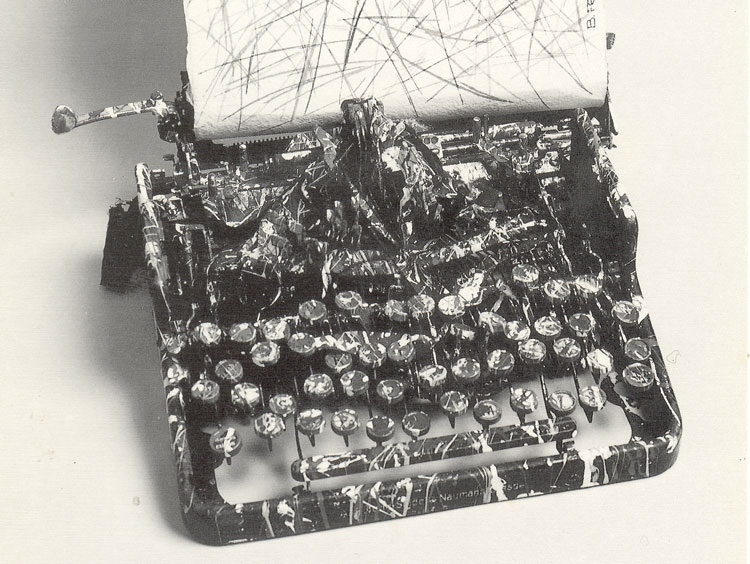
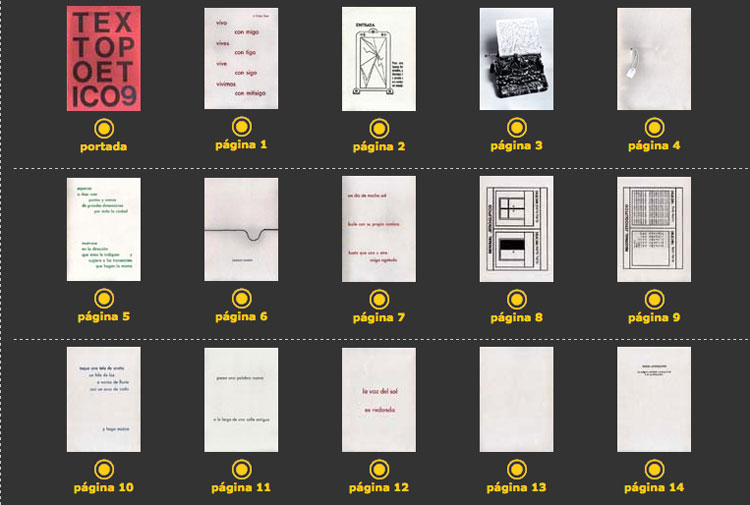
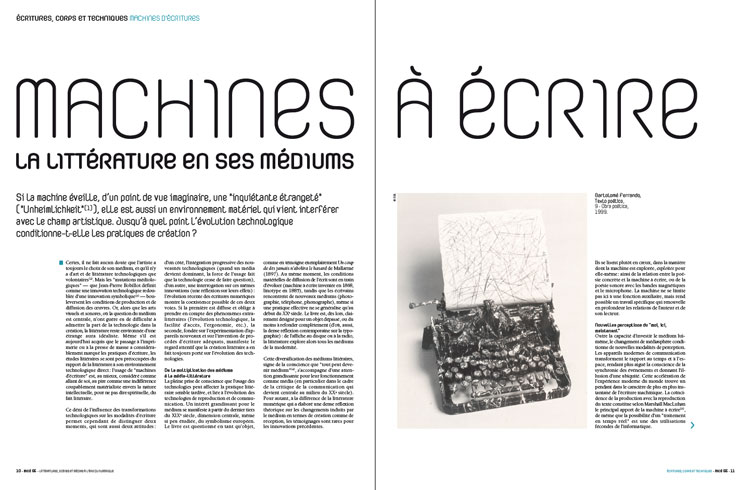
Bartolomé Ferrando, Texto poético, 9 – Obra poética, 1999.

Bartolomé Ferrando, Texto poético, 9 – Obra poética, 1999. Photo: D.R.

There is no doubt that artists have always had a choice in their medium of expression, and that there is only voluntary technological art and literature (2). However, « mediological mutations »—which Jean-Pierre Bobillot defines as a technological innovation reinforced by a symbolic innovation (3)—are radically changing the conditions for producing and distributing works. But whereas visual and sound arts, for which the medium is essential, have had no difficulty admitting the role of technology in their creative process, literature remains surrounded by a strange aura of idealism. Even if it is generally accepted today that the transition to the printing press or mass media has considerably marked writing practices, literary studies have hardly been preoccupied with the relationship between literature and its immediate technological environment. The use of « writing machines » is regarded, at best, as self-evident, at worst, as a guiltily materialistic indifference toward the intellectual, if not spiritual, nature of literary art.

This denial of the influence of technological transformations on the modalities of writing does, however, reveal two distinct movements, which are also two attitudes: on one hand, these new technologies are being gradually integrated (when a medium becomes dominant, its common usage makes technology less of an issue); on the other, these same innovations (and their effects) are being questioned. The recent development of digital writing shows that it is possible for these two movements to coexist. If the first, widespread, takes into account extra-literary phenomena (technological development, accessibility, ergonomics…), the second, founded on experimentation with new devices and the invention of adequate writing procedures, manifests the attention that literary creation has always paid to the development of these technologies.

From multiplying media to media-literature

Full awareness that the use of technology could affect literary practices comes late, and is linked to reproduction and communication technologies. A growing interest for these media emerges in the last third of the 19th century, as an important, if poorly studied, dimension of European symbolism. Books are questioned as objects, as in Mallarmé’s exemplary Un coup de dés jamais n’abolira le hasard (« A roll of the dice will never abolish chance ») in 1897. At the same time, the material conditions for distributing writing evolve (invention of the typewriter in 1868, linotype in 1885), just as writers encounter new media (photography, telephone, phonograph), even if their use is not widespread until the early 20th century. Thereafter, books are clearly designated as outdated objects, or at least to be completely reconstructed (along with a dense contemporary analysis of typography). From poster to record to radio, literature explores every medium of modernity.

As literary media diversify, a conscious sign that « everything can become a medium » (4), they attract more attention to their function as media (particularly in the context of communications criticism, which has become dominant since the mid 20th century). But contrary to digital literature, which developed rich theories on the changes brought about by the medium in terms of both creation and reception, reports on the preceding innovations are rare. Those that do exist are shallow, focusing on the way the machine is explored, exploited for what it is—the same relationship that exists between concrete poetry and the typewriter, or between sound poetry and magnetic tapes and the microphone. Here, the machine is not limited to an auxiliary function but makes possible a specific work, which in turn renews the relationship between the author and the reader.

Bartolomé Ferrando, Texto poético, 9 – Obra poética, 1999.

Bartolomé Ferrando, Texto poético, 9 – Obra poética, 1999. Photo: D.R.

New perceptions of « me, here, now »

Besides its capacity to invest in the medium itself, the changing mediasphere conditions new modalities of perception. Modern communication devices transform our relationship with time and space, sharpening our awareness of the synchrony of events and giving the illusion of ubiquity. This accelerated experience of the modern world finds a parallel in the increasingly instant nature of machine-based writing. According to McLuhan, the coincidence of text production and reproduction is the main advantage of the typewriter (5), just as « real-time processing » is one of the more fruitful uses of computers.

This immediacy, which has also led to the gradual disappearance of crossed-out text (industrially produced paper favors it, while typewriters make it complex and computers erase it), is paradoxically accompanied by a distancing effect. The common characteristic of these communicating machines, which both fascinate and perturb the latter part of the 19th century, is that they lead to depersonalization, or literally, disembodiment. The typewriter obliterates the traces of the handwritten gesture, just as the telephone and the phonograph detach the voice from the body, and photography and film separate one’s appearance from the being that animates it—a phenomenon that recalls the immobile projection of logging in to cyberspace. In the act of writing itself, this dematerialization is also expressed by the growing distance between the artist and the artwork, which Abraham Moles analyzes, in the case of computers, as an « objectification » of language (6).

The paradox is reversed, however, when the double effects of dissociation and exteriorization imposed by the machine bring the body back. Just as the plume or the pen is grasped like a tool and an extension that adapts to the body (the plume fits the hand), typewriting assumes an adaptation of the body (a constraint) that involves a rhythm, a « gesticulation » (7). The rising practice of sound in literature and, to a greater extent, in performance, confirms that machines not only amplify but also reveal the body by manifesting its interiority (François Dufrêne, Henri Chopin). The return of the body through the machine and the emphasis on immediacy coincide with a new way of considering an artistic act, not as that which produces beauty, but as that which, like machines, transforms the world. Hence the more valorized definition of art as « intervention » or « action », which is a common trait among avant-garde practices.

Writing informed by technology

In this rapid overview, we must finally consider the consequences of technology on writing procedures. Many studies attest to the stylistic changes that have accompanied the changing technosphere. Friedrich Kittler reports the claims of several writers who, because of the typewriter, have gone « from rhetoric to telegraphic style » (8). For ergonomic reasons, as much as the intent to translate modern modes of perception or material effects related to the machine, a « technological style » has developed, focused on mechanical procedures. In response to the efficiency, absence of emotion and rhythm of the machine, we find concision, objectivity or a taste for permutation in literature. Language is transformed and accelerated—we « abolish syntax » (9), prioritize the word, even the letter, as this elementary link of language; we give precedence to verbal material, which echoes the new materiality of the act of writing.

In addition to this « translation » of mechanics, some writers question their relationship with these new media and develop new literary forms, voluntarily dependent on their chosen format. But while the historical avant-garde of 1920-1930 live it as a euphoric fusion, the neo-avant-garde of 1950-1970 seem to consider the relationship between the artist and the medium as a power struggle. The two attitudes are opposed, even if the machine always appears as a constraint. On one side are those who use the tool according to its potential—concrete poetry adopts the minimalist aspect of the impersonality and stark visual style of the typewriter, while in the audio field, literature integrates the sounds that can be recorded and fixed. On the other side are those who intervene on the machine in order to thwart its use—interventions on magnetic tapes and sound collages blur audibility, while delinearized, even illegible texts produced by « typist-poets » mirror the useless machines of the dadists and the self-destructive machines of Jean Tinguely. In both cases, the machine is reappropriated to produce art and becomes an esthetic object in itself. In this sense, even as literature develops under the constraints of technology, it offers in exchange new uses that invite reflection.

If McLuhan’s affirmation that « the medium is the message » may seem extreme, at least this research invites us to recognize the medium in the production of meaning. In the face of « passive » literature, which requires a tool for mass production, « media-literature » (10) emerges, going beyond technological concerns to focus on the medium’s impact in the creative process as well as its use to challenge academicism and social attitudes regarding esthetics.

Isabelle Krzywkowski
published in MCD #76, “Writing Machines”, march/may 2012

(1) This was the term used by Sigmund Freud in the essay Das Unheimliche (1919), referring to the automaton in E.T.A. Hoffmann’s short story, The Sandman (in The Night Pieces, 1816), an essential text about the relationship between human and machine.
(2) According to Raymond Queneau, there is only voluntary literature (quoted in OuLiPo, La Littérature potentielle: créations, re-créations, récréations, Gallimard, 1973, coll. Folio essais, 1988, p. 27).
(3) Jean-Pierre Bobillot, POésie & MEdium (2006), p. 2. Accessible online at:
http://www.sitec.fr/users/akenatondocks/DOCKS-datas_f/collect_f/auteurs_f/B_f/BOBILLOT_F/TXT_F/Doc(k)s-Bob.htm
(4) Trois leçons de poésie: du bru(i)t dans la pointCom, films by Jean-Pierre Bobillot and Camille Olivier (2006 / 2008) : www.youtube.com/watch?v=ylcxSz33c2w — www.youtube.com/watch?v=dwxjgXwALn4
(5) Marshall McLuhan, Understanding Media: The Extensions of Man, (McGraw-Hill, 1964), Chapter 26:  The Typewriter: Into the Age of the Iron Whim.
(6) Abraham Moles, Art et ordinateur, (Casterman, coll. Synthèses contemporaines, 1971, p. 108).
(7) Adriano Spatola, Verso la Poesia totale (1969) — Vers la poésie totale, (Éditions Via Valeriano, 1993, p. 112).
(8) Friedrich Kittler, Grammophon, Film, Typerwriter, (Berlin, Brinkmann & Bose, 1986, p. 294).
(9) Filippo Marinetti, Manifeste technique de la littérature futuriste (1912).
(10) This term was inspired by the anthology Media Poetry conceived by Eduardo Kac in 1996.

where does literature come in?

According to grammar sticklers and purists, text messages and tweets pose a real threat to our language. As to suggesting that they might actually have some literary value, we know better than to bring up the topic if we want to stay on good terms with our friends, even the ones we have on Facebook (if we have any).

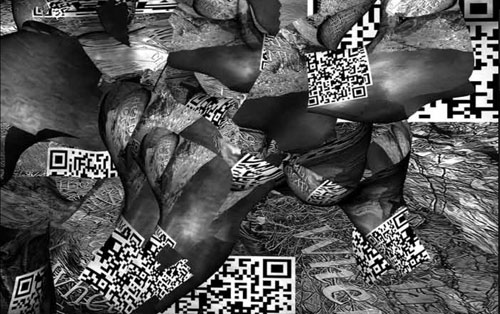
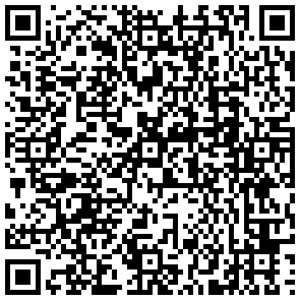
Peter Ciccariello, QR_poem, 2011. Photo: D.R.

For once, let’s look beyond our national borders to Japan, Germany and Finland, countries which are hardly lacking in brillant writers. There we find novels written especially for mobile phones, of which the first, Deep Love, in Japan, dates back to 2003. Some may say that it’s not « great » literature, that it’s (sub-)literature for teens. And they’re right. But, first, it’s a true success (some of these novels have been downloaded several tens of thousands of times); second, it’s a good idea to reach teens directly on their own turf; and third, the advantage of mobile phones (and today tablets) is that they offer us text, sound and video on a single device. This exactly what the successful novelist and dramatist (and theater director…!) Terry Deary was thinking when he published on mobile devices The Perfect Poison Pills Plot, a short story enhanced with video clips by the rapper Chipmunk.

Over the last two or three years, the target, as marketers call it—yes, I know, (sub-)literature is marketing—has changed. Many authors write novels, short stories or narratives by and for mobile phones to be read by adults, just as others make movies with their mobiles (www.festivalpocketfilms.fr). No, SMS are not reduced to ASCII art or Cute & Funny. For the past two years, Annabelle Verhaegue has been sharing an extimate fiction via text messages addressed to dozens of readers. Her literary world recalls the threads of Sophie Calle, the early days of the webcam and the pseudo-intimist texts of Sabine Révillet or Carole Thibaut. There seems to be no beginning and no end to this flowing text. The young author (dramatist) tantalizes our voyeurism by sharing her intimacy. But she is the one who invites us to come inside, rather than us peeping through the keyhole. Here, the SMS acts as a disrupter—it comes unexpectedly—and introduces a false proximity, which is even stronger than that of a blog. It’s a strange feeling that no other medium has managed to achieve.

To wrap up, a word on QR (Quick Response) codes, those two-dimensional bar codes that pop up everywhere, on all kinds of ads and political campaign posters. QR (under free license) can be read by any last-generation mobile phone. Encapsulating texts, sounds and images, QR are a new format and a new medium for poets who love to play with the material aspects of writing. Putting a poem into a QR is playing with your own invisibility. In France, there have been a few rare attempts of varying interest (by Stéphane Bataillon, for example). With his background in graphic design, the American artist Peter Ciccariello takes the game farther by placing a QR (containing a poem and a first image) into a second image, which is generated by a computer. Facinated by the relationship between words and images, Ciccariello produces visual artworks that usually include poems which have become almost unreadable in linear form, as a result of their insertion in sophisticated collages esthetically reminiscent of the 1980s and ’90s. In QR Poem, the artist reiterates Mallarmé’s gesture of randomness, generating poems that are decrypted and de(QR-)coded rather than interpreted… Or how, with a roll of the dice, to write a poem using technology that was initially designed to manage your stocks!

Emmanuel Guez
published in MCD #76, “Writing Machines”, march/may 2012

is there anyone in the machine?

The theorist Friedrich Kittler, who died last October, is still relatively unknown in France. His originality was to create a dialogue between the ideas of Foucault and Lacan and media theory, especially McLuhan. His own theory postulates that today, writing is linked to computer code—code which has become increasingly user-unfriendly.

The Hansen Writing Ball,1865

The Hansen Writing Ball,1865. Photo: D.R.

In an interview, the Germanist and media theorist Friedrich Kittler stated: I can’t understand why people only learn how to read and write the 26 letters of the alphabet. They should at least add the 10 digits, the integrals and the sinuses (…). They should also master two programming languages, in order to possess what, at the moment, constitutes culture. Elsewhere, he denounced the computer industry for wanting to rob users of their grip on the machine.

The question has haunted the debate between technophiles and technophobes: Are humans using machines to produce meaning or is it the machines that are producing humans and their productions? In a word, who are the masters and the slaves of our digital century, where computers have become the ubiquitous managers of our practical and theoretical activities? This question may still be relevant in media theory, but not so much in reality, considering that humans have never mastered their own meaningful productions, in the sense that they would have been fully aware and autonomous. This is the starting point for Friedrich Kittler.

What is his dominant thesis? That the writing system of a period, i.e. the techniques used by a culture to record, transmit and treat information, determines what we are, what we think and how we see ourselves. But while we may speak of Kittler’s technical determinism, his theories were more inspired by Foucault than by Marx. Like his French predecessor, who wrote in The Discourse on Language: If there are things that are said, do not ask for an immediate reason of the things that have been said or of the people who have said them; first consider the system of discourse, its possibilities and impossibilities of enunciation, Kittler is dedicated to shining a light on the conditions that would make possible different types of discourse allowing successive productions, by period, (from the flight of birds among the Romans to the symptoms of neurosis) to become meaningful to their contemporaries. In any given period, and independently of the speakers’ intentions, not everything can be said, or heard. But where Foucault is exclusively interested in the orders of discourse that determine language production, Kittler expands his field of investigation to the technical environment as a whole.

Writing was the first technical system used to record, transmit and treat information. For a while, it was the only channel for memory and the constitution of the world. Its monopoly was challenged in the early 20th century by the phonograph, photography and cinema. Beyond the fact that they offered a new plurality of representations of reality, these new media caused a break—contrary to writing, which reproduced reality symbolically, their mode of representation consisted of recording the physical effects of reality, thus preserving the traces of the body or event. In Grammophon, Film, Typewriter, Kittler analyzes this in Salomo Friedlaender’s story Goethe parle dans le phonographe (1916), which imagines the possibility of hearing Goethe’s voice again by recording the vibrations of his speech, among which some, bouncing from object to object, still persist today, albeit much weaker. Recorded sound, like photography, was thus mechanical proof of the object’s existence. Writing produces meaning through symbols, the phonograph and photography through recording.

A new system for producing meaning in the 20th century.

The new media acted on the education system that had instituted this writing system of 1800, putting an end to what could be called the rule of meaning. Up until 1800, it was the mother’s voice murmuring gentle words into her children’s ears that taught them how to speak. Between these syllables and the first words pronounced by the children, continuity was established from an instance of meaning. In the same way that the syllable « ma » was born from maternal love, little by little transforming into the word « mom », speech came about naturally from syllables establishing the affectionate mother-child relationship from the very first meaningful words.

Thomas A. Edison, Home phonograph, 1906.

Thomas A. Edison, Home phonograph, 1906. Photo: D.R.

But the rule of new media has changed the modalities of speech transmission. Now, just as the phonograph records the sounds emitted from the vocal cords before any ordering of signs or meaning whatsoever (vibrations are frequencies that escape our perception of movement and cannot be transcribed or written), learning language consists of processing data, itself devoid of meaning. Learning to talk and write has become a process of learning meaningless syllables, which are combined to form words and sentences. The syllable « ma » has lost its emotional value to become little more than the result of a systematic production of sounds based on the letters of the alphabet (ma-me-mi-mo-mu…). Children no longer memorize through a natural and continuous process of language spoken by their mothers, they acquire language through a series of syllables with no meaning. The writing system of 1900 rolls the dice with discrete units ordered in series. This is what media are in the modern sense of the term: meaningless building blocks, designed by random generators, selected to form arrays.

The resulting discourses are no longer the same. According to Kittler, we must radicalize Walter Benjamin’s idea that cinema produces dispersion, which opposes bourgeois concentration. This is much more general and systematic. Film has no primary role among the media that are revolutionizing art and literature. All are provoking a flight of ideas in the psychiatric sense. In Das Aufschreibesystem, Kittler relates the experimentations of the Viennese psychiatrist Stransky (1905). The subjects of his experiments, including both colleagues and patients, had to speak into the tube of the phonograph for one minute (if possible quickly and profusely). He observed the same behavior among all of them: saying sentences with no regard to meaning. The phonograph produced provocative responses, which no self-respecting civil servant or educator would dare to write. Individuals who must talk or read faster than they can think necessarily wage their own little war against discipline.

This new paradigm is still affecting the production of meaning today. Since 1900, the instance of producing discourse that transforms inarticulate babbling into meaning has been replaced by a random process of recording and combination.

A new role in the system for the digital revolution?

Computers have only served to accomplish the meaningless aspect of discrete elements which combine to produce meaningful statements. With binary code, the flow of acoustic, optical and written data, formerly differentiated and autonomous, are now coded by the same basic elements and transmitted by the same fiber optics. The monopoly of writing has been succeeded by the monopoly of numbers, while the link to reality introduced by the phonograph and photography has been broken— reality is no longer reproduced by recording, but by coding. Sounds and images, voices and texts are nothing more than interfaces created by a series of digits. The differences between media are only superficial.

Logically, the technical level of producing meaning (the code) is not the semantical level of the existence of meaning. Kittler emphasizes the gap between the code, becoming increasingly inaccessible to the users, and the interfaces, and points out the efforts of the computer industry to restrict consumer access to the machine, transforming the computer into a ready-to-use tool, which it is not. Thus, the possibilities of intervening on the machine and modifying its technical parameters are limited, while users’ desire to do so is channeled by immediate and easy-to-use interfaces.

If humans have never mastered their meaningful productions, as stated earlier, if today we are only determined by our own binary system of writing, the digital era leads us to ask ourselves if there is an author in the machine, that is, if and how users can overcome these digital determinations to reappropriate a meaningful intention.

Frédérique Vargoz
Associate of philosophy
published in MCD #76, “Writing Machines”, march/may 2012

et la littérature dans tout ça ?

À écouter les défenseurs de l’orthographe, les textos et autres tweets représenteraient un vrai danger pour la langue française. Quant à soutenir qu’ils peuvent avoir un intérêt littéraire, on sait qu’il vaut mieux ne pas aborder le sujet si on ne veut pas se fâcher avec ses amis, même avec ceux que l’on a sur Facebook (si on en a).

Peter Ciccariello, QR_poem, 2011. Photo: D.R.

Pourtant – une fois n’est pas coutume, allons au-delà des Pyrénées, par exemple au Japon, en Allemagne et en Finlande, des pays qui ne sont pas réputés pour manquer d’écrivains brillants. On y trouve des romans spécialement conçus pour les téléphones mobiles, dont le premier, Deep Love, au Japon remonterait à 2003. On me dira que ce n’est pas du « grand » roman, que c’est de la (sous-)littérature destinée à des ados. Juste. Mais, primo, c’est un vrai succès (certains sont téléchargés plusieurs dizaines de milliers de fois), secundo, il n’est pas idiot d’aller chercher les ados sur leur terrain, tertio, l’avantage des téléphones mobiles (et aujourd’hui des tablettes) c’est qu’ils permettent de lire sur un même support des vidéos, des sons et des textes. C’est ce qu’a pensé le romancier à succès et auteur dramatique (et directeur de théâtre, tiens ! tiens !) Terry Deary en concevant et en publiant sur mobile The Perfect Poison Pills Plot, une courte nouvelle de surcroît « augmentée » par des clips vidéos du rappeur Chipmunk.

Depuis deux ou trois ans, la cible, comme disent les marketeurs – oui, je sais…, la (sous-)littérature, c’est du marketing –, a bougé. Plusieurs écrivains tissent des romans, des nouvelles ou des récits par et pour les téléphones mobiles à destination des lecteurs adultes, comme d’autres font des films avec leurs téléphones portables (www.festivalpocketfilms.fr). Non, l’art du SMS ne se réduit pas à l’art Ascii ou au Cute & Funny. Ainsi, depuis maintenant deux ans, Annabelle Verhaegue partage une fiction extime par textos qu’elle adresse à des dizaines de lecteurs. Un univers littéraire qui n’est pas sans rappeler tout à la fois les filatures de Sophie Calle, les débuts de la webcam et les textes pseudo-intimistes de Sabine Révillet ou de Carole Thibaut. À ce texte-fleuve, il ne semble y avoir ni début ni fin. La jeune auteure (dramatique) joue avec notre voyeurisme, puisqu’elle nous fait pénétrer dans son intimité. Mais c’est elle qui nous convoque, plus que nous qui regardons par le trou de la serrure. Le texto agit ici comme un perturbateur – il tombe de manière imprévue – et introduit une fausse proximité, plus forte encore que ne peut le faire un blog. Un sentiment étrange qu’aucun autre média n’était parvenu à réaliser.

Pour finir, un mot sur les QR (Quick Response) codes, ces codes-barres en deux dimensions que l’on trouve un peu partout, sur les pubs en tout genre et les affiches électorales. Les QR (sous licence libre) sont lisibles par tous les mobiles de la dernière génération. Encapsulant des textes, des sons ou des images, les QR sont un nouveau support et un nouveau média pour les poètes adorants jouer avec les matérialités de l’écrit. Mettre un poème dans un QR, c’est jouer avec son invisibilité. En France, on relève quelques rares tentatives avec plus ou moins de bonheur (chez Stéphane Bataillon, par exemple). Venant du graphisme et du design, l’artiste américain Peter Ciccariello pousse le jeu un peu plus loin en dispersant un QR (contenant un poème et une première image) dans une seconde image modelée par ordinateur. Fasciné par le rapport entre les mots et les images, Ciccariello produit des œuvres visuelles qui comprennent généralement des poèmes devenus quasiment illisibles dans leur linéarité par leur insertion dans des collages sophistiqués, à l’esthétique des années 1980/90. Dans QR Poem, l’artiste américain réitère ainsi le geste mallarméen, qui fait que les poèmes se décryptent, se dé-(QR)-codent plus qu’ils ne s’interprètent. Ou comment, par un coup de dés, écrire un poème avec une technologie initialement destinée à faciliter la gestion des stocks !

Emmanuel Guez
publié dans MCD #66, « Machines d’écritures », mars / mai 2012
between evolution and sanctification

Can text be saved by the book? As writing and reading practices evolve within the digital environment, French theater defends itself above all logic of the printed text…

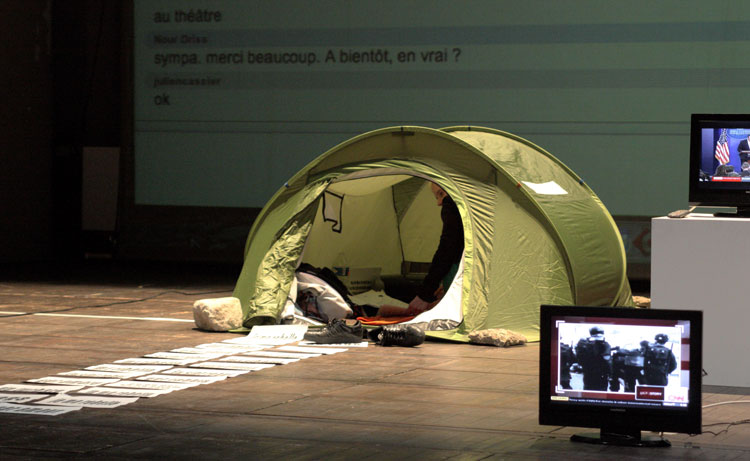
Illusion.com, 2009.

Illusion.com, 2009. Photo: © La Chartreuse de Villeneuve-lès-Avignon

Theater of text or theater of the book?

Now that the profound changes which have transformed writing and reading practices have finally been acknowledged, theater is more than ever reaffirming literary values linked to book culture as a way of legitimizing itself. While new artistic practices develop in relation to digital technology, « text » stands as the last bastion of theater. Or perhaps it should be the book—after all, those who support theater of text refer primarily to theater of the book. In this context, it is sometimes difficult to convey that textuality is evolving on new formats which contribute to renewing and opening up theater art.

Claiming the primacy of text accompanies a complementary discourse that values the interdisciplinary, transdisciplinary and transversal natures of theater, but only to assign them ancillary roles, where issues surrounding text are most often diluted. Recent developments in writing have thus troubled our cultural « networks of discourse » structured more around collection of data than openness to ideas. There is no specific difference by which they can be indexed and categorized; instead they produce new effects, which have yet to be evaluated. Therefore, a historical approach is best suited to renew these issues and put them into perspective.

It was in this context that I directed for four years at La Chartreuse – Centre National des Écritures du Spectacle a project entitled Levons l’encre, in order to give perspective to developments in textuality and writing for theater. Within a cultural structure dedicated to writing, it may seem only natural to take into account current writing technologies, as well as necessary to adapt to the evolving practices of authors and artists. While the myth of the writer’s hand scribbling away on a blank page still exists, the fact is that the vast majority of authors today write on a computer.

This approach aims to radically re-examine the issue of text in theater by confronting it with the history of writing and its current developments. It suggests that text, far from being one of the fundamentals of theater, is changing in ways that have a crucial effect on all theatrical components. Separating text from print denounces our typical confusion of text and book. If we replace the notion of theater of text with theater of the book, we will no doubt see more clearly. The problem is that many people tend to sanctify theater in relation to digital technology—through « text », although in reality through print—rather than explore ways in which new forms of writing can contribute to mapping out new territory for theater.

Writing spaces beyond the book

If text written for theater was not originally presented in the form of a book, we can just as well imagine dramatic text that is not printed. Has print influenced theatrical practices? If so, what is it like to write for theater without following the logic of print? If digital technology offers new forms of writing, can it create new spaces for writing that call for new forms of composition and other ways of making theater?

This angle of attack goes against the usual ways of thinking. While it overlaps in several points the post-drama debate, which has contributed so much in recent years to esthetic debates concerning theater in Europe, it filters the topic through the materiality of writing. It does not specify theatrical forms related to images and screens on the stage. Writing and reading media are all part of the debate on writing for theater. In short, by revealing a blind spot, we attempt to spotlight a new territory to be explored, both invisible and ubiquitous, where writing and reading in digital environments are nothing short of routine.

As we were experimenting with these topics at La Chartreuse, it occurred to me that we could try to reread the history of theater through successive changes in the history of writing. If historians put new writing modes into perspective through the history of the alphabet and printing, have these textual milestones had any effect on theater?

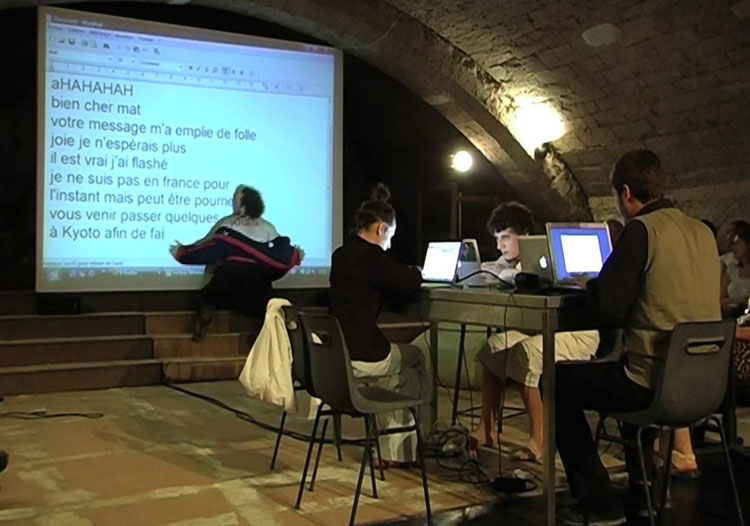
sonde03#09 - Chartreuse News Network.

sonde03#09 – Chartreuse News Network. Photo: © Alex Nollet, La Chartreuse de Villeneuve-lès-Avignon.

Several works by historians and anthropologists have made evident a constitutive and structuring relationship between writing media and the history of theater practices. The emergence of new media for writing invites us to reconsider the articulations between writing and theater that underlie and organize theater practices. We have developed this historically themed research elsewhere, placing particular emphasis on the complex articulations between theater and print, which are key in understanding the extent to which digital technology is deconstructing practices and devices linked to print.

While theater persists in theorizing, administrating, gaining expertise and perceiving itself primarily through the framework of print, a coherent series of mechanisms that link page and stage, and in fine a way of instituting theater practices, is obsolescent. After the specific typographic conventions of the drama script, we are discovering a burst of diverse materialities of writing for theater. Some authors—to mention only those in French theater: Noëlle Renaude, Matthieu Mevel, Sonia Chiambretto…—are digitally reinvesting print and exploring new materialities of drama writing that incorporate typographic wordplay, graphic design and singular layouts.

In parallel, some authors are experimenting with new media writing online, in social networks, projected on various types of screens on stage, on mobile devices. La Chartreuse encouraged this exploration of the field by commissioning four authors to create an online work (Illusion.com by Joseph Danan, Sabine Revillet, Eli Commins and Emmanuel Guez), by producing an audio journey by Célia Houdart, and by supporting Eli Commins’ Breaking, which uses Twitter testimonies to write about world events such as political resistance in Iran, the earthquake in Haiti, etc.

Opposing the affirmation of authorship in theater is the reality of multiple forms of practices, which lead the author to develop the text directly in relation to the physical and technological environment of the stage. While print distanced the author from the stage, new media for writing have reintroduced the author into the theatrical creative process. They reactivate theater as a collaborative process, neither structured hierarchically around the author’s message, nor directed and controlled remotely by the text. Far from institutionalized routines and lack of curiosity, these transformations call upon a new dynamic that welcomes experimentation, research and innovation.

Theater as a metaphor of the computer, not the book

The evolution of writing is also the evolution of reading. The viewer as displaced reader—more precisely, reader of books—is joined by the viewer as displaced TV viewer, moviegoer, Web surfer, hypertext reader or gamer.

More generally, we can compare today’s emergence of theater within the digital environment—from control room to communication, from set design to video archive—to the way it once took possession of print. The revived motif of theater of the world, which leads the way for theater and books, revolves around the idea of the stage as a metaphor of its technological, media and cultural environment, where it is critically confronted.

Theater of the book remains the central paradigm of theater today. But it can no longer be the only paradigm. As a metaphor of the book, the stage is becoming more and more of a metaphor of the computer, or even a metaphor of the relationship between the two, influenced by a new relationship between writing and orality. Linearity or simultaneity/discontinuity, prioritizing stage materials to serve the text or hybrid writing, remote or active participation of the audience, constructing meaning or constructing a sensitive and intelligible experience… are all contrasting cultural conceptions of the theatrical arts. They refer to the way the media informs our practices.

Theater coordinates writing techniques, ways of thinking, diverging perceptions. It’s a rich asset. It reflects the complex situation of writing within our society. But it can also be an invaluable vehicle to explore the evolution of writing throughout our society.

Franck Bauchard
researcher and critic, artistic director of La Chartreuse (2007-2011)
published in MCD #76, “Writing Machines”, march/may 2012

Bernard Stiegler, through his critical approach to Western intentionality in Réenchanter le monde, perfectly demonstrates that behind the turning point of democratized technology also lies a turning point in human sensibility, characterized by a lack of attention and the transformation of identification processes.

Internet_Encephalography, Art of failure.

Internet_Encephalography, Art of failure. Photo: D.R.

Technology in context

However, far from indulging in a purely negative observation, he shows that what may be a poison, through the reversibility of any pharmakon, can also become a remedy. If technology obliterates attention to the point of preventing any true investment in one’s activity, especially through the industry of mass entertainment, it can also, as a potential means of existence, clear the horizon for some form of reversal. From the passivity implied by technology, where humans are factory workers chained to cybernetic logic, weapons can also emerge to challenge the dominant ideology that determines the use of these technologies.

Before discussing the issues of integrating digital technology into the performing arts, we must first explain why it is necessary. For the past 30 years, control of individuals, bodies and desires, in both the individual and collective memory, has increasingly developed using technology that extends well beyond the simple computer, as Critical Art Ensemble pointed out in their Electronic Civil Disobedience manifesto. From videosurveillance to our own livelihoods, the possibility of digital control has enveloped our very existence. Heidegger was right when he wrote that we have gone from the age of truth of the reduced being to the essence of technique.

For this reason, our metaphorical relationship with technology has gradually become the medium of research itself. Such is the case in performance art with Stelarc’s Third Hand (1), as well as in poetry, where humans are transformed into technology, as in Anne-James Chaton’s Événements 99 (2). The poet is the mechanical membrane articulating all the codes accumulated during the day, linking this list to the current flow of events. Avoiding any dichotomy between proper and improper, Anne-James Chaton is both one who is articulated by a society of commercial codes and one who creates its micro-plans, micro-movements, and disturbances.

Writing accidents

In this technical age, performance has transformed itself and, more or less following what William Burroughs already announced in The Electronic Revolution, has questioned various media in order to produce forms of accidents. While it is possible to question the medium and how it relates to control by emphasizing the development and derailment of the relationship between writing and technology through the staged representation of theater, as does Magalie Debazeilles in C2M1 (3), for example, performance questions the resistance of media by doing so within a presentation through the very medium in question. What all these current technologies have in common is coding, algorithmic logic. Code as a processing procedure is itself considered to be an intangible format that allows for infinite reproduction and inalterable memory. Nonetheless, some works question the materiality of this material illusion. They also challenge the implicit ideology of controlling the world, beings and objects in terms of digital potential and its pseudo-dematerialization.

Internet_Topography, Art of failure.

Internet_Topography, Art of failure. Photo: D.R.

Code then becomes the place where the writing of power is disrupted; it becomes the matter and the stage for these new forms of writing. Démolécularisation—Jean-François and Jérôme Blanquet (4)—tests and produces this disturbance of performing arts technologies. The two performers are on stage, close to each other, lost in electro-analogue interfaces of audio and image processing. By taking pornographic texts, filtering them through voice recognition and little by little introducing the specificities of the active technologies, the artists disrupt the spectacular hyper effect of pornography, radically destroying the audience’s attention and their captive expectations of it in the interference. The image is projected like sound, demolecularizes, dilates, erases what it contained so that the medium appears as nothing more than a medium.

Art of Failure—Nicolas Montgermont and Nicolas Maigret (5)—radicalizes the “bugged” performance genre in 8 silences, which at first seems to be a sound piece, but is actually about writing. Beginning with a silence, a series of 1, little by little, code sent from server to server distorts then destroys itself, until all that is left is a sonorous mass of hyper noise. The computer message is not immaterial, not virtual, it travels and then destroys itself, it obeys interfaces and is altered by them. These performances show that the transparency and immateriality of information is an illusion caused by blindness to technology. As Theodor Adorno wrote regarding the attention given to the medium which favors bugs, the dissonances that scare [the audience] speak to them about their own condition; it’s for this reason alone that they are intolerable (in Philosophy of New Music).

Flesh

But at the heart of criticism of technical domination is the relationship with the body, the possibility of alienating, identifying and controlling it. The Spanish performer Jaime Del Val (6) highlights this in Anticuerpos, where he questions and criticizes the determination of the body as identified with a genre. As a militant homosexual, he stages himself naked in the street, loaded with cameras and pico-projectors, and neutralizes the definition of the body by projecting details that prevent it from being identified. Much like the first page of Jean-François Lyotard’s Libidinal Economy, the desiring and desired body, in terms of its impulses, is neither male nor female; no longer contained in its envelope, it unfolds into space, its limits and boundaries almost imperceptible. It decharacterizes the perception of the body and repolarizes it through wandering fragments. Jaime Del Val criticizes one of the primary pretensions of our society of control and surveillance: control of the body, and by extension, the possibility of categorizing identities.

Hypomnesis feedback

Lucille Calmel (7) undermines another illusion of technology: archives. After archiving all her online correspondances from 2000 to 2008 in Identifiant Lucille Calmel, which was realized for the Open festival at Paris Villette in 2011, she created an installation involving the body, real space, online space and motion sensors such as Kinect, to show exactly how this hyper memory of the Internet is fragmented, deformed and can only be revived through a new form of writing, which would itself produce a new archive. In a fine example of différance as defined by Jacques Derrida, she uses bugs and saturated writing to spotlight the indissociability of organic and digital material, then through feedbacks and flashbacks, she shows how digital archiving contracts and materially alters itself.

Identifiant : Lucille Calmel, avec Philippe Boisnard (kinect hacking, programmation), Cyril Thomas (sélections textuelles), Thierry Coduys (conseil en interactivité, mastering sonore), Open festival des scènes virtuelles, Paris-Villette, juin 2011.

Identifiant : Lucille Calmel, avec Philippe Boisnard (kinect hacking, programmation), Cyril Thomas (sélections textuelles), Thierry Coduys (conseil en interactivité, mastering sonore), Open festival des scènes virtuelles, Paris-Villette, juin 2011. En coproduction avec le Théâtre Paris-Villette. Photos © Corinne Nguyen

In the same vein, Hortense Gauthier’s hp process (8) critiques the supposed relationship between communication networks and the lisibility of their traces. In her performance Contact, a man and a woman write to each other, but their writing is presented according to an esthetic logic of stacking and on-stage interlacing, as well as live online, redeploying this correspondence in space. Behind the assumed control and transparency of writing, these two performances demonstrate how writing life, live writing, escape the determinations of control by playing with the media in question.

Transforming the ideology of means

It is no longer just a question of spectacularly representing political power. Politics, which has abdicated its power to economics ever since the 20th century, forces us to consider the very means of production. Capitalism is dominated by property, it relates to the world through appropriation, and therefore through substracting possibilities from other people, in real life. At the moment, large computer companies are driven by patents. This ideology of copyright not only takes on an economic dimension, it has become the ideological foundation of our relationship with being, of our personal inventory. Every perspective on being can be patented, displaced from public access to private property.

The performances presented here are all built on other ideological possibilities. Not only are they an explicit criticism of what has happened, they have also transformed their relationship with their means of realization. Whether it’s by reappropriating technologies or developing open source programs and freeware, the above-mentioned artists link what they make to their own practice. How credible can one be, criticizing the very medium in which they choose to operate? It is therefore important to stress that the artworks mentioned here (by Art of Failure, Lucille Calmel, hp process) were all programmed using open source code, itself resulting from the criticism of capitalism and its logic of appropriation: Pure Data created by Miller Puckette.

Unconscious decisions and education

We can see in many of these performances how criticism is not possible without first understanding the means of domination as well as the development of techniques that rival these means, while offering other forms of relational and economic models. But it should also be noted that few institutions integrate these new practices. Pure Data appears to be a perfect example. Far from being confined to a small community, this programming language has been used by many artists for professional stage performances, workshops and installations.

However, the languages that dominate most computer courses in France are ActionScript linked to Flash, and Max/MSP. Both languages are proprietary and require licences in order to be exploited. Hardly open-source, they are open to a form of commercialized algorithms… which means that we are unconsciously educating students to reproduce this intentionality of copyright and private property, against the collective intelligence of open source. And thus, unconsciously, are we preventing certain types of questioning and critique concerning the ideology of technological media.

Philippe Boisnard
published in MCD #76, “Writing Machines”, march/may 2012

(1) stelarc.org/?catID=20265
(2) aj.chaton.free.fr/evenements99.html
(3) www.desbazeille.fr/v2/index.php?/projects/c2m1
(4) projectsinge.free.fr/?paged=2
(5) artoffailure.free.fr/index.php?/projects/laps
(6) www.reverso.org/jaimedelval.htm
(7) www.myrtilles.org
(8) databaz.org/hp-process/?p=105

unreadable literature?

While language is central to computer arts (from programming languages to artificial intelligence, character recognition and text generators), the possibility of a literary or poetic computer language remains problematic.

Bumby, LifePl, 2005.

Bumby, LifePl, 2005. Photo: © Bumby

The problem lies in the perception and the understanding of what makes literature: the text. Computers function on numerous texts that obey their own logic, which we call program scripts or computer code. Florian Cramer, who pioneered the discovery and analysis of code from an esthetic standpoint, claims in Words Made Flesh: Code, Culture, Imagination (2005) that the scriptable dimension of computer code (the instructions and processes that cannot be read on the interface) is the same as that which Roland Barthes assigns to literary texts in Le plaisir du texte (1982). This scriptable dimension joins a second dimension, similarly perceptible in esthetic terms: the executability of the code (the text containing the list of instructions must be executed). We will examine some aspects of these two dimensions.

The relationship between literature and computers is most often reduced to language generators, programs which process linguistic data in order to produce original texts. The textuality (in the literary sense) of these generators is difficult to pinpoint in the resulting texts, which are usually too obvious or too obscure.

Too obvious? The program is very good at execution, especially in the art of reproduction and imitation. It can generate very classic texts, which would have delighted the academic poets of the Enlightenment who were particularly skilled in metrics—poetry that is relatively depreciated today for its lack of originality, considered poor in terms of linguistic experimentation and pre-formatted. Yet, as the Oulipo literary school and its computer-based ALAMO heritage has demonstrated, mathematical manipulation of words and sentences is indeed a form of experimentation, even if it realizes above all the fantasy of combinatory literature—of absolute control over the form by the author who becomes the program, as Jean Clément explains in his article Quelques fantasmes de la littérature combinatoire (2000).

Too obscure? It’s often the case with generators that are also chatbots, a classic case of artificial intelligence programming, which results in rather strange conversations. It may be because the robot is incoherent and doesn’t know how to adapt to its human interlocutor, or, more commonly, because it’s robotic, trapped in loops and fixed attitudes (flagrant with Eliza, the famous robot psychoanalyst). We don’t understand the robot’s intentions, very simply because it doesn’t have any. The machine doesn’t « understand » what it is saying, explains the philosopher John Searle, therefore it is not intelligent. Generators are virtual authors whose language is focused on empty intentions. The program that writes is nothing more than a machine for processing and transmitting information; it does not communicate meaning, unless it’s mathematically, according to the cybernetic theory of Claude Shannon. But this hardly rules out its poetic effect, as Roland Barthes points out: Writing is not at all an instrument of communication… It always appears symbolical, introverted, ostensibly oriented toward the secret side of language.

Of course, best concentrate on the code to better appreciate this « secret side ». If what Barthes considers readable constitutes standard representations of cultural productions, what is scriptable can then be defined by the code responsible for this production (or statement in the case of speech). Many authors working with computers decide to focus more on arranging the products of this code, inasmuch as these products demonstrate the possibilities (or virtualities) at work in the programming. This spotlights another quality of language generating: the differential emergence of language, which is also a poetic quality, according to Jacobson. In his Virtual Muse, Charles O’Hartman suggests that the value of computer scripts is revealed by this emergence, which implies that reading is important to give the product meaning: Language is created all by itself from a simple statistical interference. You choose the order of n, you observe the meaning stumble and find its balance again. It’s not very clear where this meaning comes from. Nothing is created from nothing, and the principles of nonsense require that we keep readers in their place, as co-responsible for the relevance of the text.

Photo: © Marshall

For the poet Alan Sondheim, computer languages offer tools to think about writing and new ways to play with words and meaning: I rarely leave the program to its own devices, I don’t really care how the text is produced, so I come back to the program and rearrange the elements. In other words, the commands are catalysts for a textual production, with the goal of delivering not a final text, but a body of text that I can work on. For the creators of the program JanusNode, language generators allow us to realize Lautréamont’s slogan Poetry for all! By presenting useful functions in order to explore this interesting phenomenon that emerges at the intersection of the fundamental dualities of the human condition: the dynamic boundary that separates order and chaos, law and anarchy, meaning and absurdity. The attention given to all these possible produced texts at the intersection of computer and human manipulation gives rise to the second fantasy of combinatory literature according to Clément, hailed by the avant-gardes, which consists of losing control as a condition for creativity. But also regaining control through the interpretative choices of the author, and even of the reader in some cases (hypertext literature, for example). As in many situations of everyday speech, sentences are waiting to be interpreted, or waiting for a driver, a master to give them direction, as Wittgenstein writes.

However, this approach to code remains very conceptual, even abstract in the sense that the principle of uncertainty in textual generation is still perceived as a production device, and not a text to be read and appreciated for itself. Who reads computer code? Computer programmers first, as its primary fans. But not only for practical reasons. The desire to code in your spare time, exercise your skills, amuse yourself, impress others, solve a difficult problem, etc., is at the heart of programming esthetics, which has largely fueled hacker culture. These esthetics also feed the ideology of open code, which advocates actively displaying and distributing computer code. It helps even out the balance between readability and unreadability, providing functional evidence of language structures and formally destabilizing these scripts. It develops the pleasure of coding and reading code that is very close to Barthes’ pleasure of the text. Finally, it shines a light on the processes which lead to cultural behaviors and social standards.

The pleasure of coding stems from the idea that code can be beautiful. Elegant code is concise, coherent, well-formulated code; ugly code is obscure and difficult to decipher by fellow coders. Between these two value systems are a variety of writing games that can be assimilated to veritable infra-literary activity within computer subcultures. It finds its most formal expression in coding competitions such as OCCC (Obfuscated Code Competition in C), which revive writing games such as calligrams, anagrams and cryptography or in poetry collections written in code that parodies the most caricatural forms of romantic and lyrical poetry (for example, Perl Poetry, very present on www.perlmonks.org). Constantly finding a balance between a moral vision of efficient and elegant code and a grotesque vision of crazy code that is enlightening through its disorder and creativity, these forms of esthetic coding maintain an ambiguous relationship with serious programming work, as evoked by Donald Knuth, one of the fathers of programming, upon accepting an award from the members of the prestigious Association of Computing Machines in 1974, in a passionate speech entitled Computer Programming as an Art: We shouldn’t shy away from « art for art’s sake »; we shouldn’t feel guilty about programs that are just for fun. […] I don’t think [it’s] a waste of time […], nor would Jeremy Bentham […] deny the « utility » of such pastimes. « On the contrary, » he wrote, « […] To what shall the character of utility be ascribed, if not to that which is a source of pleasure? »

Writing beautiful code or funny code is a way of rethinking didactics through folklore: by coding experimentally, by dialoguing creatively with the computer, perceived in this case both as interlocutor and system, the apprentice poet is also and above all an apprentice coder and a user of a system in a situation of learning or even initiation. The esthetic dimension of computer code is thus an art of the initiated—but not so much more than the most experimental poetry, which is touched upon only by those who love deciphering (both in the literal and the metaphorical sense) the most unreadable literary texts. This was also what the poets of « Codeworks » (including Alan Sondheim) thought as they invaded artistic networks of the Web in the 1990s with chaotic logorrhea which borrowed a lot, sometimes completely, from programming languages. At a time when code has taken on an important role in terms of not only technology and culture but also economics, politics and legal matters (Lawrence Lessig’s Code is Law, 1999), examining these texts doesn’t seem like such a crazy idea after all.

Camille Paloque-Berges
published in MCD #76, “Writing Machines”, march/may 2012

Camille Paloque-Berges developed these issues further in Poétique des codes informatiques, published in 2009 by Archives contemporaines.